
Maintaining Style Across AI-Generated Video Series

Consistency is the backbone of successful AI-generated video series. Without it, viewers may lose interest, and creators risk inefficiency. To keep your audience engaged and streamline production, you need a clear style framework that ensures characters, visuals, and tone remain uniform across episodes. Here's the key to achieving this:
- Style Framework: Document every detail - character designs, outfits, environments, and colors. Use precise descriptions and visual references to guide AI tools effectively.
- AI Tools: Leverage features like reference images and parameter controls to maintain consistent visuals while enabling natural motion and expressions.
- Reusable Assets: Centralize character designs, style templates, and settings in a single repository for faster, error-free production.
- Bulk Editing: Use platforms like LongStories.ai to produce long-form videos efficiently, reducing manual work and ensuring uniformity.
Consistency not only creates a recognizable identity but also speeds up workflows. Start small by building a detailed style guide and testing it on a few episodes. Over time, this approach will help you scale production without sacrificing quality or viewer trust.
Create Seamless AI Films from One Prompt (Consistent Characters & Scenes)
sbb-itb-94859ad
Creating and Documenting Your Style Framework
AI Video Style Framework: 4 Essential Components for Consistency
To maintain a consistent and polished brand identity, it's essential to document your creative framework in detail.
Start by crafting a written blueprint that defines your characters and world. AI models need precise instructions, so instead of vague descriptions like "casual outfit", specify something like "blue denim jacket with rolled sleeves, white t-shirt, and black jeans". This level of detail helps reduce inconsistencies and keeps the AI aligned with your vision.
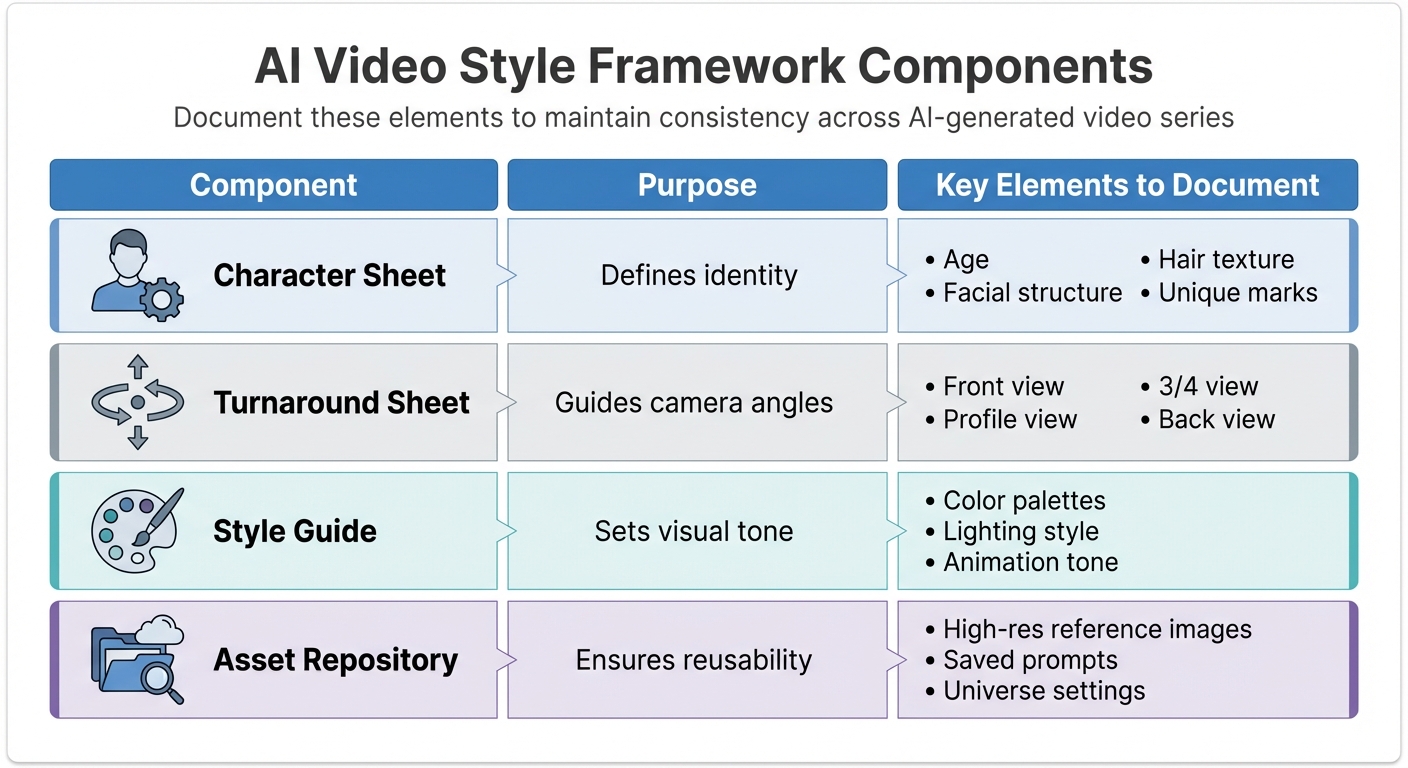
Develop a comprehensive character sheet that outlines key details such as age, body type, facial features (like nose shape and eyebrow style), hair texture, and any distinctive marks. Include a high-resolution front portrait and a turnaround sheet showing the character from multiple angles - front, profile, three-quarter, and back views. These references ensure the AI has a consistent visual guide.
Your style guide should also cover the broader visual and narrative universe. Define elements like color palettes, lighting styles, and the overall tone of animations. This ensures every video feels cohesive and unified. If your series is set in a specific world - whether it’s a post-apocalyptic wasteland or a cozy kitchen - document the environmental details with the same precision you apply to character design.
| Component | Purpose | Key Elements to Document |
|---|---|---|
| Character Sheet | Defines identity | Age, facial structure, hair texture, unique marks |
| Turnaround Sheet | Guides camera angles | Front, profile, 3/4 view, and back views |
| Style Guide | Sets visual tone | Color palettes, lighting style, animation tone |
| Asset Repository | Ensures reusability | High-res reference images, saved prompts, "Universe" settings |
Once your framework is complete, use it as a reference for every video you create. This eliminates guesswork and ensures consistency across projects. Since most AI video tools don’t retain memory between prompts, having a detailed framework is critical for maintaining uniformity over time. While it requires effort upfront, this system significantly speeds up production in the long run - many teams have reported dramatic improvements in efficiency.
Using AI Tools to Maintain Consistency
After setting up your style framework, AI tools can help you maintain consistency across all your videos. The trick lies in using reference images and parameter controls to lock in your character’s look while still allowing for natural movements and expressions. Most platforms let you upload between 6 and 10 reference images showing your character from different angles - like front, three-quarter, and profile views. These images serve as a visual anchor, ensuring your character's identity remains consistent across various shots. This initial setup lays the groundwork for using advanced AI features in later stages of production.
Fine-tuning the "reference strength" (or guidance weight) is crucial to balancing consistency with natural motion. Start with a higher setting to firmly establish your character’s appearance in the initial pass. Then, dial it down slightly to allow for more fluid motion and expressive facial features. This approach keeps your videos engaging while preserving the character's recognizable traits.
Reusable style systems take things a step further by saving your entire visual framework - not just your characters but also lighting setups, color schemes, and environmental details. Platforms like LongStories.ai organize these components into "Universes", where you can define characters, styles, and voices once and then generate countless videos that adhere to the same visual identity. As Vilma from Movie Studio shared:
"We went from 1 episode per week to 1 per day. LongStories has been the biggest help in our workflow".
Different platforms cater to varying needs for long-form content. LongStories.ai, for example, is ideal for videos up to 10 minutes long, offering strong character consistency. On the other hand, LTX Studio provides detailed control through its "Elements" hub, enabling creators to manage lighting, weather, and locations across scenes. It also includes audio-to-video tools to ensure smooth, stable dialogue. These tailored features are invaluable for maintaining visual harmony in complex, multi-scene projects.
To complement reusable style systems, bulk editing tools can significantly streamline the production of long-form videos. Instead of piecing together dozens of short clips manually, platforms that support bulk editing enable you to create cohesive 10-minute videos in a single pass. This not only cuts down on post-production time but also ensures consistency throughout the entire video.
Scaling Production with Reusable Assets
Once you've nailed down a solid style framework and mastered AI-driven consistency, the next step is scaling your production process. Reusable assets can make long-form video creation faster and more efficient.
Setting Up Character Libraries and Style Repositories
Centralizing your reusable assets is a game-changer for production efficiency. By organizing everything into dedicated Universes, you can store key elements like character designs, style templates, voice profiles, and narrative tones in one easily accessible space. For instance, creators using LongStories.ai often create Universes like "Hunger Games' Universe" or "Open Universe." This setup allows them to quickly launch new episodes without having to rebuild every single detail from scratch.
This method doesn’t just save time - it also helps maintain a consistent brand identity. With over 9,000 videos created by more than 2,500 creators, reaching a combined audience of over 30 million subscribers, this centralized approach has proven to support sustainable production while keeping both visuals and storytelling aligned.
After organizing your assets, bulk editing tools can take production speed and consistency to the next level.
Using Bulk Video Editing Tools
Bulk editing tools simplify the process of scaling production while ensuring everything stays cohesive. Instead of manually tweaking dozens of short clips, platforms like LongStories.ai - designed for long-form videos up to 10 minutes - let you create polished episodes in one go. This eliminates the need for piecing together individual clips one by one.
These tools handle tasks like timing adjustments, sound effects, and visual transitions automatically, all while sticking to your established style framework. Filmmaker Bryce summed it up perfectly:
"The timing, the looks, the sound effects... it's all coming together in a way that actually feels directed."
Conclusion: Building Consistency for Long-Term Growth
Keeping a consistent style across AI-generated video series boils down to three key practices: developing detailed style guides, using AI tools with reference systems, and organizing reusable assets in centralized libraries. Together, these steps help avoid the disjointed look that often plagues AI video projects, replacing it with a polished and unified brand identity that viewers can easily recognize and trust.
Consistency doesn’t just make your content look better; it also speeds up production by cutting down the time spent fixing mismatches. When consistency is part of your workflow from the beginning, you can move from producing content weekly to daily without sacrificing quality. Without this foundation, you’ll find yourself stuck troubleshooting inconsistencies instead of focusing on creating new material.
A solid system ensures scalable, high-quality production. Frameworks that maintain visual and stylistic standards allow you to increase output while keeping quality intact. This frees up more time for storytelling and creativity, rather than constantly revisiting and revising your work.
Beyond efficiency, a cohesive style strengthens your brand identity. It’s this consistency that turns casual viewers into loyal fans. When characters look the same from episode to episode, when your visual approach feels deliberate, and when your tone remains steady, you create a professional experience that sets you apart. This is the difference between creators who post sporadically and those who build lasting, successful channels.
Start small to build this consistency into your process. Begin with one Universe and a master character blueprint. Test your workflow on a few episodes, tweaking as needed to find your rhythm. Over time, maintaining consistency will feel natural, production will flow faster, and your content will feel thoughtfully crafted, not randomly generated.
FAQs
How do I keep characters consistent across multiple AI-generated videos?
To keep characters consistent in AI-generated videos, start by crafting detailed reference guides for each one. These should outline their looks, personality traits, and voice. Using tools that allow for reusable assets and identity anchoring can help ensure your characters remain visually and audibly consistent over time.
For example, platforms like LongStories.ai simplify this process. They let creators develop reusable "Universes" where characters, styles, and voices stay aligned. This approach avoids problems like "character drift" and maintains a unified visual and narrative style throughout your video series. By implementing these methods, you can protect your brand's identity while making production more efficient.
Why are reusable assets important in AI-generated video production?
Consistency is crucial when it comes to AI-generated videos, and reusable assets are a powerful way to achieve it. By reusing elements like characters, backgrounds, and voice styles, creators can maintain a cohesive look and feel across episodes or an entire series. This not only reinforces your brand identity but also helps build trust and engagement with your audience.
Another big advantage of reusing assets is the time and cost savings. Instead of creating everything from scratch for each video, you can spend more energy on crafting compelling stories while keeping the production process efficient. Plus, with AI platforms that support reusable assets, scaling your video production becomes much easier - without sacrificing quality.
How can AI tools ensure consistency in the style and storytelling of video series?
AI tools are a game-changer for creators looking to maintain a consistent style and narrative across a video series. By standardizing elements like character design, voice, and overall visual aesthetics, these tools ensure a seamless viewer experience. Platforms such as LongStories.ai make it easy to develop reusable assets - like characters and environments - so creators can keep the same look, feel, and tone across multiple videos without breaking a sweat. This approach eliminates common challenges like mismatched visuals or shifts in tone.
To keep characters recognizable, even in different scenes or lighting, AI employs techniques like reference frames and identity anchoring. For voice consistency, tools can clone and fine-tune character voices, ensuring they sound steady and professional throughout the series. By automating these otherwise time-consuming tasks, creators get to focus more on crafting compelling stories while delivering polished and cohesive content with ease.
Related posts
LongStories is constantly evolving as it finds its product-market fit. Features, pricing, and offerings are continuously being refined and updated. The information in this blog post reflects our understanding at the time of writing. Please always check LongStories.ai for the latest information about our products, features, and pricing, or contact us directly for the most current details.