
How to Build AI Video Series with Brand Cohesion
Creating a consistent AI-driven video series is no longer a challenge. With AI handling tasks like scriptwriting, voiceovers, and editing, production time can drop by up to 80%. However, maintaining consistency in character design, style, and tone across episodes is essential for brand recognition. Studies show that removing visual consistency can reduce character continuity scores from 7.99 to 0.55 - a major issue for long-term branding.
To succeed, focus on these key steps:
- Define Your Brand Story: Craft a narrative that emotionally connects with your audience, using a clear five-part story structure.
- Create a Style Guide: Standardize visual and audio elements, including color palettes, fonts, and character designs, to ensure uniformity.
- Use AI Tools Strategically: Platforms like LongStories.ai allow you to build reusable "Universes" for consistent characters, styles, and voices.
- Plan a Scalable Workflow: Combine automation for repetitive tasks with human oversight for storytelling and quality control.
Building the Foundation for Brand Consistency
Define Your Brand's Story and Target Audience
Your brand's story isn’t just a pitch about your product - it’s an experience or journey that connects with people on an emotional level. Stories like the founder’s journey, customer success transformations, or mission-driven narratives tend to resonate the most. In fact, 96% of marketers say that video storytelling helps users better understand products or services, but only when the story is crafted with the right audience in mind.
To do this effectively, start by defining audience personas. Consider factors like demographics, challenges, video preferences, and the specific questions your audience might have. For example, if you're reaching professionals aged 50 to 65, platforms like Facebook and LinkedIn are ideal. Meanwhile, younger audiences under 50 are more active on Instagram, TikTok, and YouTube. But it’s not just about picking the right platform - it’s about understanding the everyday struggles, habits, and language of your audience. These insights can serve as a foundation for AI script generators to create more tailored content.
When crafting your videos, use a five-part story structure: Set up (introduce the protagonist’s world), Conflict (highlight the challenge), Journey (show the steps taken), Resolution (reveal the outcome), and Takeaway (what the viewer learns). Summarize each episode in a single sentence: "Character faces X, tries Y, achieves Z". Starting your story with vulnerability - like sharing real struggles or humble beginnings - can build trust more effectively than polished success stories.
If you’re creating episodic content, think about developing a sub-brand for the series. This sub-brand can draw inspiration from your main brand but should also stand on its own. This strategy allows you to reach new audiences while staying connected to your core identity.
Once your story and audience are clearly defined, it’s time to formalize your visual and audio guidelines. This ensures that every AI-generated video aligns with your brand’s personality and values.
Create a Style Guide for AI Video Production
With your narrative in place, it’s essential to standardize your visual and audio elements to maintain consistency across all AI-generated content.
A style guide translates your brand’s identity into specific rules for visuals and audio that AI tools can follow. Document key elements like your color palette, fonts, logo usage, and overall aesthetic - whether it’s 2D animation, stylized realism, or a corporate look. Did you know that color alone can boost brand recognition by up to 80%?
"Style guides sound really fancy, but really what we're doing is we're just standardizing, what do we do and what do we not do, so that when we get to actually filming the video or designing the asset, we know what the rules are."
- Zach Basner, IMPACT Coach
Your guide should also define tone and voice - whether your brand’s personality is casual, friendly, or professional - and set standards for AI avatars. Include audio guidelines for music genres, jingles, and voiceover narration styles. Don’t forget to detail character appearances, like branded clothing, diverse representation, consistent facial expressions, and editing preferences such as transitions or camera movements (e.g., "gentle parallax" versus "dynamic sweep").
AI-specific rules are equally important. For example, generate a reference image to lock in your preferred palette, composition, and mood before creating videos. Upload high-resolution PNGs of logos or mascots to act as "brand guardrails", ensuring the AI stays true to your design. Establish clear "never" rules, such as avoiding cropped product labels or lighting that alters your brand colors. Save successful prompts so you can replicate your brand’s look across future projects.
Accessibility is another key consideration. Make sure text overlays meet WCAG 2.2 standards, with a contrast ratio of at least 4.5:1 for regular text and 3:1 for large text. Specify aspect ratios for different platforms - 16:9 for YouTube and 9:16 for TikTok or Shorts - and test your style guide for about six months to see what resonates most with your audience before finalizing it.
How AI Animation Can Turn Your Business Into a Viral Brand (InVideo AI Tutorial)
Designing a Scalable AI Video Universe
Creating a cohesive and scalable AI video universe starts by building on your brand’s established visuals and style guides. This ensures your content stays consistent and reinforces your brand identity.
Develop Characters, Settings, and Visual Themes
Before diving into content creation, lock in your visual identity. A key tool here is a character model sheet - a reference that outlines turnarounds, expressions, proportions, and color details. This prevents subtle but noticeable shifts in your character's appearance across episodes.
Consistency is critical. Without visual anchoring mechanisms, character consistency scores can drop dramatically - from 7.99 to 0.55. AI tools like Midjourney’s --cref (Character Reference), --oref (Omni Reference), and --sref parameters can help maintain character identity and style coherence. If you’re working on a high-profile brand character, consider training a lightweight LoRA (Low-Rank Adaptation) model using 10–50 images of your character for precise fidelity.
"Visual priors are essential for identity preservation." - Chayan Jain et al., Authors, arXiv:2512.16954
Keep your character designs simple and recognizable. Clear silhouettes and uncomplicated wardrobes are ideal, especially for mobile viewing, where intricate patterns can reduce readability. Think of your recurring characters as “fluent devices” that strengthen brand recognition over time. Research shows that 75% of viewers identify brands by their logo, 60% by visual style, and 45% by color. Platforms like LongStories.ai make it easier to create reusable universes where characters, styles, and even voices remain consistent across multiple videos.
Once your visual elements are in place, the next step is to focus on structuring episodes for seamless storytelling.
Structure Episodes and Maintain Story Continuity
With consistent characters and themes established, it’s time to align your narrative structure to ensure smooth story continuity. A 6-panel storyboard blueprint can help guide your episodes:
| Panel | Shot Type | Purpose |
|---|---|---|
| 1 | Establishing | Sets the recurring world |
| 2 | Medium | Introduces the episode problem |
| 3 | Close-up | Highlights character emotion |
| 4 | Over-the-shoulder | Shows POV for decisions |
| 5 | Medium | Presents the brand solution |
| 6 | Close-up | Concludes with outcome and CTA |
"Starting with a template cuts production time by at least 50% while ensuring professional results." - Kevin Alster, Strategic Advisor, Synthesia
Stick to a five-part story arc for your episodes. This structure keeps viewers engaged, which is especially important since attention spans tend to drop sharply after six minutes. To avoid jarring transitions, maintain consistent character eyelines and "look room" across panels.
Use a multistage process to streamline production: draft a script, establish visual anchors, and then synthesize each scene. This approach minimizes the risk of visual inconsistencies that can arise when trying to generate everything in one step.
sbb-itb-94859ad
Using AI Tools for Brand Consistency
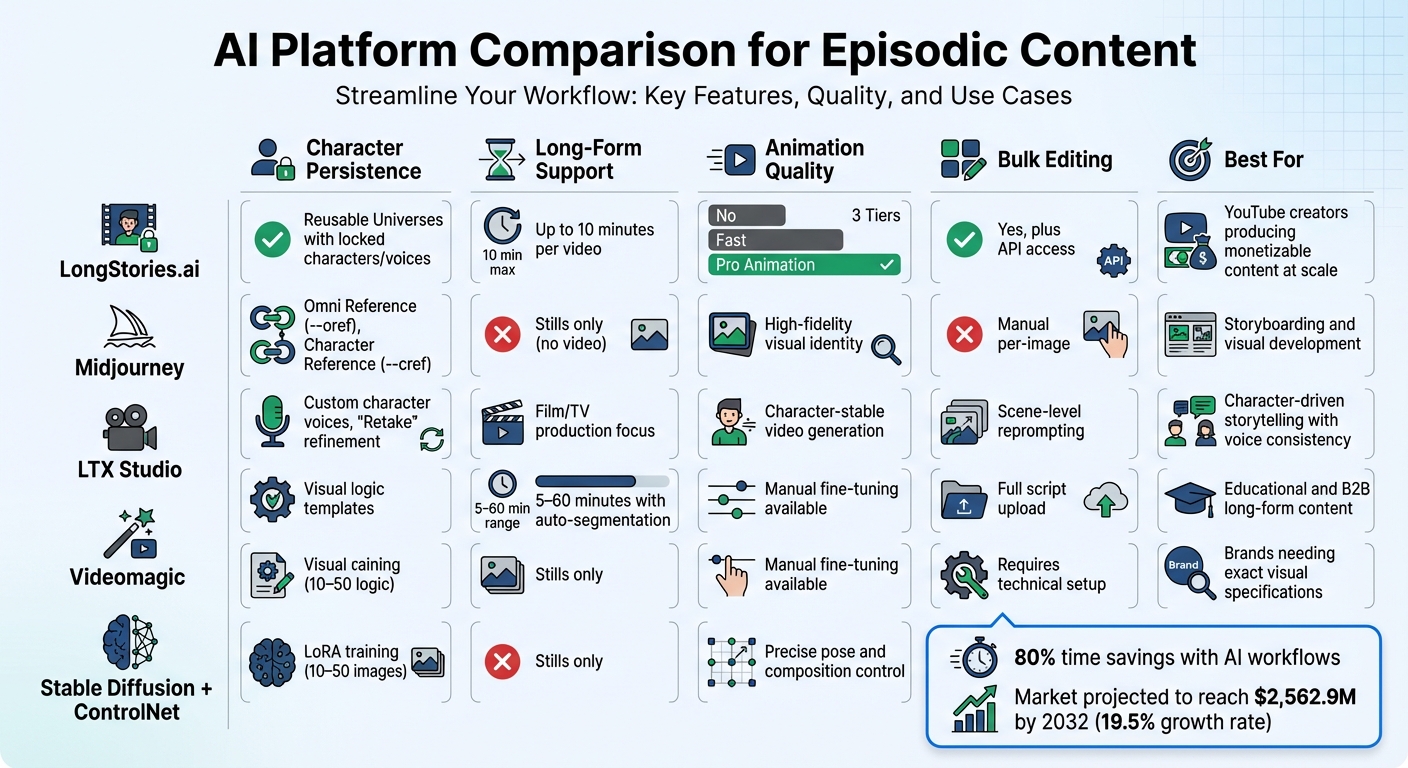
AI Video Platform Comparison for Episodic Content Creation
Once you've defined your characters and storyline, it's time to set up AI tools to ensure your visual identity stays consistent from the very beginning.
Configure AI Platforms for Consistent Output
Start by using identity anchoring before applying any stylistic tweaks. For instance, in Midjourney v7, the Omni Reference (--oref) parameter locks in character identity, while the Style Reference (--sref) maintains the overall visual style. This separation is key to keeping character features consistent across different scenes.
"Removing the visual anchoring mechanism results in a catastrophic drop in character consistency scores (from 7.99 to 0.55), confirming that visual priors are essential for identity preservation." - arXiv:2512.16954
For long-form video projects, platforms like LongStories.ai streamline this process with reusable Universes. You can define your characters, styles, and voices once, and then generate countless videos without needing to re-prompt for each episode. The platform offers three animation quality levels: No Animation for static visuals, Fast Animation for quicker production, and Pro Animation for high-quality motion. This flexibility allows you to balance production speed and visual quality to meet your brand's standards.
If you need precise control over character poses and scene compositions, Stable Diffusion with ControlNet (like OpenPose) is a powerful option. By training a LoRA model with 10–50 images of your character, you can use ControlNet to match specific storyboard panels. This ensures that every frame aligns with your creative vision.
For audio consistency, assign custom voice clones to your characters. Tools like LTX Studio let you create unique voices for each character and use a "Retake" feature to refine specific audio elements without losing the overall scene's flow.
Next, let’s dive into how specific AI tools implement these identity-locking features for smooth episodic production.
Comparison of AI Platforms for Episodic Content
Here's a quick look at how leading AI platforms stack up when it comes to creating episodic content:
| Platform | Character Persistence | Long-Form Support | Animation Quality | Bulk Editing | Best For |
|---|---|---|---|---|---|
| LongStories.ai | Reusable Universes with locked characters/voices | Up to 10 minutes per video | 3 tiers (No/Fast/Pro Animation) | Yes, plus API access | YouTube creators producing monetizable content at scale |
| Midjourney | Omni Reference (--oref), Character Reference (--cref) |
Stills only (no video) | High-fidelity visual identity | Manual per-image | Storyboarding and visual development |
| LTX Studio | Custom character voices, "Retake" refinement | Film/TV production focus | Character-stable video generation | Scene-level reprompting | Character-driven storytelling with voice consistency |
| Videomagic | Visual logic templates | 5–60 minutes with auto-segmentation | Manual fine-tuning available | Full script upload | Educational and B2B long-form content |
| Stable Diffusion + ControlNet | LoRA training (10–50 images) | Stills only | Precise pose and composition control | Requires technical setup | Brands needing exact visual specifications |
Brands using AI in their video workflows have reported up to 80% time savings compared to traditional production methods. But the best platform for you depends on your priorities - whether it’s maintaining voice consistency, achieving high animation quality, or producing YouTube-ready videos that meet monetization criteria.
The AI video generator market is on track to hit $2,562.9 million by 2032, with an annual growth rate of 19.5%. As these tools become more advanced, businesses that establish clear branding systems today will be better positioned to scale their content production in the future.
Building a Repeatable Production Workflow
Once your AI tools are set up for consistent results, the next step is creating a workflow that lets you produce episodes efficiently without compromising quality. The idea is simple: let AI handle the repetitive tasks while you focus on the creative aspects that define your brand's voice and story.
Plan Your Series Roadmap
Start by planning your content calendar 4–6 weeks in advance. Align your episodes with key moments like product launches, seasonal trends, or significant events. This kind of structured planning ensures you stay consistent with your posting schedule and keep your audience engaged.
When it comes to individual episodes, stick to a clear structure. Begin with a 3–5 second hook to grab attention, lay out a value proposition, support it with examples, and wrap up with a concise call-to-action. For educational or narrative series, think about adding recurring elements like segments or character arcs that viewers can look forward to with each episode.
If you're using tools like LongStories.ai, features like Universes can simplify scalable video production. By defining your visual identity once, you can generate multiple videos - up to 10 minutes long - while maintaining a consistent look and feel. This is particularly helpful for YouTube creators aiming to meet monetization goals without sacrificing quality or posting frequency.
With your roadmap set, strike a balance between automation for efficiency and human oversight to keep the creativity alive.
Combine Automation with Human Oversight
AI can handle many technical tasks, such as transcription, generating B-roll, or resizing content for different platforms. But when it comes to storytelling, emotional depth, and staying true to your brand, human involvement is key. This balance ensures your content remains engaging and aligned with your overall narrative.
"Think of AI as your production assistant - it handles time-consuming technical tasks so you can focus on crafting compelling narratives." - Project Aeon
For example, in 2025, the cosmetics brand Bloom Beauty used the Koro Competitor Ad Cloner to scale their video production. They analyzed a competitor's viral ad, rewrote it in their "Scientific-Glam" brand voice, and created 10 variations with AI avatars. The entire process took just 24 hours, compared to the usual 3-week studio shoot. The campaign achieved a 3.1% CTR and a 45% improvement in performance over their previous creative.
This approach, known as "programmatic variation", allows you to generate multiple hooks, visual styles, and scripts from a single concept. By testing these variations with small budgets (around $20/day) over 48 hours, you can quickly identify what resonates with your audience. Underperforming versions can be dropped, while successful ones are scaled based on metrics like Hook Hold Rate and click-through rate.
However, relying too much on automation can lead to mistakes going unnoticed. That’s why a human-in-the-loop (HITL) system is crucial. It ensures errors are caught, biases are addressed, and the final product retains emotional depth and accuracy.
Implement Quality Control and Brand Alignment
As your production scales, maintaining quality and brand consistency becomes even more important. Before publishing, use a preflight checklist to ensure everything is on point. This includes checking visual elements like facial landmarks, consistent eyelines, and text contrast (meeting WCAG 2.2 standards of 4.5:1). Keep text concise - no more than 18 words per panel - and vary your shot types. Use wide shots to set the scene, medium shots for interactions, and close-ups to convey emotion.
To maintain character consistency, use model sheets as a reference. If you're working with tools like Midjourney, parameters like Omni Reference (--oref) can lock in character identity, while Style Reference (--sref) ensures your overall visual aesthetic stays consistent.
Another time-saver is building an AI asset library. Organize AI-generated elements like B-roll, backgrounds, and motion graphics into a searchable collection. This makes production faster and keeps your visuals cohesive across episodes. For collaborative projects, tools like Frame.io or Vimeo Review can streamline feedback with timestamped notes, while platforms like Figma help with visual planning and mood boards.
Before finalizing any video, thoroughly review and edit the AI-generated outline and chapters. This is your last chance to ensure the content aligns with your brand's tone, values, and style guide.
"If I do my job right in prep, I always feel like the shooting should be boring." - David Fincher
Conclusion
Creating an AI-driven video series that stays true to your brand hinges on four key elements: a well-defined brand story, a scalable world with consistent characters and settings, dependable AI tools, and a repeatable production process. Together, these elements help produce engaging, high-quality content that resonates with your audience.
The numbers speak for themselves: 90% of video marketers say video increases brand awareness, 75% have adopted AI for content creation, and companies report up to 80% time savings with AI workflows. By cutting production time significantly, AI allows you to focus on the creative decisions that shape your brand identity.
Platforms like LongStories.ai simplify the process by letting you establish your visual identity once and generate videos up to 10 minutes long with consistent characters, styles, and voices. This eliminates repetitive tasks, making it easier to post content frequently and maintain consistency.
However, automation alone isn’t enough. As Simon Sinek reminds us:
"Audiences don't buy what you do; they buy why you do it".
AI can handle repetitive tasks, but human insight is essential to keep your content authentic and emotionally compelling. Your creative vision, editorial input, and understanding of what resonates with your audience are irreplaceable in building a strong emotional connection.
Start with a clear style guide, develop a library of assets, test your workflow, and refine it based on feedback. Building a system that supports consistent production and ongoing improvement will position your brand for long-term growth and success.
FAQs
How do AI tools help maintain brand consistency in video series?
AI tools play a key role in keeping brand identity consistent by helping creators develop reusable characters, style templates, and story frameworks. These tools ensure that every episode maintains the same look, tone, and feel, with consistent faces, voices, visual styles, and narratives. The result? A seamless and unified brand experience across the entire series.
Platforms like LongStories.ai take this a step further. They streamline the process with features such as customizable "Universes", which come equipped with pre-set characters, styles, and voice profiles. By removing common production hurdles, these tools let creators focus more on crafting engaging stories while consistently delivering polished, on-brand content at scale.
What should a style guide include to ensure consistency in AI-generated videos?
A style guide for AI-generated videos serves as a roadmap to ensure every episode reflects your brand’s identity. It’s key to maintaining consistency in visuals, audio, and storytelling, which helps avoid confusing your audience or slowing down production.
Here’s what to include:
- Visual identity: Set clear guidelines for your color palette, typography, logo placement, and animation style (like 2D or 3D). Don’t forget technical details such as aspect ratios (e.g., 16:9), resolution (e.g., 1080p), and file naming conventions.
- Character and voice details: Record specifics about character appearances, clothing, and defining traits. For AI voices, note settings like pitch and stability to ensure voices remain consistent across episodes.
- Audio branding: Define the music styles, sound effects, and recurring audio themes that align with your brand.
- Storytelling tone and structure: Clarify your brand’s voice - whether formal or conversational - along with pacing guidelines and a general episode structure to maintain a cohesive narrative flow.
Tools like LongStories.ai make this process easier by letting creators build reusable templates with locked-in designs, voices, and animation settings. To keep your content cohesive and aligned with your goals, regularly update and share your style guide with your team.
How can I combine automation and human input when creating AI videos?
To strike the right balance between automation and human input in AI video production, let AI take care of repetitive tasks like drafting scripts, editing, and rendering. Meanwhile, reserve human involvement for the key creative decisions that define your brand’s identity. Start by establishing clear brand guidelines - covering tone, visual style, and character personalities - to ensure the AI operates within the boundaries of your vision.
Introduce human review at critical stages of the process. For instance, review scripts to make sure they align with your storytelling goals, approve visuals and character designs to maintain consistency, and conduct a final check to catch any off-brand elements or errors. While tasks like background music selection or basic edits can be entrusted to automation, elements such as dialogue or brand-specific graphics should always involve manual approval.
Platforms like LongStories.ai make this collaboration seamless by automating production workflows while giving creators the opportunity to review scripts, character dialogue, and animation styles before finalizing the content. By setting clear checkpoints and keeping humans involved in the creative process, you can scale your content production without compromising on quality or authenticity.
Related posts
LongStories is constantly evolving as it finds its product-market fit. Features, pricing, and offerings are continuously being refined and updated. The information in this blog post reflects our understanding at the time of writing. Please always check LongStories.ai for the latest information about our products, features, and pricing, or contact us directly for the most current details.