
5 Steps to Build Consistent AI Characters
Creating consistent AI characters can be challenging, but it’s essential to keep your audience engaged and maintain trust. Tiny inconsistencies - like shifting personalities or altered appearances - can ruin the connection viewers have with your story. Here’s how to avoid these pitfalls and ensure your AI characters remain steady and recognizable:
- Define Core Personality Traits: Use structured frameworks like the Big Five or MBTI to set clear, measurable traits. Document everything in a "Character DNA" file.
- Build a Detailed Backstory: Establish key life events, motivations, and relationships to give your character depth and emotional reasoning.
- Set Up Consistent Communication Patterns: Define a unique speech style, tone, and quirks. Use example dialogues to anchor their personality.
- Refine Through Testing: Test how the character performs in different scenarios, ensuring they stay true to their traits and backstory.
- Validate Across Scenarios: Push the character into unpredictable situations to detect and fix inconsistencies.
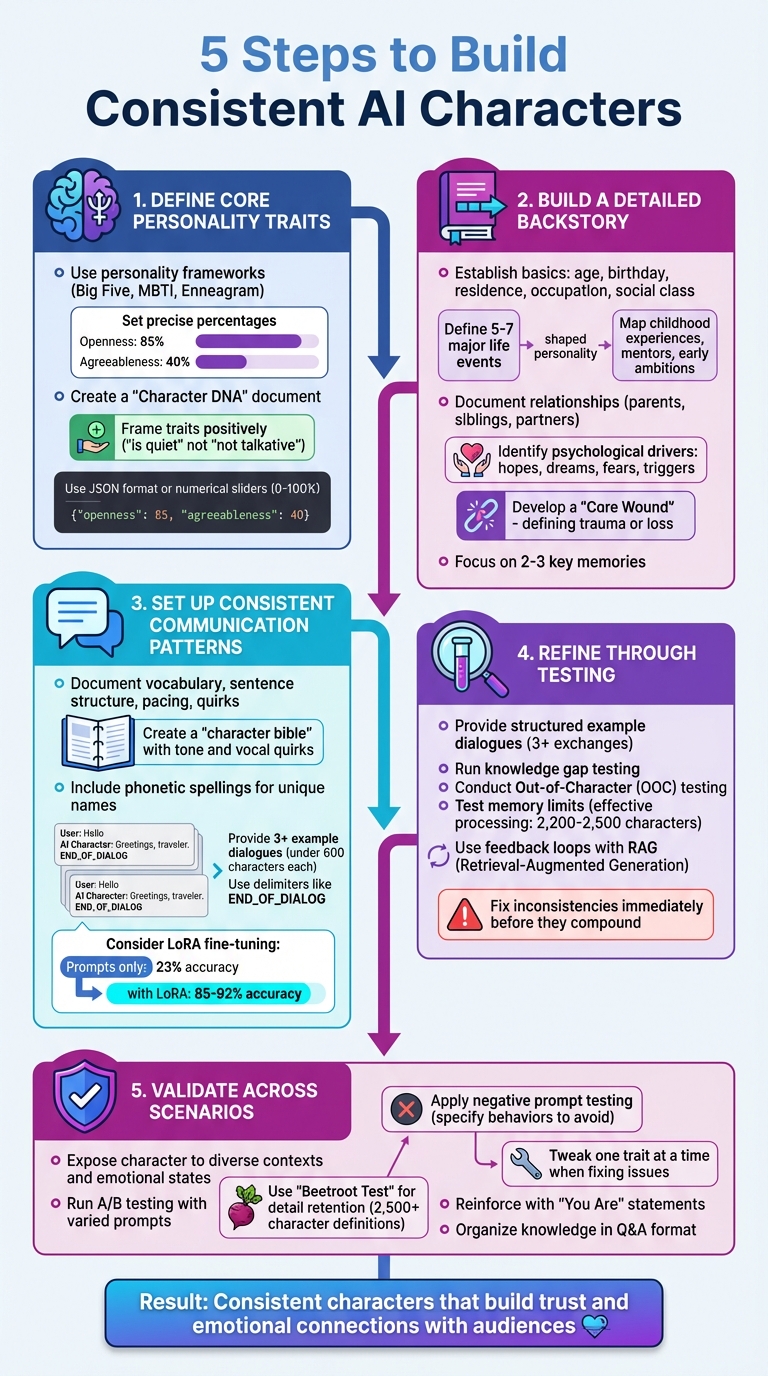
5 Steps to Build Consistent AI Characters - Complete Workflow
How to Actually Make 100% Consistent AI Characters
Step 1: Define Core Personality Traits
Before diving into generating frames, it’s essential to define your character’s core personality traits. Without this foundation, AI models can produce responses that feel inconsistent or erratic from one scene to the next. Anchoring your character to well-defined personality frameworks ensures stability and consistency in their behavior.
Use Personality Frameworks
Personality frameworks like the Big Five provide a structured approach to defining traits. These five dimensions - Openness, Conscientiousness, Extraversion, Agreeableness, and Neuroticism - act as sliding scales. Instead of vague descriptors like "friendly", aim for precise percentages, such as 85% Openness or 40% Agreeableness. This level of detail helps the AI maintain consistent responses across varying scenarios.
"The 'Big Five' is one of the tried-and-true methods for creating fictional people that feel real." - Open Book Editor
For added complexity, you can combine frameworks. Pairing the Myers-Briggs Type Indicator (MBTI) with the Enneagram creates rich, multi-layered personas. For example, an ENTJ-A with a 7w8 Enneagram profile will think and act differently than an INFP with a 4w5 profile. Some creators even take personality tests on behalf of their characters to better understand their thought processes and decision-making styles.
Document Key Traits
Once your character’s personality is defined, compile everything into a "Character DNA" document. This serves as a reference point, ensuring the AI doesn’t stray into generic or inconsistent behaviors. Include core traits, quirks, flaws, motivations, and boundaries.
When documenting, focus on positive definitions. For instance, say "is quiet" instead of "not talkative". AI tools are more effective when traits are framed in terms of what a character is rather than what they aren’t. To make this even more AI-friendly, consider structuring the traits in JSON format or as numerical sliders (e.g., 0–100%). Repeating these traits in full within every prompt ensures consistency and reduces the chances of behavioral drift across sessions.
Step 2: Build a Detailed Character Background
A character's backstory is the foundation of their every decision. Without it, an AI-generated character can feel empty or inconsistent. A well-thought-out background gives depth and emotional reasoning to their actions, making them feel more authentic. Here's how to map out the key elements that bring a character to life.
Key Backstory Elements
Start by establishing the basics: age, birthday, residence, occupation, and social class. These details create a realistic framework for the character's existence. Then, delve into formative origins like their hometown, cultural influences, or reasons for relocation. For example, moving to a new city might shape how they interact socially or adapt to change.
Next, explore their childhood experiences - what hobbies did they have? Who were their mentors? What early ambitions drove them? These elements paint a clearer picture of who they are and how they've evolved. Identify 5–7 major life events that have significantly shaped their personality. These turning points help connect their past experiences to their current behavior. Relationships are equally important - dive into their connections with parents, siblings, or partners to reveal whether they lean toward independence or vulnerability.
Finally, uncover their psychological drivers: What are their hopes, dreams, fears, and emotional triggers? For example, someone abandoned as a child might go out of their way to please others to avoid rejection. Or, a broken childhood promise might lead to an intense commitment to honesty later in life. These inner motivations guide how they respond in different scenarios.
Connect Backstory with Traits
Once the backstory is fleshed out, make sure it aligns with the character's core traits. A consistent connection between their history and personality ensures they feel believable and avoids contradictions. For instance, if a character scores high in assertiveness, their backstory should reflect experiences that built their confidence.
Consider developing a "Core Wound" - a single, defining trauma or loss that shapes their identity. This could explain why a character is guarded or overly cautious, for example.
When documenting behaviors, use positive phrasing to tie them back to the backstory. Instead of saying a character "doesn't trust authority", describe how they "avoid authority figures due to a betrayal by a trusted teacher in childhood." This approach gives depth to their actions and makes their behavior feel purposeful. To keep things manageable, focus on 2–3 key memories that define their personality.
Step 3: Set Up Consistent Communication Patterns
Once you've crafted your character's personality and backstory, the next step is to ensure their speech feels authentic and recognizable. A character's speech patterns are what make them stand out. Without consistency, they might seem like a completely different person each time they appear. With their traits and history established, the focus shifts to making their dialogue consistent and unmistakable.
Define Speech Style
Start by documenting the specific elements that shape your character's voice - this includes vocabulary, sentence structure, pacing, and any unique quirks. For instance, does your character lean on academic jargon? Do they prefer short, sharp sentences? Maybe they pause before tackling tough questions or respond with a calm, dry wit. These details create a voice that feels alive.
Create a "character bible" to keep track of these traits. This document should outline their tone, vocal quirks, and even phonetic spellings for unique names or terms. For example, if your character's name is "Shreedar", include a phonetic guide to ensure AI tools pronounce it consistently across various outputs. Eden Barel, Video Content Specialist at Artlist, highlights the importance of this approach:
"What's exciting about these new AI tools is the ability to keep a character truly consistent across different shots - something that simply wasn't possible before. But it's a very different skillset to traditional filmmaking; you're not managing actors and costumes so much as shaping words into images, and continuity comes down to how precisely you guide the prompts."
Additionally, include brief stage directions like "(short pause, slight smile)" to guide emotional delivery and timing in dialogue prompts.
Maintain Dialogue Consistency
Once your character's voice is defined, reinforce it with consistent dialogue examples. These examples act as templates, showing the AI exactly how your character speaks, far more effectively than a list of descriptive traits. As Noah Albert from RoboRhythms explains:
"Dialogue teaches the AI how to behave, more than definitions ever will."
Carefully structure these example conversations and end each one with a clear delimiter, like END_OF_DIALOG, to set boundaries. Use positive phrasing when describing behaviors. For instance, instead of saying "doesn't lie", which could be misinterpreted, you might say, "avoids lying because it makes their stomach twist."
To prevent "character drift" - when an AI loses the personality you've defined over extended interactions - include the full character description in every prompt. You can also ground your character's responses in a curated knowledge base to maintain accuracy and consistency. For more advanced customization, consider training a personalized GPT model using your character profiles. This can automate prompt creation and reduce the risk of drift.
For even greater precision, fine-tune with a LoRA (Low-Rank Adaptation) model. This method can boost character accuracy from around 23% (using only prompts) to 85–92%. While this requires extra setup, the payoff is clear, especially for long-form projects where even minor inconsistencies in speech can stand out to your audience.
sbb-itb-94859ad
Step 4: Refine Characters Through Testing
Once you've defined your character's traits and dialogue cues, it's time to put them to the test. This phase ensures your character stays consistent and behaves as intended. Testing acts as the bridge between your initial design and how your character performs in practice, identifying any deviations from its defined traits.
Provide Example Dialogues
Creating sample dialogues is a practical way to anchor your character's behavior. These examples should follow a structured format: start with a user prompt, then provide your character's response (keep responses concise, ideally under 600 characters). This approach helps the AI better understand patterns in tone, pacing, and emotional delivery compared to relying solely on abstract trait lists.
Include at least three exchanges that reflect a variety of emotional states or scenarios. For instance, if your character uses specific formatting - like asterisks for actions or quotes for speech - demonstrate this consistently in the examples. These dialogues act as a foundation for further refinement and testing.
Use Feedback Loops
Testing is an iterative process. You need to reinforce your character's core traits by evaluating them in different scenarios. Start with knowledge gap testing, where you ask your character specific questions related to its expertise or backstory. For instance, in November 2024, Convai Technologies tested a virtual product specialist, Dr. Maya Patel. When asked about the dosage of a fictional drug, the character initially provided incorrect information. To fix this, the team uploaded accurate data to its Knowledge Bank using Retrieval-Augmented Generation (RAG). After retesting, Dr. Patel gave the correct dosages, demonstrating how feedback loops can close gaps effectively.
Other useful methods include Out-of-Character (OOC) testing and memory limit testing. OOC testing helps catch behavioral inconsistencies that might not appear in standard interactions. Memory limit testing, on the other hand, evaluates how well the AI retains details. For example, place a minor detail (like a favorite food) at the end of the character's definition, then ask about it later. If the AI fails to recall it, you've likely exceeded its effective processing limit. While some platforms claim to handle up to 32,000 characters, most AI models only process the first 2,200 to 2,500 characters effectively.
As Aisha Imtiaz, Senior Editor at AllAboutAI, puts it:
"Review and correct early: Fix small inconsistencies immediately before they compound across images or frames".
The key is to address inconsistencies as soon as they arise. Regularly reapply your character profile to prevent drift, especially during longer sessions where the AI might reset its context with each new interaction.
Step 5: Test Consistency Across Different Scenarios
Now it’s time to push your character to its limits. After the initial testing phase, introduce unpredictable situations to ensure your character remains steady and true to its design. This step is crucial to uncover any weak points in how the character handles edge cases or unexpected interactions.
Run Scenario Tests
Expose your character to diverse contexts to identify cracks in its personality or tone. Try different environments, emotional states, and query types. For instance, if you’ve created a supportive mentor character, test how they respond to hostile users or random, unrelated questions. The goal is to spot "character drift" - moments when the AI strays from its intended personality or tone.
Use A/B testing to compare responses from slightly varied prompts. This helps ensure your character's internal logic stays aligned with its defined traits.
Another tool is the "Beetroot Test", which checks how well the character retains details. Add a random fact, like "Favorite food: pickled beetroot", to a long character definition (over 2,500 characters). If the AI fails to recall this detail during testing, it’s a sign the definition exceeds its processing limit. Similarly, negative prompt testing can help. Specify behaviors to avoid, such as "no slang" or "no hats", and see if the character adheres to these boundaries when challenged.
When deviations occur, flag them for immediate refinement to keep the character consistent.
Fix Inconsistencies
If you notice inconsistencies, tweak one trait or instruction at a time and re-test. Adjusting too many variables at once can make it harder to pinpoint the root of the issue. To combat recurring drift, reinforce the character’s core traits with "You Are" statements at the beginning of prompts. For example, "You are Dr. C. Beetee, and you always provide warm, supportive advice".
For knowledge-based issues, organize the character’s information in a question-and-answer format within its knowledge base. This structure helps the AI retrieve and apply facts more effectively. Additionally, set up fallback mechanisms for ambiguous queries, prompting the character to either provide a default response or seek clarification.
"AI characters modeled with a clear, consistent narrative are more likely to build trust and engender emotional connections with users" - Curtis Pyke
The trick is catching and fixing small inconsistencies early, so they don’t spiral into bigger problems during future interactions.
Scale Character Creation with LongStories.ai

Once you've nailed down the basics of creating consistent AI characters, the next big step is scaling your production without compromising quality. This is where LongStories.ai steps in as a game-changer for creators looking to expand their output.
Benefits of Reusable Character Universes
LongStories.ai tackles one of the biggest hurdles in AI-based storytelling: re-prompting. Its "Universe" system allows you to create reusable video templates where characters, visual styles, and voices are defined just once. From there, you can generate endless videos using simple prompts like "Episode 5: Professor discovers time travel." This approach eliminates the character drift often seen in traditional AI tools, where faces or personalities unintentionally change when starting from scratch.
Setting up a universe takes just 10–15 minutes, and launching new projects within that universe takes as little as 3 minutes. One film studio, for example, was able to go from producing one episode per week to several episodes per day. The platform supports videos up to 15 minutes long, meeting YouTube's monetization standards. It’s already trusted by creators with subscriber counts ranging from 10,000 to over 500,000. This system doesn’t just ensure consistency; it also creates a streamlined process for scaling your production efforts.
Reduce Production Bottlenecks
LongStories.ai doesn’t stop at reusable universes. It also addresses common production delays that slow creators down, such as animation, voiceovers, and editing. The platform offers three animation tiers - No Animation, Fast Animation, and Pro Animation - so you can choose the level of complexity that suits your project.
High-volume creators benefit from bulk asset downloads and API access, which make it easy to export assets to external editing platforms while maintaining character and style consistency. Pricing starts at just $9/month, and a free trial with 400 credits lets you explore the platform’s features before committing. Whether you’re a solo creator or part of a larger team, LongStories.ai provides the tools to scale production efficiently and effectively.
Conclusion
Creating consistent AI characters is the backbone of engaging storytelling. When characters undergo unexplained changes in appearance or personality, it disrupts the audience's experience and weakens their emotional connection. As Zack Saadioui from Arsturn explains:
"If a character's appearance keeps changing, it shatters the illusion. Viewers get pulled out of the story."
This guide's five-step process - defining personality traits, building backstories, establishing communication patterns, refining through testing, and validating across scenarios - offers a clear framework to address AI's memory limitations. Without such a structure, character drift becomes inevitable, undermining the consistency needed for effective storytelling.
Maintaining a consistent art style also plays a key role in audience recognition. Any noticeable deviations can significantly impact how viewers perceive and engage with the content. A systematic approach to character design and development is what separates polished, professional projects from casual experiments, especially as generative AI becomes more widespread among creators.
For those looking to scale their projects, platforms like LongStories.ai simplify these steps into an efficient production pipeline. By building a cohesive universe once, creators can produce consistent content at an impressive pace. For instance, one film studio was able to shift from producing one episode per week to several per day using this method.
Investing in character consistency doesn't just elevate storytelling - it also strengthens audience engagement, reinforces brand identity, and streamlines production workflows. Whether you're crafting a YouTube series, marketing campaign, or interactive narrative, following these five steps ensures your characters remain as dependable and memorable as the stories they help tell.
FAQs
How do personality frameworks like the Big Five help create consistent AI characters?
Personality frameworks, such as the Big Five, offer a clear structure for defining and maintaining a character’s personality through traits like openness, conscientiousness, extraversion, agreeableness, and neuroticism. By tying an AI character’s behavior to these traits, creators can ensure the character behaves consistently and feels authentic across various interactions and scenarios.
This method proves particularly effective when creating reusable character profiles for storytelling or video production. It helps maintain continuity, making characters more engaging and lifelike, which, in turn, strengthens the connection with the audience.
How does LongStories.ai help creators produce consistent AI characters at scale?
LongStories.ai streamlines the creation of consistent AI characters by allowing users to build reusable "Universes" filled with well-matched characters, styles, and voices. This approach helps maintain continuity across projects, eliminates the need to repeat tedious setup tasks, and strengthens your overall brand identity.
The platform also tackles common production hurdles like animation, voiceover recording, and editing. With features such as bulk editing, customizable animation quality, and API access, creators can focus entirely on storytelling. By simplifying these processes, LongStories.ai enables regular production of high-quality content, helping creators expand their audience and boost revenue.
What are scenario tests, and how do they ensure AI characters stay consistent?
Scenario tests are essential for keeping AI characters consistent. They simulate various situations or scenes to identify any "character drift", ensuring that traits like appearance, style, and personality remain intact across episodes or stories.
By spotting inconsistencies early, creators can fine-tune their AI characters, helping them stay aligned with their original design and improving the storytelling experience as a whole.
Related posts
LongStories is constantly evolving as it finds its product-market fit. Features, pricing, and offerings are continuously being refined and updated. The information in this blog post reflects our understanding at the time of writing. Please always check LongStories.ai for the latest information about our products, features, and pricing, or contact us directly for the most current details.