
Best Platforms for Selling Merch Without Inventory

If you want to sell merch without worrying about inventory, Print-On-Demand (POD) platforms are the way to go. These platforms handle production, shipping, and even customer service, so you can focus on designing and marketing. Here's a quick look at six popular options:
- Printful: Offers 491 products, custom branding options, and integrates with 22 platforms. Pay-as-you-go pricing with optional $24.99/month membership for discounts. Most items ship in 2–5 days.
- Printify: Largest catalog with over 1,300 products. Free plan available, plus a $29/month Premium plan for discounts. Ships in 2–7 days via 140+ global print providers.
- Bonfire: Focuses on apparel and accessories with sustainable materials. No upfront costs but charges an 8% transaction fee. Limited international shipping.
- Redbubble: Marketplace with built-in traffic. Simple setup but limited control over branding and smaller profit margins.
- Spreadshop: Free to use with over 300 products. Offers social commerce integrations and lets you set your own profit margins.
- Amazon Merch on Demand: Access to Amazon's massive audience and Prime shipping. Limited product variety and uses a royalty-based model.
Quick Comparison
| Platform | Product Range | Pricing Model | Shipping Speed | Branding Options |
|---|---|---|---|---|
| Printful | 491 products | Pay-as-you-go | 2–5 days | Custom packaging |
| Printify | 1,300+ products | Free/$29 Premium plan | 2–7 days | Limited |
| Bonfire | Apparel-focused | Free, 8% fee | Varies | Minimal |
| Redbubble | 70+ products | Royalty-based | 3–7 days | None |
| Spreadshop | 300+ products | Free, set margins | 48 hours | Some options |
| Amazon Merch | Limited products | Royalty-based | 2-day Prime | None |
Each platform has its strengths depending on your goals. For beginners, marketplaces like Redbubble or Amazon Merch are ideal due to built-in audiences. For more control and higher profits, Printful or Printify are better choices. Always test product quality with samples before launching.
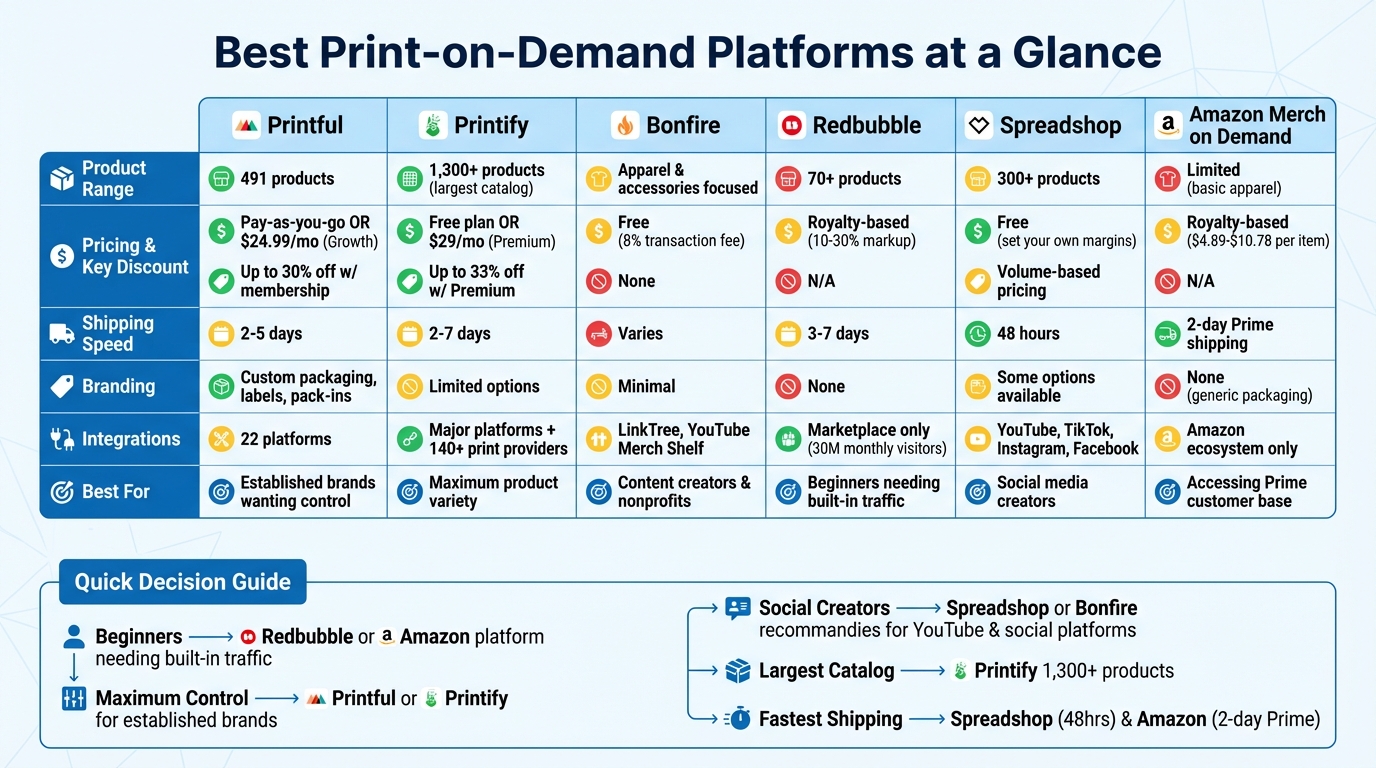
Print-on-Demand Platform Comparison: Features, Pricing, and Shipping
17 Print on Demand Websites RANKED by Successful Seller
sbb-itb-94859ad
1. Printful
Let’s take a closer look at what Printful has to offer.
Printful provides access to 491 customizable products spanning categories like apparel, accessories, and home & living. It supports various printing methods, including DTG (direct-to-garment), embroidery, all-over printing, DTFlex, and even custom knitting. To help businesses establish a professional identity, it also offers branding options such as inside and outside labels, custom packaging, and branded pack-ins.
Integration Options
Printful integrates with 22 e-commerce platforms, making order fulfillment a breeze through automatic imports. For independent brands, platforms like Shopify, Wix, or Squarespace are great options. Meanwhile, creators looking for platforms with built-in audiences can turn to Etsy (home to over 96 million active buyers), Amazon, or eBay. Additionally, Printful supports social commerce integrations with TikTok Shop, Spotify, and YouTube, allowing creators to monetize directly through their followers.
Pricing Model
Printful operates on a pay-as-you-go system, meaning there are no upfront or monthly fees. You set your retail prices, and when a customer places an order, Printful charges for the product, fulfillment, and shipping - your profit is the difference.
For those looking for additional perks, there’s an optional Growth membership for $24.99 per month. This membership includes discounts of up to 30% on products and 7% on branding costs. Plus, if your store generates $12,000 in annual sales, the membership is free for a year. Keep in mind, though, that embroidery designs require a one-time digitization fee of up to $6.50 per design.
Shipping Speed
With 12 global fulfillment centers, Printful ensures quick delivery and minimizes delays. Most items are ready to ship within 2–5 business days, and the platform boasts an impressive 99.76% order approval rate.
"Printful has been integral to my company's early success. They handle all the things I don't have time to worry about, like shipping and manufacturing." - Ryan McCarthy, IMOURI
2. Printify
Compared to Printful's 491 products, Printify boasts an even larger selection. With over 1,300 customizable items, it offers the most expansive catalog in the industry. The options include apparel, home goods, accessories, and even niche items like pet products and eco-friendly collections.
Integration Options
Printify integrates smoothly with major e-commerce platforms such as Shopify, WooCommerce, Wix, Squarespace, and BigCommerce. It also supports marketplace connections for Etsy, eBay, Amazon, and TikTok Shop. For those not ready to launch a full website, Printify provides a Pop-Up Store option, allowing you to start selling right away. Additionally, API access is available for creating custom workflows. These features make it adaptable to a variety of business needs.
Pricing Model
Printify offers three flexible pricing plans:
- Free Plan: Costs $0 per month and supports up to 5 stores with unlimited designs.
- Premium Plan: Priced at $29 monthly (or $24.99 annually), it includes discounts of up to 33% on all products and supports 10 stores.
- Enterprise Plan: Tailored for high-volume sellers, this plan includes custom pricing and unlimited stores.
You set your product prices and keep the profit margin, which typically ranges from $5 to $15 per sale.
"Printify Premium has helped my profit margins tremendously, and spending $20 a month has probably saved me over $200 a month." - Christopher, Dog Ross Pet Painting
Shipping Speed
Orders are usually shipped within 2-7 business days. Printify works with over 140 print providers worldwide, automatically routing orders to the nearest provider to minimize shipping times and costs. With more than 60 million orders completed and a 4.8/5 rating from over 6,000 reviews, Printify has built a strong reputation.
3. Bonfire
Bonfire simplifies selling by eliminating the need to manage inventory, much like other platforms in this space. It focuses on offering a carefully chosen range of apparel and accessories, including t-shirts, hoodies, crewneck sweatshirts, and bags, all crafted from sustainable, high-quality materials. Verified creators gain access to an expanded catalog with exclusive products, plus the ability to replace standard mockups with custom product photos.
Integration Options
Bonfire stands out for its seamless social media integrations, making it a great fit for content creators. It connects with LinkTree, enabling followers to shop directly through your link-in-bio on platforms like Instagram, TikTok, YouTube, and Twitter. Verified creators can also use the YouTube Merch Shelf to sell products directly beneath their videos. The platform is focused exclusively on its hosted storefronts and the YouTube Merch Shelf, ensuring a straightforward selling experience.
Now, let’s take a closer look at Bonfire’s pricing structure.
Pricing Model
Bonfire offers a setup with no upfront costs - it’s completely free to start. You set your retail price, and your profit is simply the difference between the retail price and the base cost. However, Bonfire applies an 8% transaction fee to every sale. It's worth noting that Bonfire’s base costs tend to be higher than those of its competitors. For design assistance, Bonfire Studio provides design packages, but these come at an additional cost.
"Bonfire makes it super easy to create merch and sell for my nonprofit. I get the donations, and they deal with the sales tax." - Meg, Nonprofit Organizer
Beyond pricing, let’s explore how Bonfire handles shipping.
Shipping Speed
Bonfire primarily works with US-based suppliers, and every product is reviewed before shipping to ensure high print quality. While this attention to detail enhances the final product, it does limit international shipping options. For example, international shipping starts at approximately $11.99 for the first item.
Creator Royalties
Bonfire offers creators clear and straightforward royalty terms. After covering the base cost and the 8% transaction fee, you keep 100% of the remaining profit. For those running fundraising campaigns, Bonfire’s "Giving Campaigns" ensure that 100% of the proceeds go directly to the nonprofit organization of your choice.
4. Redbubble
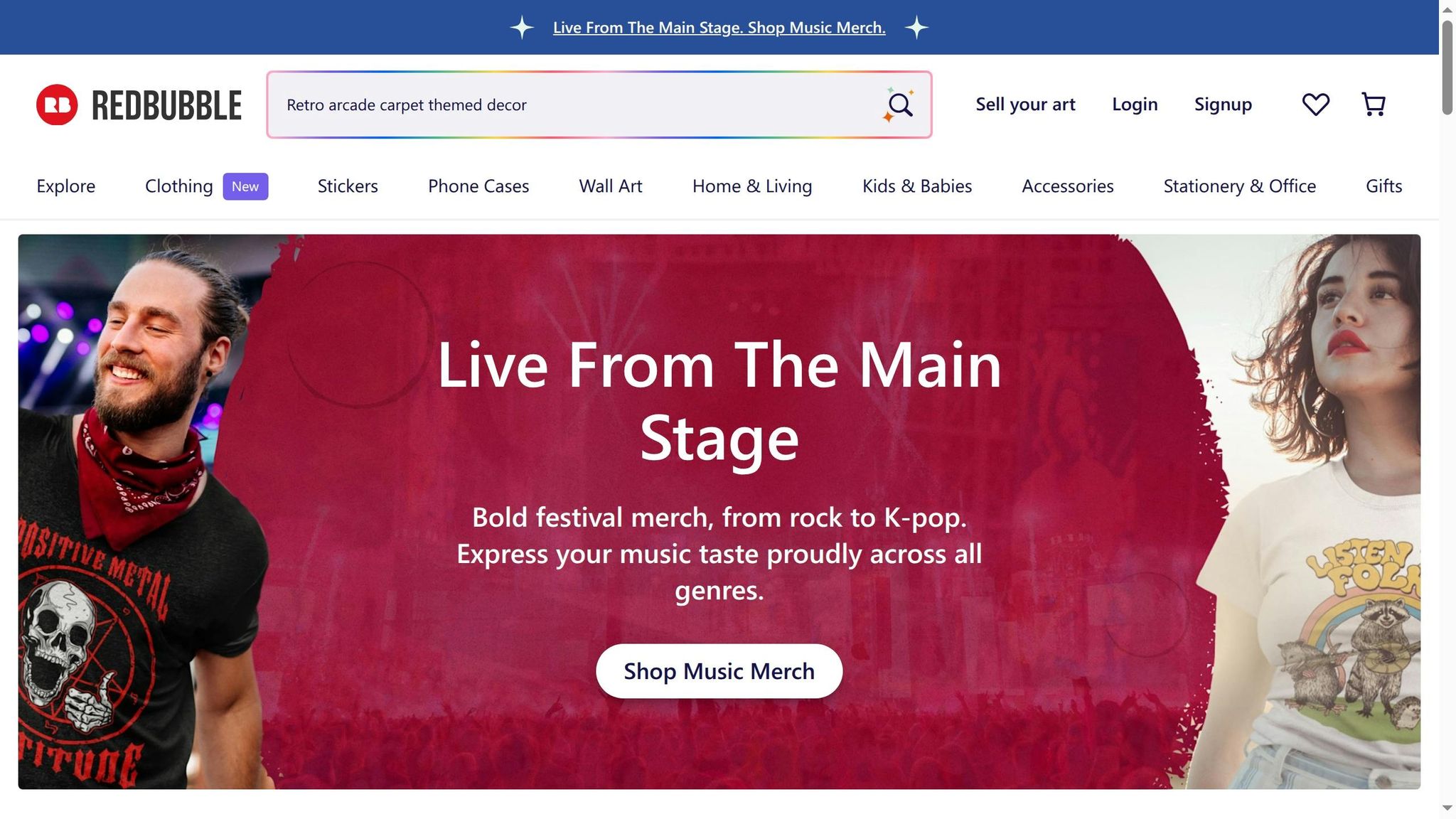
Redbubble is another inventory-free platform that operates as an independent marketplace. As a creator, you simply upload your designs, and Redbubble takes care of everything else - production, fulfillment, shipping, and even customer service. With a community of over 700,000 artists and more than 30 million monthly visitors, it’s a straightforward way to earn passive income. However, the competition is fierce, and you’ll have limited control over branding.
Product Variety
Redbubble offers more than 70 product types, including apparel, stickers, wall art, home decor, and accessories. While this is a decent range, it’s far smaller than platforms like Printify, which boasts over 1,300 products. Success on Redbubble often hinges on high-volume, budget-friendly items like stickers and t-shirts. One thing to note is that Redbubble’s auto-placement feature might not always align your designs perfectly across all products, so manual adjustments may be necessary to ensure quality.
Pricing Model
Redbubble sets a base price for each product, and you add your profit margin - usually between 10% and 30%. For instance, if a classic t-shirt has a base price of $19.90, adding a 20% markup would earn you $3.98 per sale. Keep in mind, account fees based on your tier are deducted, and you need to hit a $20 threshold to receive your monthly payout.
"Redbubble prioritises speed over control, which is great for beginners but kind of a no-go for experienced designers." – Brenda Barron, Writer and Editor, Bootstrapping Ecommerce
Shipping Speed
Orders are processed and printed within 2–3 days. Redbubble partners with third-party printers across the US, UK, Canada, Europe, and Australia, ensuring a global reach. Delivery times vary by region: US and UK orders typically arrive in 3–7 days, while European orders take 5–10 days. This global network helps maintain consistent delivery times, especially for major markets like the US.
Creator Royalties
Your earnings on Redbubble are determined by the markup you set, minus any account fees tied to your tier. Artist margins usually fall between 10% and 20%. While these margins are lower compared to running a self-hosted store with integrated fulfillment, Redbubble’s built-in audience of over 30 million monthly visitors can help drive sales, making it a worthwhile option for many creators.
5. Spreadshop
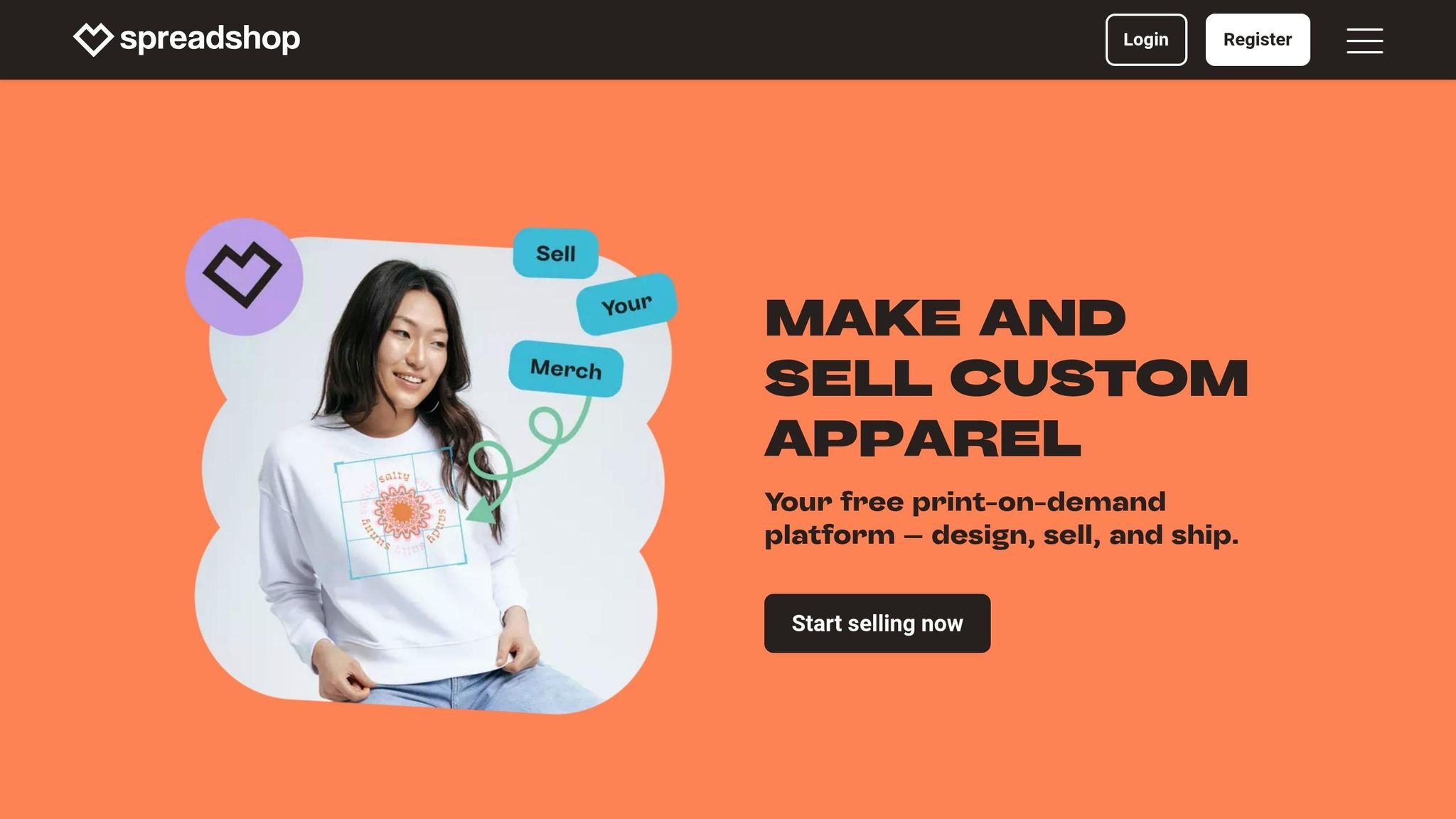
Spreadshop has been a steady player in the print-on-demand world for over two decades. It offers a free-to-use platform and comes with the flexibility to integrate with external marketplaces through its Spreadconnect plugin. All production is managed in-house at their Las Vegas facility, where orders are typically shipped within 48 hours.
Here’s a closer look at what Spreadshop brings to the table in terms of product options, integrations, and pricing.
Product Variety
Spreadshop boasts a catalog of over 300 customizable items. This includes everything from apparel and headwear to drinkware and accessories. Whether you're a creator looking for classic T-shirts or unique drinkware, there’s a solid range to choose from. They employ multiple printing methods, such as digital printing, embroidery for caps and hoodies, and thermosublimation for items like mugs. For those prioritizing eco-friendly options, Spreadshop offers sustainable materials like organic cotton and recycled polyester.
Integration Options
Spreadshop shines when it comes to social commerce. It provides direct connections to platforms like YouTube's Product Shelf, TikTok Shop, and Instagram and Facebook for tagging products in posts. For broader e-commerce needs, the Spreadconnect plugin links seamlessly with Shopify, WooCommerce, Etsy, Amazon, eBay, and Squarespace. Whether you prefer running an independent online store or integrating with these platforms, Spreadshop’s tools make it easy to manage inventory-free sales.
Pricing Model
The platform uses a simple pricing structure: Base Price + Margin = Retail Price. The base price covers production and printing, while you decide your profit margin. To sweeten the deal, a volume-based incentive reduces base prices as your sales increase. On average, creators can expect profit margins between 20% and 40%, giving plenty of room to tailor pricing strategies to your business goals.
Creator Royalties
Spreadshop allows creators full control over their earnings by letting them set their own retail prices. For example, if the base price of a T-shirt is $10 and you add a 30% margin, you’d make $3 in profit per sale.
Partner feedback has been positive. Modern Millie, who joined in 2022, shared:
"Not only was I selling more but my fans were way happier. It was higher quality product on a better looking website and way easier to manage".
Spreadshop also takes care of customer service and returns, so creators can focus entirely on designing and marketing their merchandise. Up next, we’ll dive into some of the platform’s strengths and areas for improvement.
6. Amazon Merch on Demand
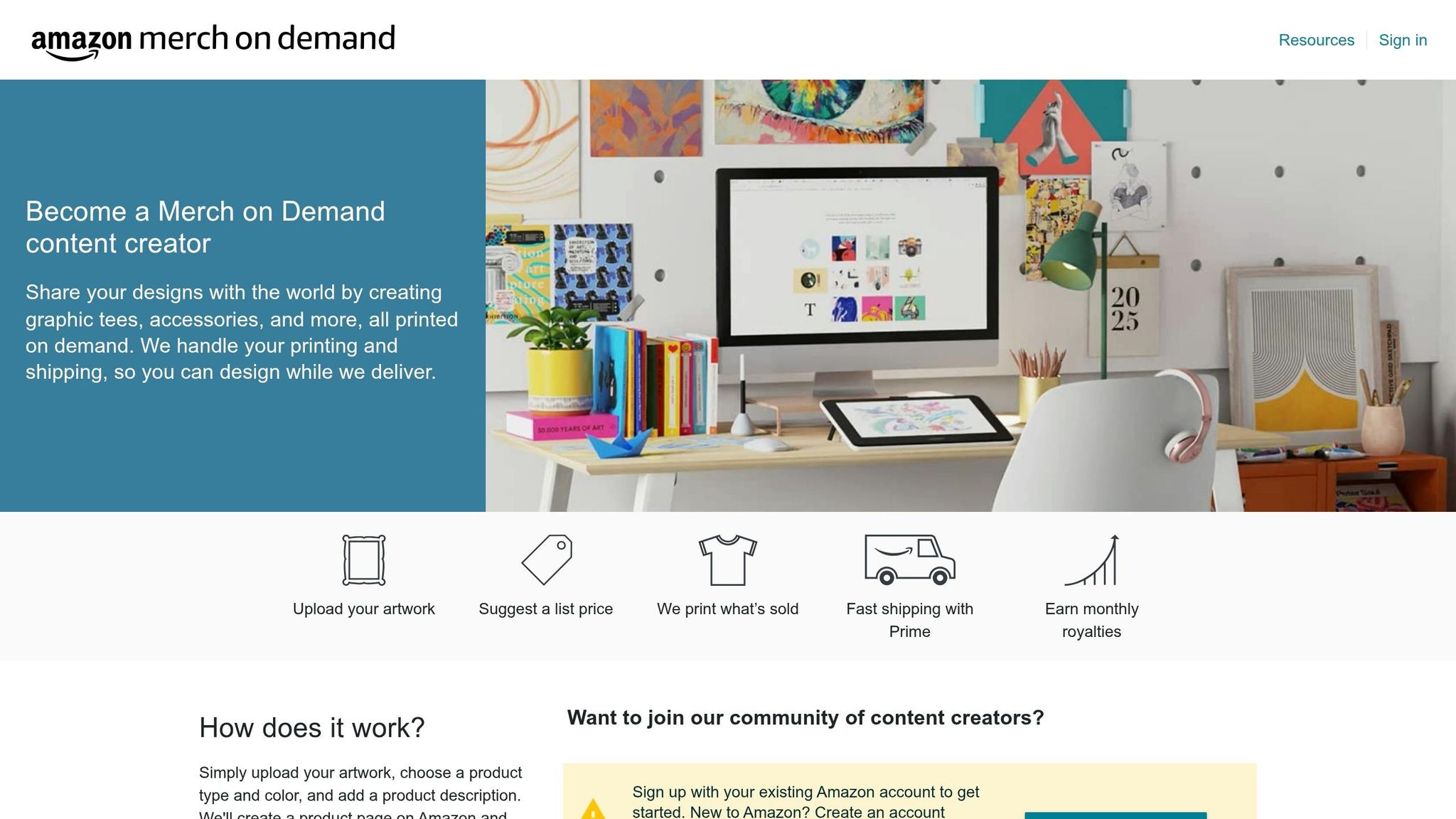
Amazon Merch on Demand keeps things simple for sellers by eliminating the hassle of inventory management. With Amazon taking care of printing, shipping, and customer service, sellers can avoid upfront costs and inventory risks. Plus, products qualify for Amazon Prime, offering free two-day shipping to Prime members - a big draw for customers.
Product Variety
The platform offers a focused selection of products, including standard, long-sleeve, and V-neck t-shirts, as well as hoodies, sweatshirts, phone cases, pillows, and tote bags. While the range is smaller compared to some competitors, this narrower lineup helps streamline creative decisions.
Integration Options
Amazon Merch on Demand works exclusively within the Amazon ecosystem but offers plenty of tools to help you promote your designs. For example, you can boost visibility using Amazon Ads to drive traffic within the marketplace. Additionally, you can easily share product links on social media platforms like Instagram, TikTok, and X (formerly Twitter).
If you’re managing sales across multiple platforms, tools like LitCommerce allow you to oversee Amazon listings alongside other channels like Etsy or eBay from a single dashboard. Since the service is non-exclusive, you’re free to sell the same designs on other platforms too.
Pricing Model
Joining and listing products on Amazon Merch on Demand comes with no upfront costs. Instead, Amazon uses a royalty system to calculate your earnings. After deducting material, production, fulfillment, and customer service costs, you receive the remaining amount as your royalty.
Here’s an example: A standard t-shirt priced at $19.99 earns a royalty of $4.89, while a $25.99 t-shirt brings in $9.32. Hoodies priced at $39.99 generate a royalty of $10.78. Keep in mind that extra features, like two-sided printing or premium-brand shirts, can lower royalties by $1.50 to $4.00.
| Product Type | List Price | Estimated Royalty |
|---|---|---|
| Standard T-Shirt | $19.99 | $4.89 |
| Standard T-Shirt | $25.99 | $9.32 |
| Long Sleeve T-Shirt | $22.99 | $3.81 |
| Pullover Hoodie | $31.99 | $5.01 |
| Pullover Hoodie | $39.99 | $10.78 |
Creator Royalties
Amazon uses a tier system that limits the number of designs new sellers can upload until they hit certain sales milestones. While this may seem restrictive, it encourages creators to focus on producing high-quality designs. Unlike platforms like Printful, Amazon Merch on Demand uses generic packaging without custom branding options.
For an extra revenue stream, you can join the Amazon Associates Program to create affiliate links for your merchandise, earning referral commissions on top of your royalties. Amazon also provides tools to analyze your sales, track best-selling designs, and monitor revenue trends.
Pros and Cons
Here's a quick breakdown of popular platforms for selling merch without inventory, focusing on product variety, profit margins, and delivery speed.
Printify stands out with a massive catalog of over 1,300 products. For US $29 per month, its Premium plan offers up to 20% discounts. Delivery times depend on the print provider you select from their network of 90+ global suppliers, typically ranging from 2 to 7 days.
Printful takes a different approach with a curated selection of about 491 products and in-house production, keeping its return rate impressively low at under 0.2%. Its Growth membership costs US $24.99 per month - or is free after reaching US $12,000 in annual sales - and provides discounts of up to 33% on select items. Delivery times are generally faster, ranging from 2 to 5 days, with over 1 million items fulfilled monthly.
Amazon Merch on Demand offers unparalleled exposure to millions of Prime customers, with 2-day shipping as a major perk. However, its royalty-based model often leads to slimmer profits. For instance, selling a t-shirt for US $19.99 might earn you just around US $5 in royalties. The product range is limited to basic apparel and a few accessories, and custom branding isn't an option.
Other platforms bring unique advantages to the table. SPOD excels in fast fulfillment, shipping over 95% of orders within 48 hours, and more than half within 24 hours.
Fourthwall simplifies operations by acting as the Merchant of Record, managing sales tax, VAT, and customer support. It charges a 5% fee on digital products and memberships.
Finally, Spreadshop is a beginner-friendly option with a core catalog of about 130 items and no monthly fees, making it a straightforward choice for those just starting out.
Conclusion
When it comes to picking the best platform for your merch business, it all boils down to your specific goals and where you are in your journey. If you're just starting out and don't have an established audience, marketplaces like Redbubble or Amazon Merch on Demand are ideal. They bring built-in traffic and require no upfront costs, making them perfect for beginners. Another beginner-friendly option is Spreadshop, thanks to its seamless social media integrations with platforms like YouTube and TikTok.
For creators who already have a steady stream of sales, platforms like Printful or Printify offer more control and better profit margins. Their paid plans - Printful Growth at $24.99/month and Printify Premium at $29/month - provide discounts that are especially valuable at higher sales volumes. As Christopher from Dog Ross Pet Painting shared:
"Printify Premium has helped my profit margins tremendously, and spending $20 a month has probably saved me over $200 a month".
An added bonus? These platforms let you collect customer email data, something that marketplaces typically don’t allow.
If branding is your top priority, look for platforms that offer custom packaging and white-label shipping. Both Fourthwall and Printful provide options like personalized labels, hang tags, and premium packaging. These features help reinforce your brand identity with every order your customers receive.
To start strong, focus on a small range of 3–5 products. This keeps things manageable and helps drive conversions. Always order samples to ensure quality before launching. And instead of just slapping your logo on everything, consider creating "identity merchandise" that reflects your values or resonates with inside jokes - this strategy has been shown to boost conversion rates.
The key is to experiment and see what connects with your audience while keeping financial risks low. By choosing a platform that aligns with your audience and brand goals, you’ll set the stage for sustainable growth and build a merch business that lasts.
FAQs
Which platform gives me the highest profit per sale?
Print-on-demand platforms generally provide profit margins ranging from 20% to 70%, influenced by the type of product and pricing approach. Margins tend to be higher for premium or specialized items, such as candles or other high-value goods. For instance, platforms like Printify and Printful often aim for margins between 20% and 40%, though certain premium products can push that figure up to 50% or even 70%. Prioritizing high-margin products and implementing smart pricing strategies can significantly boost the profit earned from each sale.
How do I choose the best print provider and shipping speed?
To find the right print provider and shipping option, here are some key factors to weigh:
- Shipping Speed: If quick delivery is a priority, platforms like Printful (with delivery times of 2–5 days) and Gelato are dependable choices.
- Product Quality: Printful stands out for its premium printing and branding services, while Gelato is known for its consistent quality and extensive global network.
- Costs and Margins: Printify offers the potential for higher profit margins, but be aware that shipping times can vary.
It's a good idea to check customer reviews and order samples to make sure your chosen provider aligns with your expectations.
Do I own the customer data and branding on each platform?
Most print-on-demand platforms keep a tight grip on customer data and branding. In practice, this means you usually won't have direct ownership over your customer relationships or the branding materials - those are handled entirely by the platform.
Related posts
LongStories is constantly evolving as it finds its product-market fit. Features, pricing, and offerings are continuously being refined and updated. The information in this blog post reflects our understanding at the time of writing. Please always check LongStories.ai for the latest information about our products, features, and pricing, or contact us directly for the most current details.