
Multi-Platform Affiliate Marketing with AI: Guide

Affiliate marketing has transformed with AI tools, making campaigns faster, smarter, and more effective. Here's the bottom line:
- 79.3% of affiliate marketers use AI to boost efficiency and results.
- AI reduces repetitive tasks like partner recruitment and link updates from hours to minutes.
- Businesses using automation report 129% more leads and 36% higher deal closure rates.
- The AI marketing industry reached $20.45 billion in 2024 and is growing by 25% annually.
Key steps to leverage AI in affiliate marketing:
- Choose AI tools for content creation, funnel management, and analytics.
- Automate workflows for tasks like content distribution and partner tracking.
- Create multi-platform campaigns tailored to platforms like YouTube, TikTok, and LinkedIn.
- Track performance using AI-driven attribution and server-side tracking.
- Scale revenue with data insights and predictive analytics.
AI tools like Jasper, LongStories.ai, and Systeme.io can help you save time, improve campaign performance, and increase revenue. For example, Yamazaki Home achieved a 15x ROI and 576% revenue growth in six months using AI-powered tools.
Start small, integrate the right tools, and focus on data-driven strategies to grow your affiliate marketing efforts.
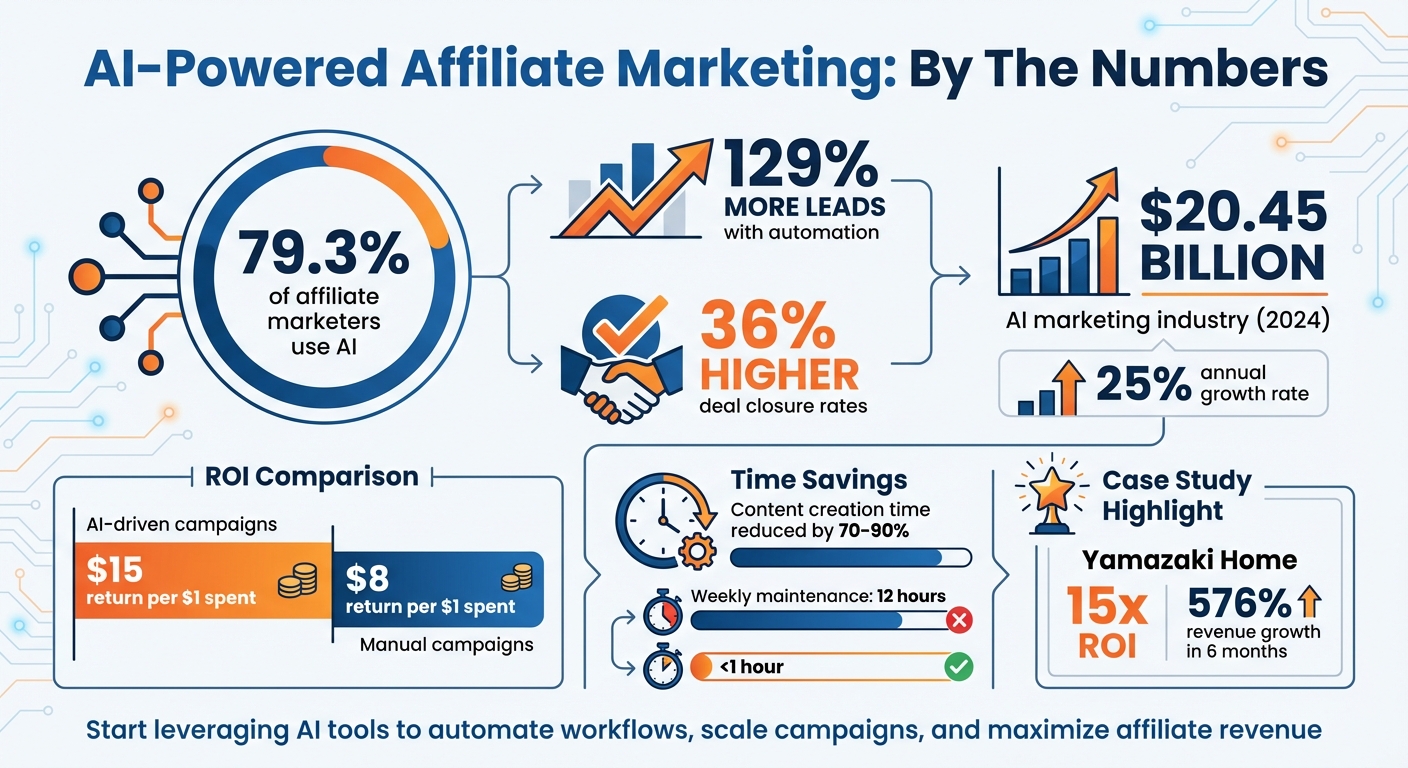
AI in Affiliate Marketing: Key Statistics and ROI Impact 2024
I Automated Affiliate Marketing Using AI Agent (Full $10K PM Setup Revealed)
sbb-itb-94859ad
Step 1: Select AI Tools for Affiliate Marketing
Using the right AI tools can dramatically streamline your affiliate marketing efforts. For example, they can reduce content creation time by 70–90% and boost click-through rates by 40% compared to manual methods. The key is to choose tools that fit your needs, whether that's content creation, funnel management, or finding the right partners.
AI Tools for Content Creation and Optimization
Start with AI tools that ensure your brand voice stays consistent across all platforms. Jasper ($49–$69/month) is a great option. It uses your existing content to mimic your tone in blogs, emails, and ads. For SEO, Surfer SEO ($89/month) analyzes top-ranking competitors and offers real-time keyword suggestions using natural language processing (NLP).
If you're venturing into faceless YouTube channels, LongStories.ai (https://longstories.ai) allows you to create "Universes" with recurring characters and voices. This is ideal for producing scalable, branded video content - perfect for product reviews and comparisons. Videos can be up to 10 minutes long and maintain consistent branding across uploads.
For multi-format content, Copy.ai ($29/month) can automatically repurpose long-form articles into social media posts, email campaigns, or video scripts. If you're focused on affiliate articles, Koala AI ($9/month) generates SEO-friendly product reviews with just one click. However, always double-check AI-generated specs and prices as these tools may sometimes provide outdated or incorrect details.
Once your content is in place, shift your attention to tools that simplify funnel management and program operations.
AI Tools for Funnel Building and Program Management
Systeme.io ($17/month, with a free plan for up to 2,000 contacts) is an all-in-one platform for landing pages, email automation, and affiliate program hosting. With it, you can launch a complete funnel in just a few hours. For partner-focused marketing, Tapfiliate offers AI-driven tools to create marketing materials for affiliates. This approach helped Optmyzr save eight weeks of implementation time while increasing affiliate sign-ups by 200% and improving conversion rates by 35%.
For larger operations, platforms like CJ Affiliate (starting at $15,000+) and impact.com provide advanced features like fraud detection across 50+ indicators and cross-channel attribution. Uber, for instance, used impact.com's PostTap solution to recover attribution data lost due to iOS 14 privacy changes. The result? 2x revenue growth and restored tracking accuracy.
Once your funnels are optimized, you can turn to AI tools that specialize in partner discovery and analytics to refine your campaigns further.
AI Tools for Partner Discovery and Analytics
Lindy ($49.99/month) acts as a virtual assistant, automating partner discovery, standardizing metrics across platforms, and keeping your CRM updated. In 2025, Yamazaki Home used impact.com's AI tools to categorize and activate top-performing partners based on data like Average Order Value (AOV) and Customer Lifetime Value (LTV). This approach led to a 250% increase in active publishers within six months.
Similarly, PartnerStack helped Genesys save over 120 hours monthly on routine tasks and cut partner recruitment time by 50% using AI-driven lookalike modeling. Instead of focusing on follower counts, these tools analyze intent and audience overlap - key factors that actually predict conversions. By integrating these partner discovery tools with your content and funnel management systems, you can create a seamless, data-driven affiliate marketing strategy.
Step 2: Automate Affiliate Marketing Workflows
After choosing your AI tools, it’s time to tackle those repetitive tasks that eat up your time. Did you know businesses using automation see 129% more leads and close 36% more deals in their first year? The idea here is simple: let AI handle the heavy lifting so you can focus on strategy and creativity. One area where automation shines is in content distribution, which can dramatically boost efficiency.
Automate Content Distribution
AI-powered distribution systems link all your platforms to a central hub. Instead of manually posting on platforms like YouTube, Instagram, LinkedIn, and your blog, you can create one core piece of content and let AI adapt it for each platform. For instance, a single long-form blog post can be transformed into LinkedIn articles, X threads, or Instagram carousels - each tailored to the platform’s style and audience. On top of that, AI can schedule posts at optimal times, increasing engagement by an average of 23% compared to manual scheduling.
Tools such as Distribution AI (15-day free trial) simplify this process even further. They repurpose content while maintaining your brand’s tone using features like automated tone scoring and image compliance filters. For example, one marketing team managing five brands cut their weekly distribution workload from 40+ hours to just 8–10 hours by automating these workflows.
You can also set up automated triggers to cross-promote posts when specific engagement levels are reached. That said, keeping 20–30% of your posts manual is a smart move - it allows you to stay agile and respond to trends in real time. As InfluenceFlow puts it:
"Automation handles distribution and timing - you still create authentic, high-quality content".
Use AI APIs for Workflow Integration
On top of automating content distribution, you can use AI APIs to integrate video production directly into your workflows. If you’re producing videos at scale, tools like LongStories.ai (https://longstories.ai) offer API access that connects automated video production to platforms like Zapier or n8n. This is especially helpful for affiliate marketers managing faceless YouTube channels or bulk product reviews. For example, you could set up a workflow where a new product in your affiliate dashboard triggers the creation of a review video. That video could then be rendered, scheduled for YouTube, and adapted into shorter clips for Instagram Reels and TikTok.
Automating these steps ensures consistent posting across platforms and eliminates the hassle of manual uploads. Imagine a system where a blog post goes live, and within minutes, related videos and social media posts are automatically created and scheduled. This approach not only saves time but also enables scalable, multi-platform campaigns.
Before diving in, make sure to check your API’s rate limits and batching capabilities. Start small - focus on one impactful task, like video ads or email campaigns, for a couple of weeks to measure results. Once you’ve validated the metrics, you can confidently expand your efforts.
Step 3: Build and Deploy Multi-Platform Campaigns
Now that your automated workflows are in place, it’s time to create content tailored for each platform. This step is all about aligning your content with the strengths of each channel to drive better conversions. For example, B2B SaaS and AI tools often see higher conversion rates on platforms like YouTube and LinkedIn, ranging from 3% to 10%. Meanwhile, consumer-facing apps tend to perform better on TikTok and Instagram, with conversion rates typically between 1% and 4%. Getting this alignment right could be the difference between earning $200 a month and $5,000 a month.
Use LongStories.ai for Video Content
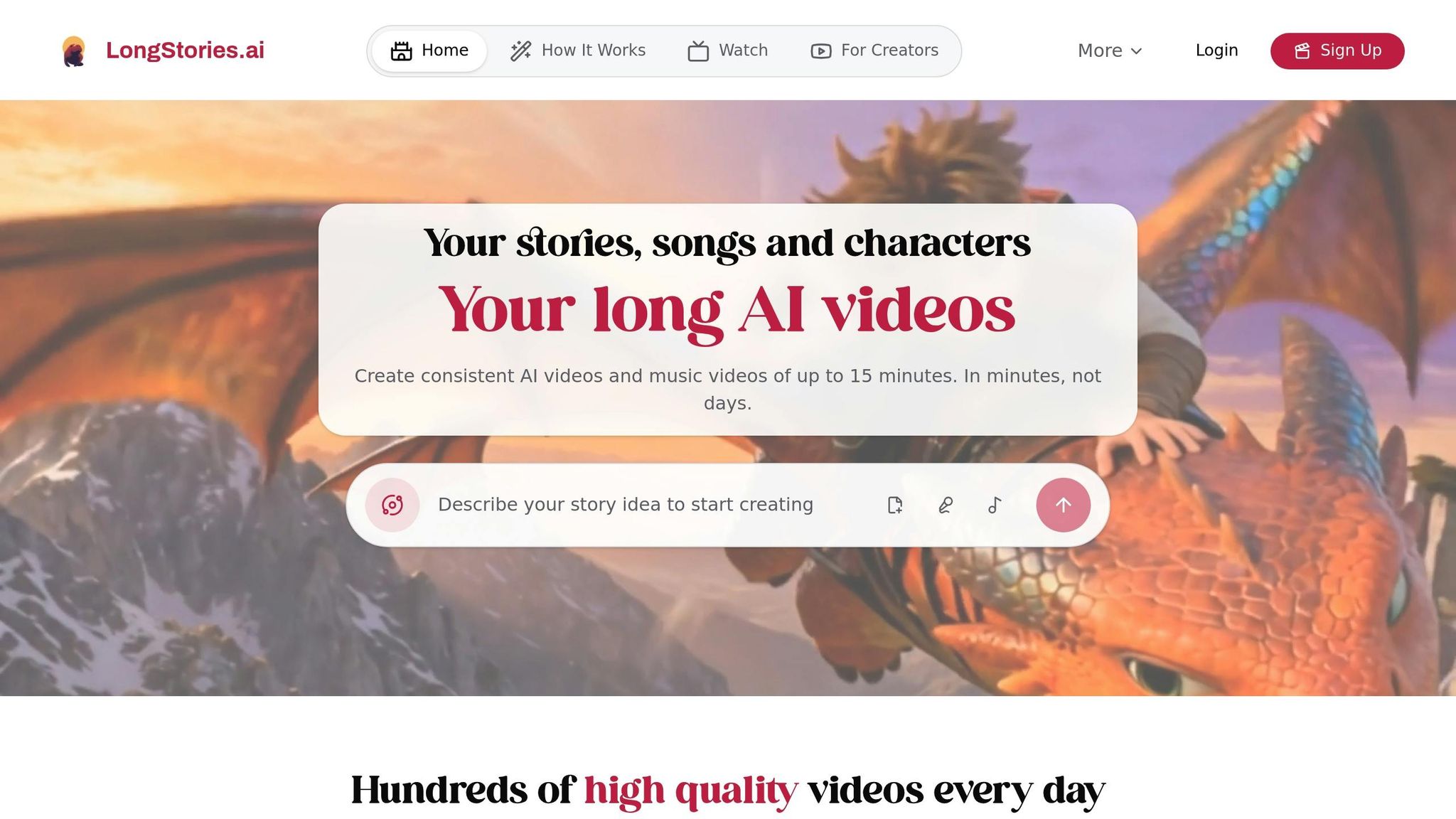
If you’re managing faceless YouTube channels or producing bulk product reviews, LongStories.ai (https://longstories.ai) can help you maintain consistent branding across all your videos. The platform uses “Universes” to standardize characters, styles, and voices, making it easy to create unlimited videos - up to 10 minutes long - that comply with YouTube’s monetization standards. Unlike generic AI tools, this approach avoids repetitive, cookie-cutter content.
For affiliate marketers, this is a game-changer. You can produce a steady stream of product reviews or tutorials without needing animators or voice actors. LongStories.ai offers three levels of animation quality: No Animation, Fast Animation, and Pro Animation. With API access and bulk editing tools, you can automate the creation of new review videos whenever a high-commission product is added to your affiliate dashboard. Pricing starts at just $9 per month, and a 400-credit free trial makes it accessible even for beginners.
Once you’ve established visually consistent video content, you can focus on repurposing and expanding it for other platforms.
Expand Content Reach Across Platforms
With your video production automated, you can repurpose that content to maximize its reach. Tools like Jasper ($69/month) or eesel AI can transform a YouTube video script into platform-specific formats while keeping your brand voice intact. For instance, eesel AI was able to generate over 1,000 optimized articles from single keywords between late 2025 and early 2026, skyrocketing daily impressions from 700 to over 750,000 in just three months.
To keep your audience engaged, follow the 80/20 rule: 80% of your posts should deliver value, such as tutorials, case studies, or honest reviews, while only 20% should focus on direct promotion. Tailor your content for each platform: use trending audio and attention-grabbing “POV” hooks within the first two seconds on TikTok, or break complex ideas into 5–10 easily digestible slides for LinkedIn carousels. On YouTube, place your main affiliate link in the first two lines of your description and pin it in the comments - pinned comments can get up to 5× more clicks than the description alone.
Step 4: Track Performance and Personalize Campaigns
Track Conversions Across Platforms with AI
After your content goes live, it’s crucial to figure out which platforms are actually driving revenue. This is where AI-driven algorithmic attribution comes into play. By leveraging machine learning, this method analyzes your conversion history and assigns credit based on the true impact of each channel - not just the last one a user clicked. Why does this matter? Businesses using multi-touch attribution (MTA) report an average 20% to 30% boost in ROI compared to those relying on outdated last-click models. Looking ahead, it’s estimated that by 2026, over 70% of marketing decisions will be influenced by AI-driven attribution.
But there’s a catch: browser restrictions, like Safari's Intelligent Tracking Prevention (ITP), are making it harder to collect conversion data. The solution? Server-side tracking (SST). This method sends data directly between servers, bypassing browser cookies altogether. Using SST can recover up to 30.67% of purchase conversion signals. To get started, set up your SST container on a first-party subdomain (e.g., sgtm.yourdomain.com), which extends cookie durations beyond Safari’s 7-day limit.
Another challenge is tracking users across devices. Since 90% of consumers begin a task on one device and finish it on another, cross-device tracking is essential. Tools like Rockerbox (starting at $500/month) and Wicked Reports (starting at $700/month) use fingerprinting technology to recognize users across smartphones, tablets, and desktops. Some tools even include AI page validation, which scans for issues like broken tracking links or missing pixels before you launch - think of it as a spell-check for your campaigns.
Once you’ve identified which platforms are driving sales, you can fine-tune your campaigns to maximize engagement and revenue.
Personalize User Journeys with AI
After setting up conversion tracking, the next step is to create a tailored experience for your audience. AI-powered recommendation engines can analyze user behavior in real time to suggest personalized affiliate offers. Meanwhile, behavioral segmentation groups audiences dynamically based on factors like engagement level, device type, and traffic source, allowing you to rotate offers automatically. For instance, a home-fitness brand linked Hyros with their Shopify store and used AI to rank visitors by their likelihood to purchase. By focusing ad spend on high-intent buyers, they boosted conversions by 19% in just four weeks.
You can also customize experiences based on user preferences. For example, mobile visitors might see app-based products, while desktop users are shown software subscriptions. Tools like Manychat simplify this process by using AI chatbots to engage leads on platforms like Instagram and WhatsApp, answering questions around the clock. Personalized creatives can double click-through rates, and AI-generated video content has been shown to increase purchase intent by 200% compared to static images.
Step 5: Analyze Performance and Scale Revenue
Compare AI Tools for Affiliate Campaigns
Once you've set up personalized tracking and analytics, it's time to evaluate AI tools that can help scale your revenue. These platforms vary widely in features and target audiences, so choosing the right one depends on your business size and goals. For mid-sized businesses, Tapfiliate offers a starting price of $79/month, with generative AI capabilities to automatically create marketing materials. On the other hand, PartnerStack focuses on recurring revenue models, featuring AI-powered partner matching, with a median contract value of around $18,923.
For enterprises, the stakes - and costs - are higher. CJ Affiliate starts at $15,000+ per month and includes fraud detection across 50+ indicators in real time. Meanwhile, impact.com supports dynamic payouts that adjust commissions based on over 100 variables. However, first-year costs for impact.com often exceed $100,000.
One major advantage of AI tools over traditional affiliate platforms is their ability to provide real-time, multi-touch attribution. This shift from analyzing past performance to predicting future outcomes is a game-changer. AI-driven campaigns, on average, deliver a return of $15 for every $1 spent, compared to just $8 for campaigns managed manually.
Scale Revenue with Data-Driven Insights
After selecting the right tools, focus on scaling revenue by leveraging data-driven strategies. Use performance insights to replicate your most successful campaigns and amplify growth. Centralizing data streams with platforms like Voluum or AnyTrack can help prevent up to 40% of attribution loss caused by privacy restrictions.
Predictive analytics can also play a key role in optimizing your budget allocation. For example, Uber used impact.com's PostTap solution to recover lost attribution data due to iOS 14 restrictions. This resulted in a 2× revenue increase in just 90 days through privacy-compliant deep linking and dynamic routing. Similarly, Excel Impact achieved 230% revenue growth with Everflow’s dimensional analytics and fraud detection, monitoring over 50 fraud indicators in real time.
Automated triggers are another powerful tool. For instance, set rules to pause campaigns when CPA rises by 10% or increase budgets when ROAS exceeds 200%. As AFFiNCO aptly states:
"The manual era is dead. If you are still guessing, you are losing money".
Lastly, optimize your campaigns by feeding lead quality scores from your CRM back into your affiliate tracker. This allows you to reward partners who deliver high-value customers, not just high volumes, creating a feedback loop that drives profit-focused growth.
Conclusion
AI has reshaped affiliate marketing by simplifying operations and driving higher revenue. For instance, AI automation can reduce weekly maintenance time from 12 hours to less than one, delivering an impressive $15 return for every $1 spent - far surpassing the $8 return seen with traditional methods. With 79.3% of affiliate marketers already incorporating AI, adopting these tools has become a necessity to stay ahead.
Selecting the right AI tools is key. Platforms like Jasper, Systeme.io, and LongStories.ai can streamline tasks such as content creation, funnel management, and video production - all while maintaining your brand's unique identity.
The benefits of seamless AI integration are clear: automation can result in 129% more leads and a 36% increase in closed deals. As highlighted in earlier case studies, implementing AI effectively not only saves time but also drives significant revenue growth. Start by automating essential tasks like creating content briefs, generating reports, and managing follow-ups. Using open API platforms can help eliminate data silos and ensure smoother workflows. Use these strategies to fine-tune your multi-platform approach and achieve consistent growth.
FAQs
Which AI tools should I start with?
To get started with AI tools for multi-platform affiliate marketing, prioritize platforms that make tasks like content creation, automation, and analytics easier. For example, Zeely AI is great for simplifying ad creation and managing campaigns. If you're looking to produce scalable, high-quality video content, tools like InVideo AI and UTubeKit are excellent options. On the affiliate management side, platforms such as impact.com and CJ Affiliate offer features like automation and fraud protection. By combining these tools, you can build a strong foundation for running and optimizing your campaigns efficiently.
How do I track affiliate conversions across platforms?
To monitor affiliate conversions effectively across different platforms, it's essential to use a tracking system that captures user activity from the initial click to the final conversion. Here’s how you can do it:
- Use specialized tracking tools: Platforms like Voluum or Post Affiliate Pro are designed to handle multi-platform tracking seamlessly.
- Set up postback URLs or tracking pixels: These tools help record and report user actions, such as clicks, sign-ups, or purchases.
- Utilize UTM parameters: Adding UTM tags to your links helps identify the exact traffic sources driving conversions.
- Integrate with affiliate networks: Configure postback URLs or webhooks to sync with your affiliate network for real-time data sharing.
- Maintain consistent tracking IDs: This ensures accurate attribution and avoids data discrepancies across platforms.
By following these steps, you can gain clear insights into your affiliate performance and optimize your campaigns effectively.
How can I scale without losing quality or trust?
To expand affiliate marketing efforts while keeping quality and trust intact, leverage AI tools to simplify tasks like content creation, campaign management, and automation. Prioritize creating platform-specific content that delivers real value - think tutorials, product reviews, or how-to guides. Always disclose affiliate relationships to remain transparent and build credibility.
AI can also help tailor outreach efforts and maintain consistent content quality as your reach grows. By blending automation with thoughtful oversight, you can scale your efforts without losing the authenticity and trust that drive long-term success.
Related posts
LongStories is constantly evolving as it finds its product-market fit. Features, pricing, and offerings are continuously being refined and updated. The information in this blog post reflects our understanding at the time of writing. Please always check LongStories.ai for the latest information about our products, features, and pricing, or contact us directly for the most current details.