
Subscription Models for Serialized Video Content
Serialized video content is reshaping how creators earn steady income. Unlike standalone videos, serialized formats encourage regular audience engagement by releasing episodes on a set schedule. This model is proving effective, with in-app revenue for micro-series projected to reach $7.8 billion by 2026, doubling from 2025. Platforms like YouTube, Wattpad, and Substack are driving this shift by offering tools for creators to monetize serialized content while retaining audiences.
Key takeaways:
- YouTube creators benefit from ad revenue and memberships by producing long-form serialized videos.
- Wattpad thrives on episodic storytelling, using a freemium model with micro-transactions to support authors.
- Substack combines video, audio, and text, helping creators monetize directly through subscriptions.
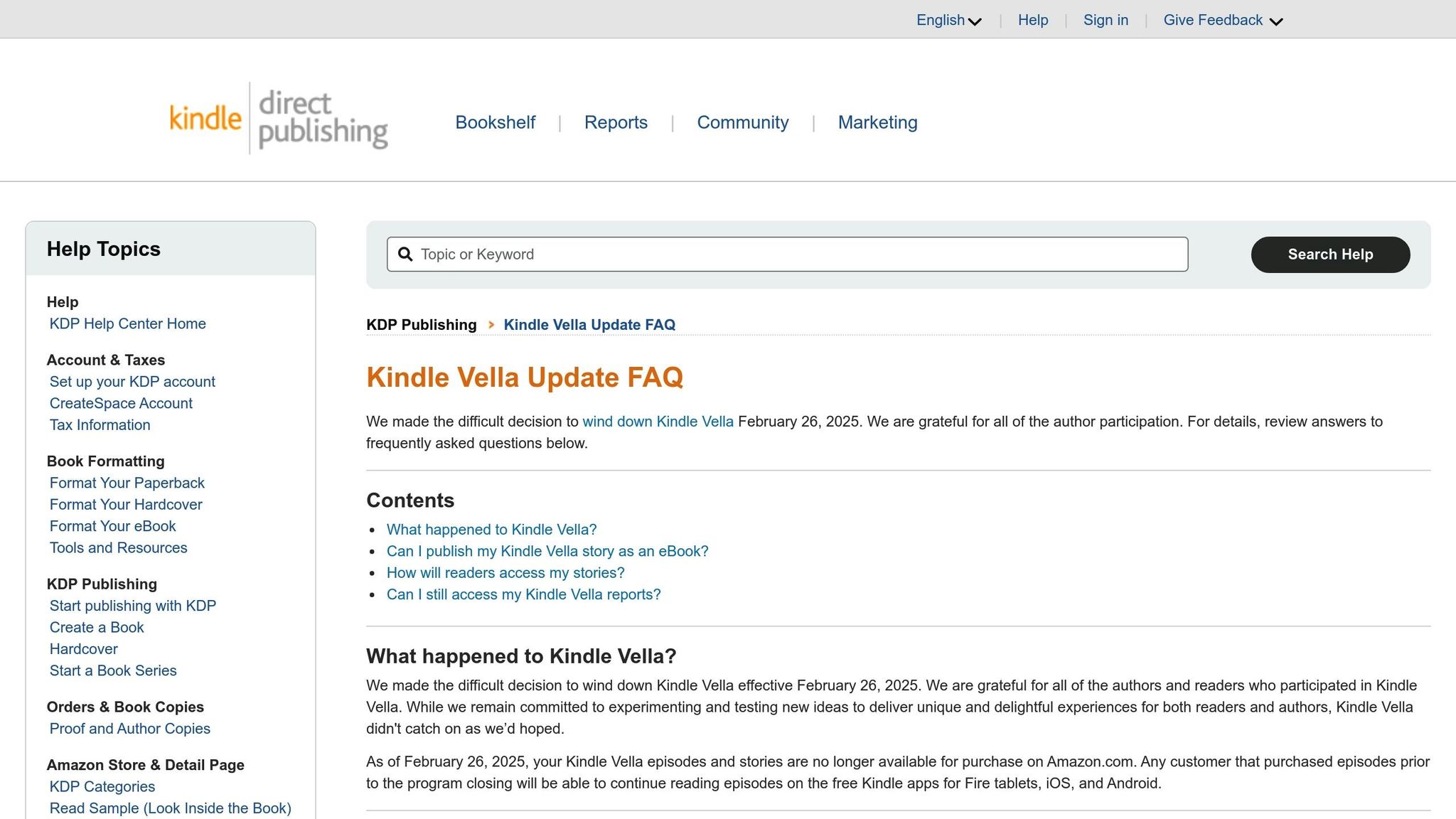
- Kindle Vella (shut down in 2025) offered pay-per-episode royalties but struggled with reader retention.
Serialized content builds predictable viewing habits and reduces churn, which is essential for subscription-based models. Creators are increasingly adopting hybrid strategies - using short-form content for discovery and long-form or subscription platforms for stable income. The right platform depends on your goals: audience growth or reliable revenue streams.
1. LongStories.ai
Content Format
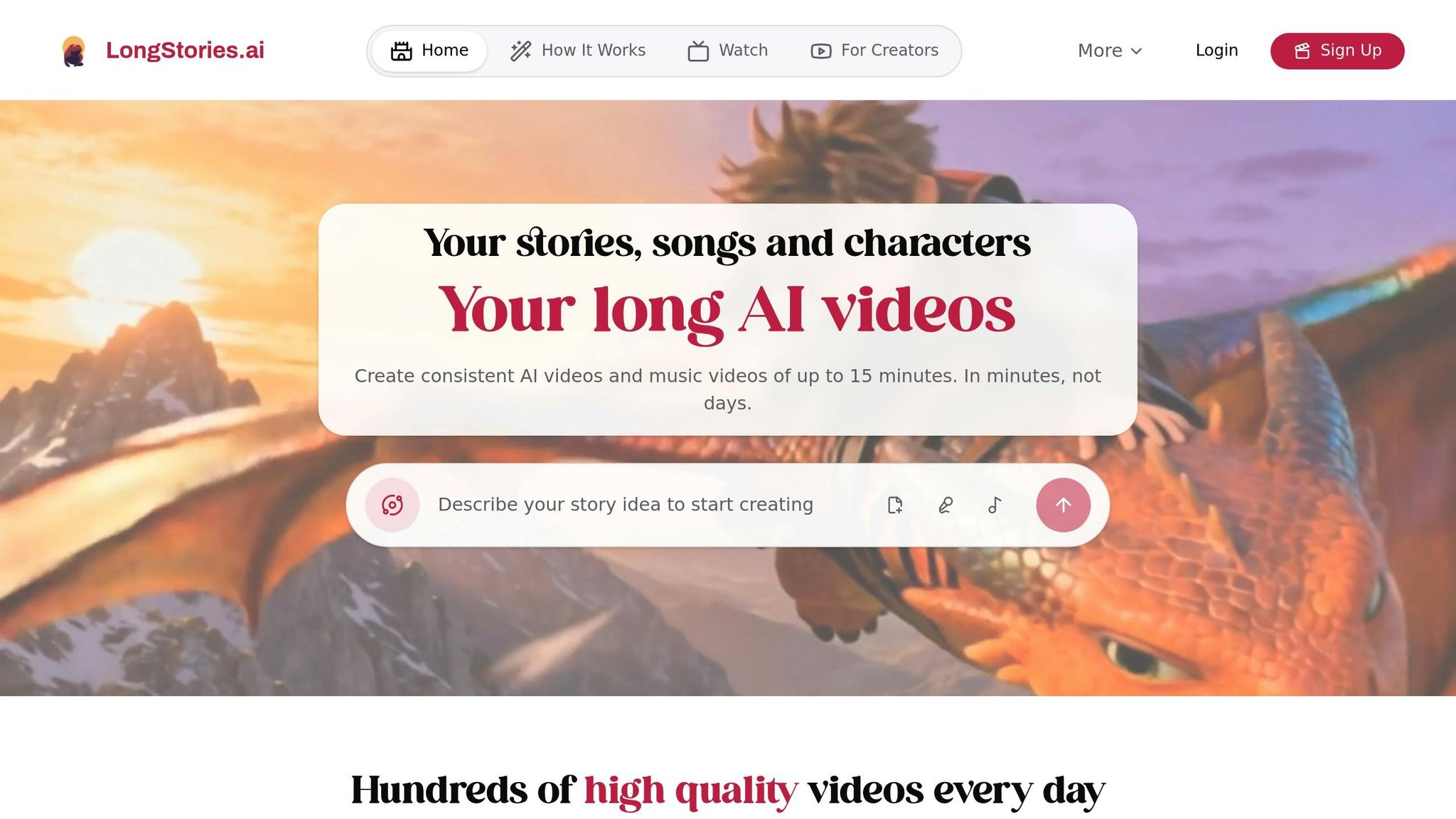
LongStories.ai specializes in creating long-form videos, particularly those around 10 minutes long, which aligns perfectly with YouTube's monetization requirements. A standout feature is the ability to build reusable "Universes." This means creators can define key branding elements just once and then generate multiple videos with consistent branding - no need to reconfigure settings or prompts for every new episode. This makes it especially useful for serialized content, offering a streamlined production process.
The platform provides three animation quality options to suit different needs: No Animation (static visuals paired with voiceovers), Fast Animation (basic motion graphics), and Pro Animation (full character animations). This flexibility lets creators strike a balance between production speed and visual appeal based on their audience's preferences and release schedules.
Production Scalability
LongStories.ai removes traditional bottlenecks like hiring animators, voice actors, and editors by automating much of the production process. Its tools, including bulk editing and API access, allow creators to manage and refine multiple episodes at once without needing a larger team.
Videos can be generated from text prompts in just 2 minutes. The platform also offers AI-powered voice cloning, which helps creators overcome language and accent challenges, making their content more accessible to global audiences. By shortening production times and automating complex tasks, LongStories.ai makes high-volume content creation both faster and more efficient.
Monetization
The platform’s pricing starts at $9 per month for the Starter Plan and goes up to $99 per month for the Studio Plan. To help new users explore its features, it offers 400 credits for testing. Compared to hiring freelance animators or professional voice talent, the cost-per-video model becomes a much more budget-friendly option for creators who regularly produce serialized content.
YouTube videos longer than 8 minutes qualify for mid-roll ads, which generate more revenue than pre-roll ads. LongStories.ai enables creators to consistently produce 10-minute episodes, meeting these monetization standards. Beyond ad revenue, the platform also supports opportunities like subscription video on demand (SVOD) through channel memberships. By helping creators maximize advertising income and explore subscriber-based revenue models, LongStories.ai proves to be a powerful tool for monetizing serialized content.
2. Wattpad
Content Format
Wattpad has made a name for itself as a hub for serialized, text-based storytelling. With a staggering 90 million monthly users, the platform thrives on episodic chapters that keep readers coming back for more. Writers release their stories in installments, creating a binge-worthy experience. Some of these serialized hits even make their way to Hollywood. For instance, the After series, which started on Wattpad, has racked up over a billion reads and transformed into a full-blown film franchise. Similarly, The Kissing Booth found its way to Netflix as a popular movie series. This chapter-by-chapter format fuels reader engagement and opens doors for creative retention strategies.
Audience Retention
In October 2023, Wattpad introduced "Wattpad Originals", featuring over 1,600 titles. This freemium model uses a clever "wait-to-read" system: readers can either pay to unlock chapters instantly or wait about a week to access them for free. To keep things enticing, only the latest ten chapters are locked behind a paywall, encouraging fans to stay engaged while creating opportunities for stories to gain viral momentum.
Nick Uskoski, Wattpad's Head of Content and Creator Development, explained the challenges of balancing monetization with growth:
"Paid Stories paid out millions to authors, but it also meant slower story growth. It was harder for a story to go viral or suddenly pick up new readers at the same rate as a free story."
To ensure the best-performing content rises to the top, the platform's editorial team uses reader engagement data to curate "Originals", focusing on stories with proven audience appeal.
Production Scalability
Wattpad equips authors with tools to streamline their creative process. The Publishing Scheduler Tool allows writers to plan and schedule chapter releases, maintaining a consistent publishing rhythm. For those looking to sharpen their skills, "Story School" offers resources on writing and platform strategies. Meanwhile, the Creator Program provides editorial guidance, specialized workshops, and a dedicated Discord community for networking and support. Between 2018 and 2023, Wattpad paid nearly $10 million to authors through this program, with top creators earning significant stipends.
Monetization
Wattpad Premium+ is available for $7.49 per month, giving subscribers an ad-free reading experience plus bonus coins to unlock chapters. The platform's freemium model drives revenue through micro-transactions, such as direct coin purchases, and through stipends for creators. Unlike video platforms that lean heavily on ad revenue tied to watch time, Wattpad's approach centers on reader engagement and small-scale purchases, making it a unique player in the digital content space.
3. Kindle Vella
Content Format
Kindle Vella, like other serialization platforms, had its own distinct approach to monetization before shutting down on February 26, 2025. The platform offered serialized text stories, with episodes ranging from 600 to 6,000 words. Instead of using a subscription model, readers purchased "Tokens", an in-app currency, to unlock episodes. The cost was set at 1 token per 100 words. To help readers get invested in a story, the first 10 episodes of every series were free. These choices defined how Kindle Vella structured its monetization.
Monetization
Kindle Vella's pay-per-episode system gave authors 50% royalties on token purchases. For example, a 3,000-word episode priced at 30 tokens (around $0.30) earned the author $0.15. Token bundles were available at different price points, starting at 100 tokens for $0.99 and going up to 2,000 tokens for $16.79. Additionally, Amazon offered a monthly bonus pool based on engagement metrics like "faves" and "thumbs up", though the exact payout formula wasn’t disclosed. It’s worth noting that this 50% royalty rate was lower than the 70% royalty authors could earn through Kindle Direct Publishing for eBooks. This revenue model pushed authors to develop strategies to maximize reader engagement.
Audience Retention
To keep readers hooked, Kindle Vella introduced gamified elements like weekly "faves." Each reader could vote for one favorite active story per week, and the top 250 most-faved stories received a crown icon for increased visibility. Authors could also include personal notes at the end of episodes to hint at upcoming content or explain how the token system worked, as the platform itself offered limited guidance for readers. However, Kindle Vella lacked a robust comment section and was only accessible through mobile apps - not on Kindle e-readers. These limitations made it harder to build a strong community compared to platforms like Wattpad.
Production Scalability
Kindle Vella allowed authors to schedule episodes up to a year in advance, ensuring a steady release schedule. Writers managed their serialized content through their existing Kindle Direct Publishing (KDP) accounts, with Amazon recommending Kindle Create for formatting episodes. Authors could also republish content from other platforms, provided it wasn’t available for free elsewhere. After the platform’s closure, Amazon encouraged creators to compile their episodes into full-length eBooks for distribution through the standard Kindle store.
4. Substack
Content Format
Substack supports high-quality 1080p/2K video in formats like MP4, H.264, and AAC. It combines video, audio, and text into a smooth, episodic experience that keeps everything in one place. The inline player is a standout feature - it lets subscribers read and watch at the same time without losing their spot. Plus, show homepages include interactive transcripts, which make it easy to search for keywords and jump to exact timestamps. This multimedia approach creates a strong setup for creators to experiment with different revenue models.
Monetization
Substack charges a 10% fee on paid transactions, along with standard Stripe fees. However, creators can publish videos for free if they choose not to enable subscriptions. Its flexible paywall system allows creators to offer free previews before prompting users to pay. As of April 2024, podcasters on Substack are earning over $100 million annually, and creators using audio or video see their revenue grow 2.5 times faster than those who don’t. For instance, the sports podcast Split Zone Duo moved from Patreon to Substack in early 2024 to streamline its free and paid feeds. Within six months, the podcast experienced major growth. These monetization options work hand-in-hand with Substack's tools for engaging audiences.
Audience Retention
Substack focuses on helping creators own their audience relationships through email and its app, reducing reliance on unpredictable social media algorithms. The dedicated mobile app boosts engagement significantly - users log in 63% more often than those on the web and retain 23% more subscribers after a year. Active engagement with subscribers also makes a big difference, cutting subscriber churn in half. Additionally, the Substack Network generates over 50% of new subscriptions. Creators like Cody Alexander of MatchQuarters use Substack’s video clipping tool to create branded social media content, drawing in new listeners from platforms like X (formerly Twitter).
Production Scalability
Substack offers creators tools like interactive transcripts, social media clipping, and seamless syncing with Spotify to make content production more efficient. Creators can sync both free and paid podcast episodes directly to Spotify while maintaining their subscription model - and they keep 90% of their revenue (minus Stripe fees). This is a big advantage over Spotify’s typically lower per-stream payouts. The platform’s appeal is evident: the number of active podcasters on Substack more than doubled between 2023 and 2024, showing its growing popularity among serialized content creators.
sbb-itb-94859ad
How to Sell Videos With The Subscription Model (with examples!)
Platform Comparison: Strengths and Weaknesses
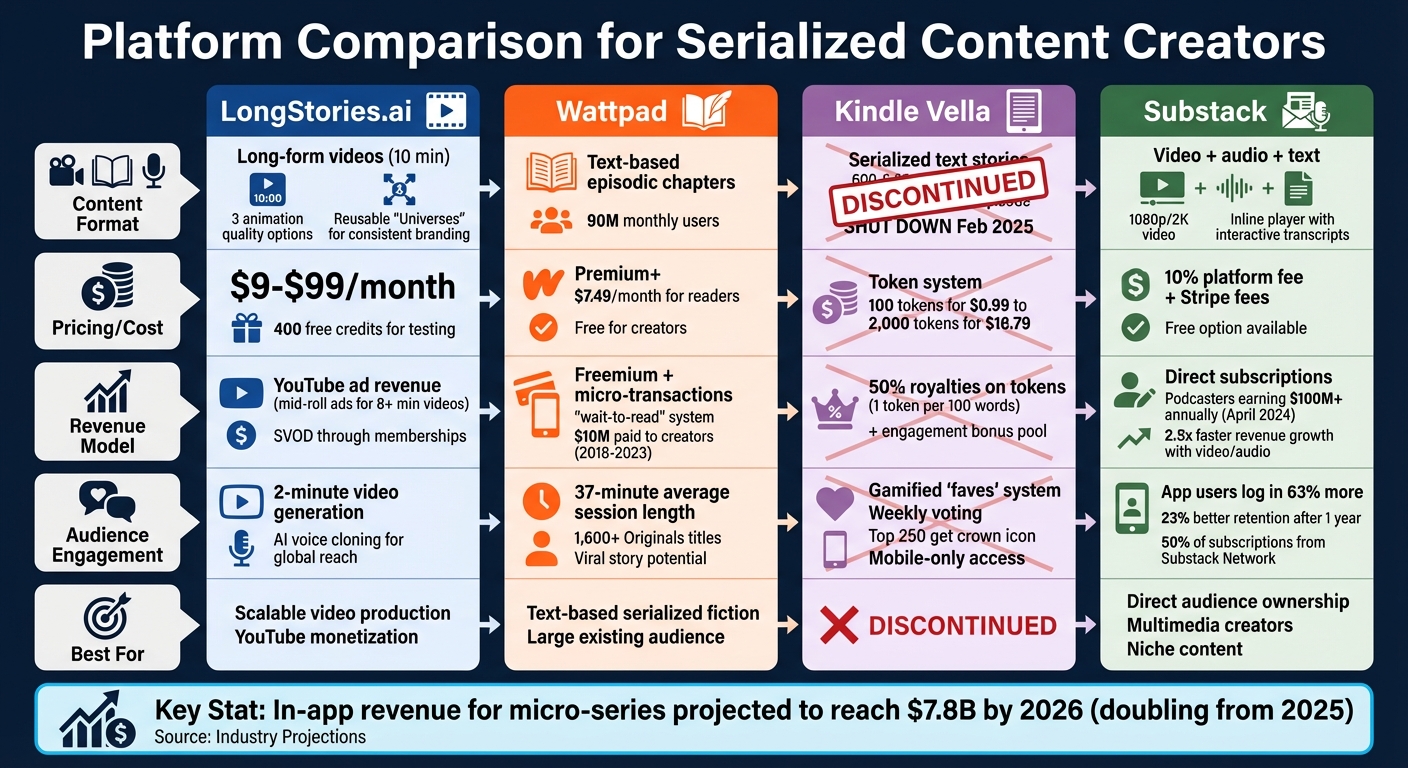
Serialized Video Content Platform Comparison: Features, Pricing, and Revenue Models
When choosing a platform, it's important to weigh factors like revenue potential, audience engagement, ease of production, and scalability. Each platform has its own set of advantages, so creators need to prioritize based on their goals. Here's a closer look at what each platform offers and where trade-offs come into play.
LongStories.ai is a strong option for creators looking to scale their production of long-form videos (up to 10 minutes). It shines in maintaining consistent characters and branding, with subscription costs ranging from $9 to $99 monthly. Its automated tools make it easier to meet YouTube's monetization criteria. However, creators must manage their own distribution and audience growth, unlike platforms that integrate discovery features into their ecosystem.
Revenue models vary widely depending on the platform. Long-form YouTube videos tend to deliver higher RPMs than Shorts, while platforms like Substack offer lucrative opportunities for niche creators through direct subscription models. On average, global subscription video-on-demand users spend $78.97 annually. Meanwhile, platforms like Wattpad and Kindle Vella use micro-payment systems, where users pay per chapter - a model tailored for written content.
Audience engagement also differs significantly by platform. Substack's mobile app users log in 63% more frequently and retain 23% more subscriptions after a year compared to web-only users. Wattpad, with its 80 million users, boasts an impressive average session length of 37 minutes, showing its ability to hold attention. On the other hand, YouTube Shorts generate a staggering 200 billion daily views but offer a lower revenue share for creators - 45% from a pooled model versus 55% for long-form videos.
Another critical factor is the trade-off between discovery and control. Platforms like YouTube offer algorithmic reach, helping creators connect with non-subscribers. In contrast, platforms like Substack give creators full ownership of their audience but require external marketing to attract new readers. As MrBeast aptly put it:
"If you get a billion views on TikTok, that's like $1,000. If you get a billion views here on YouTube, that could literally make you $100,000".
For creators producing serialized content, hybrid strategies are becoming increasingly popular. Many use platforms like Shorts to attract new audiences and then guide them toward long-form subscriptions for consistent revenue. This approach balances discovery with audience loyalty, offering a sustainable way to grow over time.
Conclusion
Choosing the right platform boils down to your priorities: do you want faster audience growth or more reliable income? For discovery, YouTube Shorts and TikTok stand out - an impressive 74% of YouTube Shorts views come from non-subscribers. But when it comes to steady income, long-form videos are the clear winner, offering $3–$5 RPM compared to Shorts' $0.05–$0.20 RPM. That’s up to 30 times more revenue. This gap highlights why a hybrid funnel strategy is so effective.
Looking ahead to 2026, the smartest move combines short-form content to grab attention and long-form or subscription-based platforms to build deeper connections. As Kurzgesagt wisely stated:
"It is critically important to become independent from ads…money from YouTube alone is not enough if you want to sleep well at night".
This approach offers the best of both worlds: leveraging algorithms for reach while creating direct relationships for predictable income.
Tools like LongStories.ai (priced between $9 and $99 per month) help creators produce polished long-form videos at scale, ensuring consistency to meet algorithm demands. For those working with fewer resources, remember this: 1,000 true fans paying $5 monthly can generate $60,000 annually. Compare that to relying on ads, where you’d need 500,000 monthly YouTube views to earn the same amount.
Whether you lean toward platforms like Substack for direct control or YouTube for its broad reach - or a mix of both - the secret is building a system that balances growth with financial stability. Start where your audience is most active, and guide them toward subscription channels you control.
FAQs
How do subscription models help video creators achieve more stable income?
Subscription models offer video creators a steady and predictable income, allowing them to plan their finances with greater confidence. Unlike one-time purchases or fluctuating ad revenue, subscriptions provide consistent payments - whether on a monthly or annual basis - creating a dependable revenue stream.
This model works especially well for serialized content. When audiences get hooked on ongoing stories or characters, they’re more likely to maintain their subscriptions to keep up with the latest installments. Platforms like LongStories.ai make this even easier by simplifying the production of high-quality serialized videos, enabling creators to post regularly and keep their audience engaged.
How does LongStories.ai benefit creators producing serialized video content?
LongStories.ai simplifies the process of creating serialized video content by providing tools that save time and ensure consistency. With its reusable "Universes", creators can maintain a cohesive look, feel, and character voice across episodes, helping to establish a strong and recognizable brand.
The platform takes care of essential production tasks like animation, voiceovers, and editing through automation. This allows creators to focus more on crafting compelling stories without getting bogged down by technical challenges. By making it easier to produce high-quality content at scale, LongStories.ai helps creators engage their audience, post regularly, and build a reliable income stream with serialized content.
Why did Kindle Vella have trouble keeping readers engaged compared to other platforms?
Kindle Vella struggled to keep readers engaged, and a big part of the problem came down to its release approach. Instead of building excitement with steady, predictable updates, many serialized stories were dropped all at once or followed inconsistent schedules. This made it harder to create that "can't wait for the next episode" feeling.
Other platforms have seen success by either sticking to a regular release schedule or catering to binge-readers. These strategies show how much pacing and structure matter when it comes to keeping readers hooked on serialized stories.
Related posts
LongStories is constantly evolving as it finds its product-market fit. Features, pricing, and offerings are continuously being refined and updated. The information in this blog post reflects our understanding at the time of writing. Please always check LongStories.ai for the latest information about our products, features, and pricing, or contact us directly for the most current details.