
Best Practices for Metadata on YouTube, TikTok, and Instagram

- YouTube: Focus on keyword-rich titles, detailed descriptions, and custom thumbnails. Prioritize the first 40 characters of your title and use timestamps to improve search visibility. Audience retention and click-through rates are key metrics.
- TikTok: Keywords in captions, on-screen text, and spoken audio are critical. Use niche hashtags (3-5) and design content for high completion rates (70%+). Shares and "Sends per Reach" weigh more than likes.
- Instagram: Use captions with keywords in the first 150 characters, descriptive alt text, and relevant hashtags (5-15). Saves and shares drive discovery. Avoid recycled content with watermarks for Reels.
Quick Comparison
| Platform | Key Metadata Focus | Primary Metrics | Discovery Models |
|---|---|---|---|
| YouTube | Titles, descriptions, thumbnails | Retention, CTR | Search, Recommendations, Shorts |
| TikTok | Keywords in captions, text, audio | Completion, Shares | For You Page, Search |
| Captions, alt text, hashtags | Saves, Shares | Search, Explore/Reels |
Tailor your metadata to match each platform’s discovery system. Strong metadata ensures your content reaches the right audience and performs better over time.
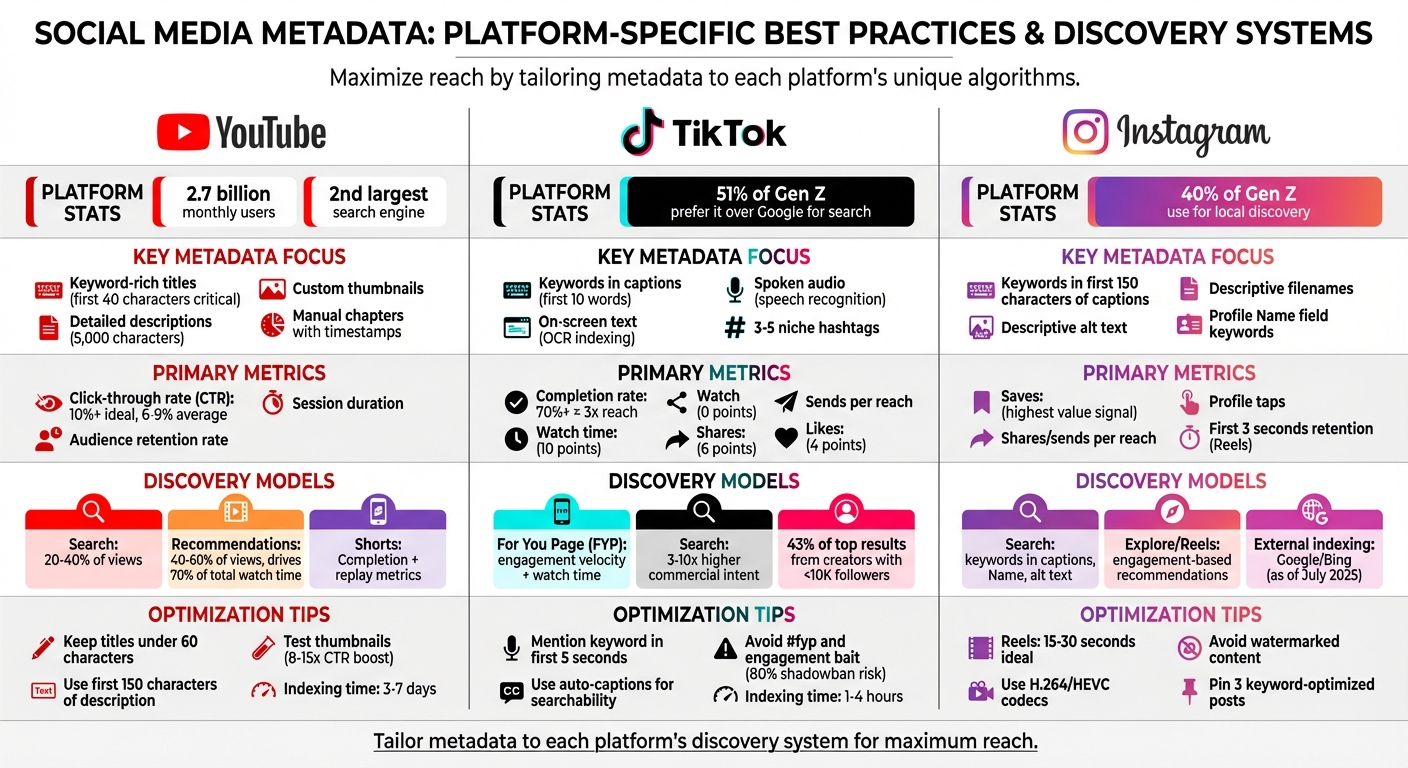
YouTube vs TikTok vs Instagram Metadata Best Practices Comparison
YouTube Metadata Tips 2021 | How To Get More Views On YouTube For Beginners
sbb-itb-94859ad
1. YouTube
YouTube stands out as the second-largest search engine globally, with 2.7 billion monthly logged-in users. Unlike TikTok and Instagram, which focus on fast interactions and social discovery, YouTube operates as a viewer satisfaction prediction engine. Its algorithm is built to keep users watching rather than just scrolling.
Metadata Optimization
When it comes to YouTube, metadata plays a key role in getting your content noticed. For example, the platform places the most weight on the first 40 characters of your title. To maximize visibility, start with your primary keyword and keep titles under 60 characters to avoid truncation on mobile devices - where over 70% of watch time happens. In the description, use the first 150 characters to highlight your main value and include secondary keywords.
Custom thumbnails can significantly improve your click-through rate (CTR), often boosting it by 8–15x. To create effective thumbnails, use expressive facial expressions, bold colors that contrast with YouTube’s red and white theme, and limit text to 3–5 words. Aim for a CTR above 10%, though 6–9% is considered average. YouTube Studio’s "Test & Compare" feature is a great tool for A/B testing thumbnails.
Manual chapters with keyword-rich timestamps are another powerful tool. These "Key Moments" often appear in Google search results. Avoid generic labels like "Part 1" and opt for descriptive titles like "How to Setup SEO Tools" to attract more search traffic. Plus, since YouTube's AI indexes spoken audio, naturally mentioning your target keyword 2–3 times in the video can reinforce its relevance.
Algorithmic Priorities
YouTube’s recommendation algorithm drives a staggering 70% of total watch time. Todd Beaupré, YouTube’s Senior Director of Growth and Discovery, explains:
"There's no single answer to that question [which metric matters most]... The system continually learns what works for different types of content and viewing situations".
Two metrics stand out as critical: audience retention rate and click-through rate. While metadata helps categorize content initially, it’s the actual behavior of viewers - how long they stay engaged and how often they click - that determines how far a video will reach.
The first 48 hours after uploading are especially crucial. During this period, YouTube tests the video with a small group of your subscribers, using their retention and engagement data to decide whether to share it more broadly. Videos that extend overall session duration - keeping viewers on the platform longer - are also rewarded.
Content Discovery Models
YouTube employs three main discovery systems: Search, Recommendations, and Shorts. Each operates differently:
- Search: This system relies on keyword relevance and CTR, making metadata like titles and descriptions essential. For SEO-focused channels, search traffic accounts for 20–40% of views.
- Recommendations: Based on watch history and retention, this system drives 40–60% of views. Metadata here helps clarify intent and expand reach.
- Shorts: These rely heavily on completion rates and replay metrics rather than traditional metadata. Shorts can now run up to three minutes, and their success is tied more to engagement metrics than keywords.
Pinned comments can also drive 40–60% more replies compared to unpinned ones, signaling higher engagement. Additionally, uploading custom captions ensures accurate indexing, as auto-generated captions often miss the mark.
| Discovery Model | Primary Signal | Metadata Role |
|---|---|---|
| Search | Keyword relevance + CTR | High - titles and descriptions drive rankings |
| Recommendations | Watch history + retention | Medium - metadata clarifies intent and scales reach |
| Shorts | Completion rate + replays | Low - engagement metrics dominate |
2. TikTok
TikTok takes a different approach from platforms like YouTube, focusing heavily on discovery and engagement rather than traditional SEO. It’s a discovery-first platform, where the relevance of your content often outweighs your follower count. For example, 43% of top-ranking TikTok search results come from creators with fewer than 10,000 followers. It’s even becoming a go-to search engine, with 51% of Gen Z preferring TikTok over Google for their primary searches.
Metadata Optimization
TikTok’s algorithm analyzes metadata from four key sources: captions, on-screen text (using Optical Character Recognition, or OCR), spoken words (via speech recognition), and hashtags. By 2026, keywords have taken the lead over hashtags as the main driver of content reach. To maximize visibility, include your primary keyword within the first 10 words of your 100-character caption and ensure it’s spoken within the first 5 seconds of your video.
On-screen text plays a crucial role, especially since 30–40% of TikTok sessions occur without sound. The algorithm prioritizes keywords that appear in text overlays during the first 3 seconds of a video.
When it comes to hashtags, follow the 3-5 rule:
- Use one broad or trending hashtag.
- Add 2-3 niche hashtags (with 10K–500K views).
- Include one ultra-niche or branded hashtag.
Niche hashtags generate 60-70% higher engagement rates compared to broad ones. Stay away from generic tags like #fyp or engagement-bait phrases like #followme, as these can lead to an 80% risk of shadowban, reducing views by up to 90%.
Algorithmic Priorities
TikTok’s algorithm assigns points to various engagement metrics. Watch time scores the highest at 10 points, followed by shares at 6 points, and likes at 4 points. Videos with a completion rate of 70% or higher are rewarded with approximately 3x the reach. Louis Vick, a content creator and entrepreneur, explains:
"Play duration equals watch time plus finish rate. TikTok wants high percentage completion rates. Savable content is critical because it increases watch time when viewers return later".
New videos are tested with a small group of 300–500 users before being distributed more widely. To move past this initial phase, a video typically needs to earn at least 50 points. Unlike YouTube, which relies on subscribers for initial traction, TikTok focuses on content relevance rather than the creator’s popularity.
One standout metric is "Sends per Reach" - how often users share a video via direct messages. This has become a stronger discovery signal than likes or comments. TikTok’s algorithm also favors original AI-generated content, penalizing reposts or low-effort duets by limiting their reach. These unique algorithmic features define TikTok’s approach to content discovery.
Content Discovery Models
TikTok uses two main algorithms: the For You Page (FYP) and Search. The FYP prioritizes engagement velocity and watch time, serving content tailored to users’ interests rather than their social connections. In contrast, the Search algorithm focuses on relevance, keywords, and user intent, functioning more like a traditional search engine.
Search traffic on TikTok holds 3-10x higher commercial intent compared to the passive browsing typical of the FYP. Beauty brand Glossier capitalized on this by creating search-optimized tutorials like "how to use cloud paint", which ranked in the top spots for numerous product-related searches. This strategy led to a 340% ROI on TikTok content, with 67% of sales attributed to search traffic.
| Discovery Model | Primary Signal | Metadata Role |
|---|---|---|
| For You Page | Engagement velocity + watch time | Medium - hashtags categorize content |
| Search | Relevance + keywords + user intent | High - captions, OCR, and audio drive rankings |
To optimize for these discovery models:
- Enable auto-captions on every video to create a searchable transcript, making it easier for TikTok to rank your content.
- Use location tags for local content to capture "near me" searches.
- Group related videos into Creator Playlists with keyword-rich titles to establish topical authority and encourage binge-watching.
3. Instagram
Instagram has evolved into a powerful search engine, with 40% of Gen Z using it to discover local activities and products. Unlike YouTube's subscriber-driven model or TikTok's algorithm-heavy approach, Instagram combines search-based discovery with algorithmic recommendations via its Explore page and Reels feed.
Metadata Optimization
Captions on Instagram work like mini search-engine snippets. The first 100–150 characters are crucial - place essential keywords before the "more" break to align with search intent. Adding 1–2 primary keywords to your profile Name (e.g., "Sarah | Yoga Teacher") can also boost discoverability.
Alt text plays a big role in helping Instagram's algorithm understand your content. Writing clear, descriptive alt text in the Advanced Settings ensures your image or video is accurately categorized. Even media file names matter - rename files with descriptive keywords (e.g., minimalist-bedroom-decor.jpg) to improve how Instagram's AI processes them.
Hashtags have shifted from being tools for broad reach to serving as niche classifiers. Instead of using the maximum number of hashtags, stick to 5–15 that are highly relevant to your content.
These metadata strategies directly impact how Instagram's algorithm evaluates and promotes your content.
Algorithmic Priorities
Instagram's algorithm relies heavily on user engagement signals rather than traditional metrics like likes. One key factor is "sends per reach", which tracks how often users share your content via direct messages. As Adam Mosseri, Head of Instagram, explained:
"The five interactions we look at most closely are how likely you are to spend a few seconds on a post, comment on it, like it, share it, and tap on the profile photo."
For Reels, the algorithm assesses the first 3 seconds to gauge drop-off rates and determine whether the content deserves wider exposure. To ensure your Reels perform well, focus on technical quality - use codecs like H.264 or HEVC to avoid compression issues that might turn viewers away. Keep Reels short and engaging, ideally between 15 and 30 seconds, to maximize completion rates. Also, avoid posting recycled content with visible watermarks from other platforms like TikTok, as this can hurt your reach.
Content Discovery Models
Instagram's discovery system is a blend of traditional SEO and modern engagement-based algorithms. It uses two main mechanisms: Search and Explore/Reels recommendations. The Search function relies on keywords found in captions, the Name field, and alt text, functioning much like conventional SEO. Meanwhile, Explore and Reels prioritize engagement signals, particularly saves and shares, to showcase content to users who aren't already following you.
As of July 10, 2025, professional accounts can opt in to have their Reels and profiles indexed by external search engines like Google and Bing, expanding their reach beyond the Instagram app. This shift creates a hybrid SEO model - one that primarily depends on in-app signals like saves, shares, and profile visits, but also benefits from external search traffic.
| Metadata Type | Algorithmic Role | Best Practice |
|---|---|---|
| Captions | Core Search & Context | Use keywords in the first 150 characters |
| Alt Text | Machine Understanding | Write clear, descriptive text |
| Hashtags | Niche Classification | Use 5–15 highly relevant tags |
| Filenames | Ingestion Categorization | Rename files with descriptive keywords |
| Video Codec | Quality/Watch Time | Use H.264/HEVC for optimal performance |
To boost your reach, focus on creating content that encourages saves - like carousels with tips or checklists - as saves signal high value to Instagram's Explore algorithm. Additionally, pin three keyword-optimized posts to your profile to establish topical authority for new visitors. Katie Shore, Senior SEO Specialist at Later, emphasizes:
"Consistency in your niche teaches Instagram who you are and what you offer, ensuring your content is served to relevant users."
Pros and Cons
When it comes to growing an audience, each platform has its own strengths and challenges, shaped by how their metadata systems work. Let’s dive into how YouTube, TikTok, and Instagram stack up.
YouTube stands out for its ability to support evergreen content. Thanks to its integration with Google, videos can rank for years, provided they’re optimized with detailed metadata like 5,000-character descriptions and tags. This long-term visibility is a huge plus, but it comes at a cost. YouTube requires thorough optimization, and its indexing process can take 3–7 days - much slower than TikTok’s lightning-fast 1–4 hour turnaround.
On the other hand, TikTok is the go-to platform for rapid discovery. A striking 43% of top-ranking search results feature creators with fewer than 10,000 followers. Its advanced indexing system uses keywords from captions, on-screen text (via OCR), and spoken audio (via speech recognition). This makes follower count less critical for visibility. However, many creators focus solely on optimizing for the For You Page (FYP), missing out on the higher-value search traffic. For example, a personal finance creator in early 2025 earned $47,000 in affiliate revenue from a single search-optimized video titled "Best high-yield savings accounts 2025." Impressively, 92% of the 3.8 million views came from search, not the FYP.
Instagram takes a different approach, prioritizing relationship-driven discovery. While this fosters deeper connections, it makes viral reach harder for new accounts compared to TikTok’s content-first model. Instagram’s key metric, "sends per reach", emphasizes creating shareable content over keyword optimization. On the bright side, Instagram’s recent move to allow external search engine indexing through Google and Bing has opened up new opportunities to expand reach beyond the app.
Here’s a quick comparison of each platform’s strengths and weaknesses:
| Platform | Strengths | Weaknesses |
|---|---|---|
| YouTube | Long-term ranking, Google integration, detailed metadata tools | Slow indexing (3–7 days), requires in-depth optimization |
| TikTok | Fast indexing (1–4 hours), less reliance on followers, high commercial intent | Short content lifespan, balancing FYP and search optimization is tricky |
| External search indexing, strong for visual content, flexible ecosystem | Focus on relationships limits viral potential, tough for new accounts |
Each platform’s discovery model demands a tailored metadata strategy to maximize reach and impact. Whether you’re aiming for long-term visibility, rapid discovery, or relationship-driven growth, understanding these dynamics is key.
Conclusion
Optimizing metadata for YouTube, TikTok, and Instagram means tailoring your strategy to fit how each platform helps users discover content. On YouTube, focus on keyword-rich titles and detailed descriptions to capture long-term search traffic. TikTok, on the other hand, benefits from quick hooks and strategic keyword placement in captions, on-screen text, and spoken audio. Instagram leans heavily on visual appeal, engaging captions, and interactive elements like stickers to drive discovery.
For creators juggling multiple platforms, start by defining a single search intent before creating content. Then, adapt your approach: craft a detailed tutorial for YouTube, a snappy teaser for TikTok, and an eye-catching Reel for Instagram. Make sure to front-load keywords in the first few words of your titles and captions to avoid them being cut off during display.
Keep your metadata fresh to match each platform's changing algorithms. Revisit keywords monthly and update underperforming evergreen content with new hooks or thumbnails to reignite interest. With video content predicted to make up 82% of all internet traffic by 2025, staying disciplined and platform-savvy with your metadata strategy can pave the way for long-term growth.
FAQs
How do I pick the right keywords for each platform?
When selecting keywords, it's important to adapt your approach based on each platform's unique features and algorithms.
On YouTube, focus on placing your primary keywords early in your titles and descriptions - ideally within the first 60 characters. This helps both users and search engines quickly understand your content. Don’t forget to include relevant tags that reinforce your topic and boost discoverability.
For TikTok and Instagram, weave keywords naturally into captions, on-screen text, and even spoken audio within your videos. Pair these keywords with trending hashtags and themes that align with current platform trends. These algorithms often prioritize content with high engagement, watch time, and shares, so matching your keywords to what’s trending can significantly improve your reach.
By tailoring your metadata and keyword strategy to each platform's strengths, you can maximize your visibility and connect with your audience more effectively.
Should I optimize for search or recommendations first?
For platforms such as YouTube, TikTok, and Instagram, the key to success lies in focusing on recommendation algorithms. These algorithms are designed to highlight content that keeps users engaged - whether through retention, shares, or interactions. While search optimization (like using keywords, crafting metadata, and writing compelling titles) still plays a role, your priority should be creating attention-grabbing content.
Think about strong hooks, trending audio, and eye-catching visuals - these elements align perfectly with how recommendation systems work. Once your content is primed for recommendations, you can layer in search tactics to make it easier for users to find your content within those algorithm-driven suggestions.
What should I change when cross-posting the same video?
To get the most out of cross-posting videos on platforms like TikTok, Instagram Reels, and YouTube Shorts, you’ll need to tweak your content for each platform. Start by removing any watermarks - platforms often penalize videos with visible branding from competitors. Then, customize your metadata, including titles, descriptions, and hashtags, to suit the audience and trends of each platform.
Make sure your video format aligns with platform requirements, like the 9:16 aspect ratio and 1080x1920 resolution, for a polished look. Take advantage of native tools, such as captions or special effects, to boost engagement. Lastly, avoid directly re-uploading videos between platforms, as this can reduce quality and limit how well your content performs.
Related posts
LongStories is constantly evolving as it finds its product-market fit. Features, pricing, and offerings are continuously being refined and updated. The information in this blog post reflects our understanding at the time of writing. Please always check LongStories.ai for the latest information about our products, features, and pricing, or contact us directly for the most current details.