
Trending Topics vs. Evergreen Ideas For Videos
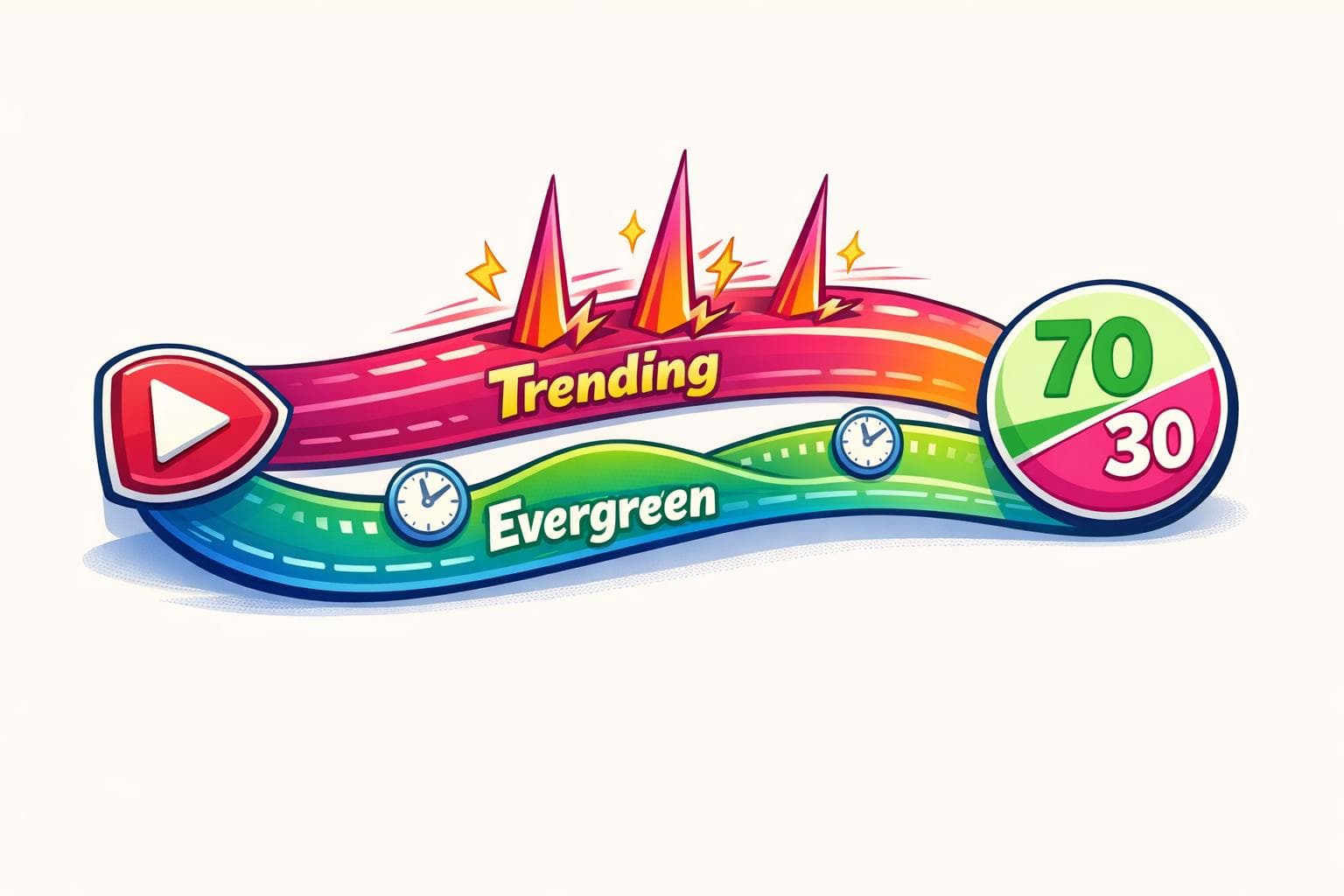
Should you focus on trending topics or evergreen ideas for your video content? It depends on your goals. Trending topics bring immediate attention, while evergreen ideas ensure long-term, consistent growth. Here's a quick breakdown:
- Trending Topics: Short-lived but high-impact. These are tied to current events or viral trends, offering quick spikes in views. However, their relevance fades fast, often within 72 hours. Great for rapid discovery but hard to sustain.
- Evergreen Ideas: Timeless and steady. These address ongoing questions or teach skills, providing consistent traffic over years. They take longer to gain traction but deliver better ROI over time.
Key Takeaways:
- Trending Topics: Ideal for quick growth and staying relevant in the moment.
- Evergreen Ideas: Perfect for building a steady audience and long-term revenue.
- Best Strategy: Use a mix of both - 70% evergreen for stability and 30% trending for visibility.
Quick Comparison:
| Factor | Trending Topics | Evergreen Ideas |
|---|---|---|
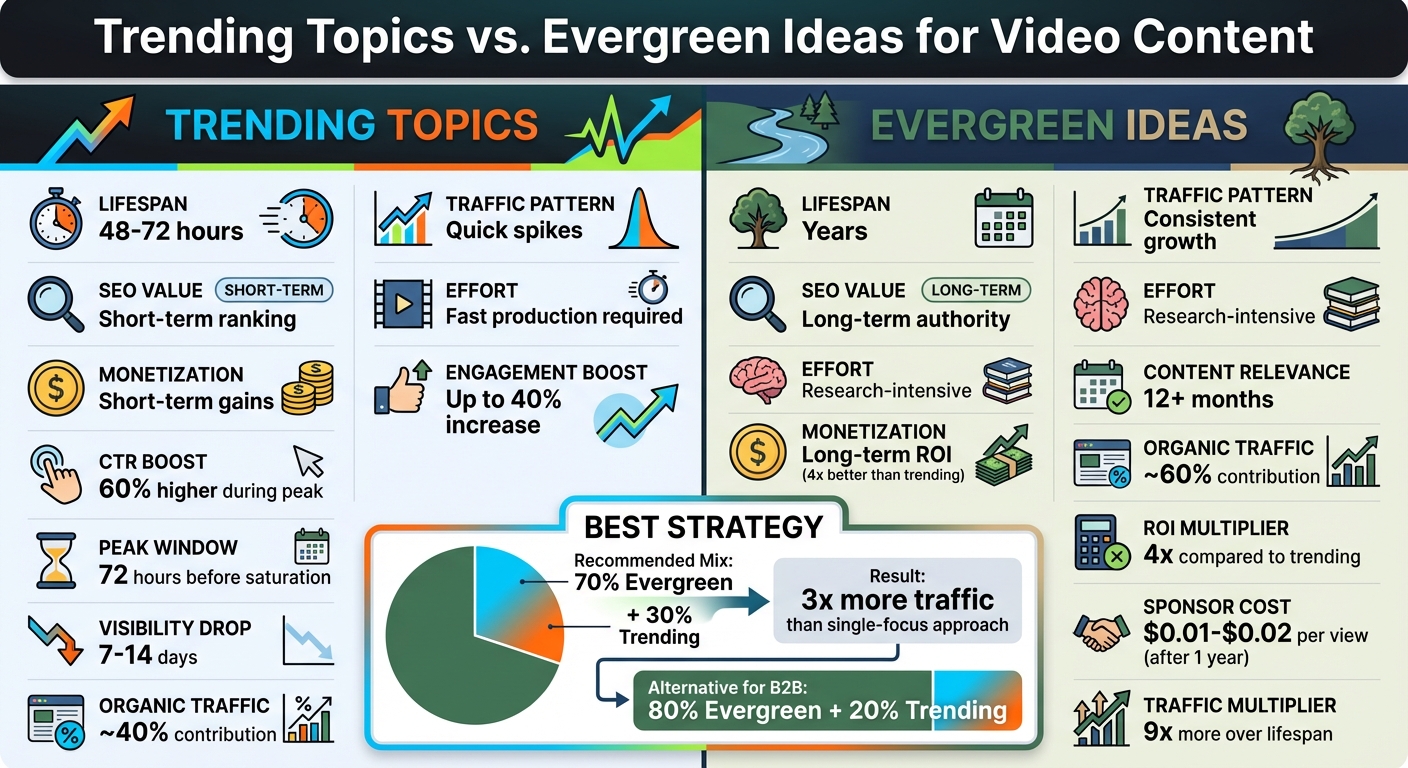
| Lifespan | 48–72 hours | Years |
| Traffic Pattern | Quick spikes | Consistent growth |
| SEO Value | Short-term ranking | Long-term authority |
| Effort | Fast production required | Research-intensive |
| Monetization | Short-term gains | Long-term ROI |
Balancing these approaches ensures immediate engagement while building a sustainable content strategy. Let’s dive deeper into how to leverage both effectively.
Trending vs Evergreen Video Content Strategy Comparison
Trending Topics: Pros and Cons
Advantages of Trending Topics
Trending topics, unlike evergreen content, can deliver quick wins but demand fast action. They drive immediate spikes in viewership and help attract new audiences. For instance, emerging trends can boost engagement by up to 40%, while niche trend-focused videos may see 60% higher click-through rates during their peak moments.
Platforms like YouTube, TikTok, and Instagram reward content with strong Click-Through Rates (CTR) and Audience Retention (AR) in the first 24–48 hours. These metrics signal the algorithm to push your video to a broader audience. Regularly tapping into trends also positions you as relevant and in-the-know, signaling that you’re deeply engaged with your industry rather than stuck in outdated approaches.
Pat, the founder of ClipCreator.ai, puts it succinctly:
"The goal isn't just finding trends. It's building an efficient machine that turns those trends into high-quality, relevant content that actually grows your channel".
While the benefits are clear, there are also notable challenges to consider.
Limitations of Trending Topics
One major downside is the short shelf life of trending content. These videos often lose relevance as quickly as they gain it. Most trends have a 72-hour peak before saturation sets in, and visibility typically drops off within 7–14 days. This creates a "traffic rollercoaster" where brief spikes are followed by steep declines, making it hard to build lasting authority.
The speed required to capitalize on trends can also be a double-edged sword. Creators must act quickly to produce and publish long AI videos content while a topic is still hot. This urgency can lead to intense pressure, as ReelMind.ai explains:
"If a creator spends a week producing a technically brilliant video about a topic that ceased trending yesterday, the impact is negligible".
This time crunch can lead to burnout or compromises in quality. Additionally, popular trends often attract a flood of creators, making it harder for any single video to stand out unless it offers a unique twist. Pat also warns:
"If your entire channel is built on fleeting trends, you're building on sand. An algorithm change or the death of a popular meme format can tank your views overnight".
Lastly, there’s an unpredictable element to viral success - it’s difficult to replicate consistently.
How to Use Trending Topics Effectively
To strike the right balance, many creators follow the 70/30 rule: dedicate 70% of content to evergreen topics for stability and 30% to trending topics for quick growth. This approach can generate three times more traffic compared to focusing heavily on one type alone.
Here are some strategies to make the most of trending content:
- Spot trends early: Use tools like TikTok's Creative Center to identify sounds with fewer than 50,000 uses but rising popularity (marked by a rising arrow). This helps you catch trends before they’re oversaturated.
- Act fast: Aim to publish within 12–48 hours of identifying a trend to maximize its peak interest window.
- Research smartly: Create a separate "burner" profile on social platforms to see trends without interference from your personal algorithm bubble.
- Blend trends with evergreen themes: For example, use a trending event as a hook to discuss a timeless concept, ensuring your content has long-term appeal.
Lastly, focus on the "Velocity Trifecta" - your title, thumbnail, and the first 5–10 seconds of the video. These elements are crucial for grabbing attention and satisfying algorithmic checks in the first hour. Combining speed, creativity, and relevance is the key to mastering trending topics.
sbb-itb-94859ad
Evergreen Ideas: Pros and Cons
Advantages of Evergreen Ideas
Evergreen content is like planting a tree that keeps bearing fruit year after year. It stays relevant for over 12 months, providing a steady stream of traffic and accounting for about 60% of ongoing organic traffic for seasoned online creators.
One of its standout benefits is its ROI. These types of videos can deliver up to four times the return compared to trending content because they keep attracting views long after their initial release. For sponsors, this longevity translates into lower costs. While sponsorships might cost $0.04 per view within the first 30 days, evergreen content can reduce that cost to $0.01–$0.02 per view over a year. Rob Ciampa, author of Become a YouTuber, captures this perfectly:
"If YouTube were a refrigerator... a viral video would have a shorter expiration date to more evergreen content."
Search engines also favor evergreen content because it answers fundamental questions people consistently search for. This helps creators build lasting domain authority and a dependable audience, avoiding the unpredictable spikes and dips that come with chasing viral trends.
Still, even a long-term strategy like this comes with its share of hurdles.
Limitations of Evergreen Ideas
The biggest drawback of evergreen content is its slow takeoff. It doesn’t offer the instant gratification that trending content might, which can make it feel like progress is dragging at first. On top of that, creating evergreen content requires a larger upfront effort. You’ll need to spend more time on research and production to ensure the content is thorough and detailed.
Even though it’s called “evergreen,” this type of content isn’t entirely maintenance-free. To stay relevant, you’ll need to periodically update statistics and examples, often through quarterly or bi-annual reviews. There’s also a risk of seeming out of touch if you focus too much on evergreen topics and neglect current industry trends. Plus, since evergreen topics tend to be broad and foundational, they often face stiff competition in search rankings, making it harder for newer creators to stand out.
Despite these challenges, evergreen content provides a reliable base for long-term audience engagement.
How to Create Effective Evergreen Content
To overcome these challenges, careful planning is key. Focus on creating how-to guides and tutorials that address recurring questions in your niche. Avoid using time-sensitive language in your titles or scripts - like mentioning a specific year - as this can make your content feel outdated and discourage future viewers.
Revisit your top-performing videos every year to refresh statistics, update examples, and tweak titles or descriptions with timestamps to maintain strong search rankings. Use precise, targeted keywords in your titles and descriptions to improve discoverability. To get the most out of your efforts, try the "1:5 ratio" approach: turn one evergreen video into five other assets, such as short clips, blog posts, or social media graphics.
As discussed earlier, combining evergreen content with trending topics creates a balanced strategy that ensures both immediate and lasting growth.
Direct Comparison: Trending Topics vs. Evergreen Ideas
Performance and Longevity
When it comes to performance, trending topics and evergreen ideas serve very different purposes. Trending content grabs attention quickly but fizzles out just as fast - usually within 48 to 72 hours. In contrast, evergreen content builds its audience slowly but continues to deliver value for years.
Here’s a side-by-side look at their performance:
| Factor | Trending Topics | Evergreen Ideas |
|---|---|---|
| Content Lifespan | Short (48–72 hours) | Long (Years) |
| Traffic Pattern | Immediate, intense spikes | Consistent, compounding growth |
| SEO Value | Quick ranking driven by freshness | Long-term authority (E-E-A-T) |
| Engagement | High initial CTR and shares | Steady watch time and subscriber growth |
| Audience Growth | Rapid discovery | Sustained growth and loyalty |
Evergreen content has the potential to generate up to 9x more traffic over its lifespan and accounts for around 60% of sustained organic traffic for seasoned creators. This makes it a cornerstone of long-term strategy.
As Planoly aptly puts it:
"Trends bring people in. Evergreen makes them stay."
This distinction highlights the importance of balancing short-term visibility with lasting impact, especially when considering the resources and returns involved.
Resource Allocation and ROI
The effort and investment needed for these two strategies are vastly different. Trending content thrives on speed. To make an impact, you need to spot a trend, create content, and publish it fast enough to ride the wave. This approach requires quick turnarounds and constant monitoring of what's hot.
Evergreen content, however, takes more time upfront. It involves thorough research, detailed scripting, and high-quality production. While this might seem like a heavier lift, the payoff is substantial. Evergreen videos can deliver up to 4x the ROI of trending content over time.
For creators working with tight budgets, a 70/30 split - 70% evergreen, 30% trending - can be a game-changer. This strategy has been shown to generate 3x more traffic than focusing exclusively on one type of content. Plus, for sponsored evergreen videos, the cost-per-view can drop to as little as $0.01–$0.02 a year after publication. This is because these videos keep accumulating views without requiring additional sponsorship fees.
To make managing both types of content easier, platforms like LongStories.ai offer tools to streamline production. Their reusable "Universes" allow creators to maintain consistent characters and styles, enabling quick responses to trends while steadily building a library of evergreen content. This ensures creators stay on-brand without overextending their resources or schedules.
Creating a Balanced Content Strategy
Why Combining Both Approaches Works
Trending content and evergreen content aren't at odds - they work hand in hand to create a balanced strategy. Trending topics can drive immediate traffic, while evergreen content ensures your channel remains relevant over time. Focusing solely on trends might give you short-lived spikes, but the momentum fades quickly. On the flip side, relying only on evergreen content can make your channel feel disconnected from current conversations.
The numbers tell the story. In 2024, InnovateHub, a tech startup, shifted their approach from 90% trending news to a 65% evergreen and 35% trending mix. The result? A 150% increase in organic traffic and a 20-point boost in domain authority, thanks to foundational guides like "Getting Started with Cloud Computing". Similarly, EcoWear, an e-commerce brand, adopted a 70/30 split, adding evergreen resources like "The Guide to Sustainable Fashion Materials." This tweak led to a 4x increase in year-over-year search visibility for their core product categories.
How to Integrate Both Approaches
To strike the right balance, structure your content calendar into three tiers:
- Monthly evergreen pillars for consistent, long-term traffic.
- Quarterly seasonal content to align with predictable trends.
- Agile trending videos to capture immediate interest.
A 70/30 evergreen-to-trending ratio works well for many creators, though B2B businesses might lean toward an 80/20 split to cater to longer buying cycles. Maximize your evergreen content by repurposing it into multiple formats - like turning one video into blog posts, infographics, or social media snippets.
Trending videos can do more than just grab attention - they can direct viewers to your evergreen content. Include links to related tutorials or guides in your trending video descriptions to turn short-term traffic into loyal subscribers. Don’t forget to conduct quarterly audits to refresh stats and update links in your top-performing evergreen videos, keeping them relevant and ranking high in search results.
Tools for Efficient Video Production
Balancing quick-turn trending content with well-planned evergreen pieces can be challenging, but tools like LongStories.ai simplify the process. This platform allows creators to build reusable "Universes" with consistent characters, styles, and voices. This means you can quickly create trending videos while maintaining brand consistency and use the same assets for evergreen content. Its three animation tiers - No Animation, Fast Animation, and Pro Animation - let you adjust production speed depending on whether you're chasing a viral moment or crafting a timeless piece.
Other tools can also help streamline your strategy. Use project management platforms like Trello or Asana to color-code your calendar (green for evergreen, blue for trending) and visually track your 70/30 balance. For keyword research and A/B testing, platforms like TubeBuddy can help identify evergreen topics with high search potential. The key is to choose tools that maintain quality and consistency without overwhelming your resources.
Conclusion
Key Takeaways
Balancing trending and evergreen content is all about understanding the strengths of each approach. Trending content grabs immediate attention by tapping into what’s hot right now, while evergreen content lays the groundwork for consistent, long-term growth by offering timeless value.
"Trends come and go, but evergreen videos are the foundation that keeps your channel alive long-term." - Tinyfool, Tinyfool's Youtube Lab
The numbers back this up: evergreen content contributes roughly 60% of organic traffic, and creators who maintain a 70/30 mix of evergreen to trending content can see traffic triple. Plus, evergreen videos can deliver up to 4× ROI.
To make the most of both strategies, focus on creating evergreen tutorials and guides as your foundation. Then, sprinkle in trending content when it naturally fits your niche and audience interests. Keep experimenting, monitor your results, and fine-tune your approach to meet your audience’s evolving needs.
The most successful creators don’t choose one over the other - they use both intentionally to drive growth and stay relevant.
Evergreen vs Trending: Perfect YouTube Strategy
FAQs
How do I pick evergreen topics in my niche?
To pick evergreen topics, zero in on subjects that stay relevant and consistently resonate with your audience. These are the kinds of topics that answer fundamental questions, outline best practices, or explain key processes in your niche - think how-to guides or foundational frameworks. The goal is to choose topics with lasting appeal and steady search interest, so they continue to attract and engage readers without needing frequent updates.
When is a trend worth covering for my channel?
A trend is worth highlighting when it resonates with your audience's interests, sparks engagement, and aligns with your content strategy. Jumping on trends can deliver quick visibility and help you tap into current moments, creating opportunities for short-term growth. However, it’s crucial to ensure the trend fits your niche and assess whether it has lasting relevance. For sustained success, strike a balance by combining trending topics with evergreen content to keep your audience engaged over time while maintaining consistent growth.
How do I turn trending viewers into subscribers?
To turn trending viewers into subscribers, focus on building a connection through engaging and relevant content. Start by creating clear calls-to-action (CTAs) that encourage viewers to subscribe, like mentioning it at the beginning or end of your videos. Pair this with high-quality videos that match their interests - this is key to keeping them hooked.
Use trending topics as a way to grab their attention, but don’t stop there. Guide them toward your evergreen content or curated playlists that showcase your expertise and keep them coming back for more. Throughout your videos, emphasize the perks of subscribing, like staying in the loop on future trends or gaining access to exclusive content. Consistent reminders can make all the difference in turning casual viewers into loyal subscribers.
Related posts
LongStories is constantly evolving as it finds its product-market fit. Features, pricing, and offerings are continuously being refined and updated. The information in this blog post reflects our understanding at the time of writing. Please always check LongStories.ai for the latest information about our products, features, and pricing, or contact us directly for the most current details.