
How Shorts Boost Long-Form Video Performance

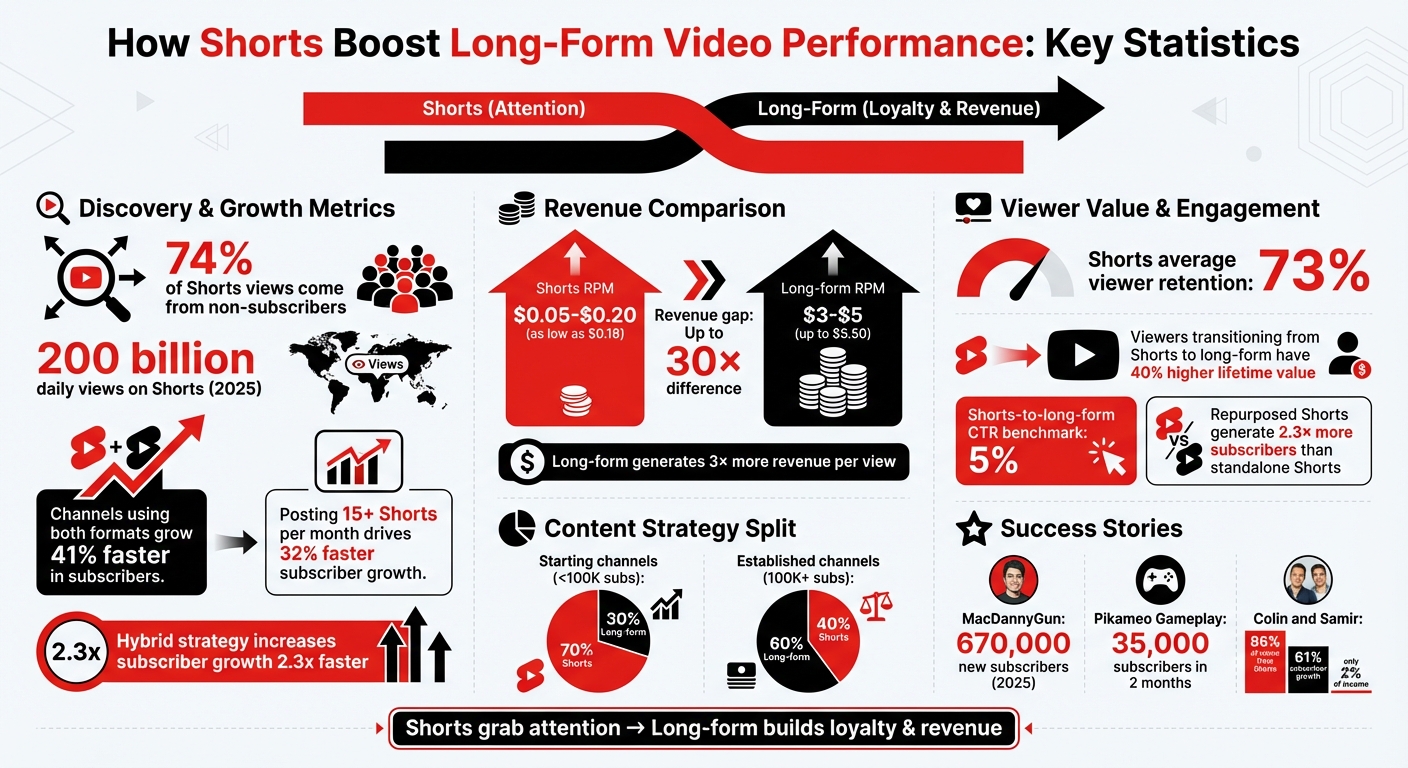
YouTube Shorts are a shortcut to growing your channel. They bring in new viewers fast - 74% of Shorts views come from non-subscribers. When paired with long-form videos, this combo can grow your subscribers 2.3x faster and boost audience engagement. Here's the secret: Shorts grab attention, while long-form content builds loyalty and revenue. Creators who use both formats see 41% faster growth in subscribers.
Key takeaways:
- Shorts attract 200 billion daily views and are ideal for discovery.
- Linking Shorts to long-form videos increases traffic and watch time.
- Viewers who transition from Shorts to long-form content have a 40% higher lifetime value.
- Posting 15+ Shorts per month can drive faster growth.
If your long-form videos aren’t getting noticed, start creating long AI videos and Shorts to funnel viewers into your deeper content. It's a simple way to spark growth and maximize your channel's potential.
YouTube Shorts vs Long-Form Video Performance Statistics
The Problem: Why Long-Form Videos Struggle with Discovery
Algorithm Bias Toward Short-Form Content
YouTube runs two distinct recommendation systems - one tailored for Shorts and another for long-form videos. This separation creates a challenge for creators, as each system rewards different types of viewer engagement.
Shorts excel in passive discovery. Their feed-based design lets viewers swipe through content effortlessly, with YouTube presenting videos based on behavioral patterns rather than deliberate searches. Todd Sherman, Senior Director of Product for Shorts at YouTube, explains:
"With long-form content, people actively choose what to watch by clicking on specific videos. Shorts, on the other hand, is all about swiping through a feed and discovering content on the go".
In contrast, long-form videos demand active selection. The algorithm for long-form content prioritizes metrics like click-through rate, average view duration, and session depth. These factors tend to favor established creators with a history of high engagement. For newer creators, this creates a steep uphill climb to gain visibility and grow their audience.
This divide in discovery mechanisms underscores the economic challenges long-form creators face.
Slower Growth for Long-Form Creators
The time and effort required to produce long-form videos add another layer of difficulty. Creating a single long-form video can take anywhere from 4 to 15 hours, while Shorts can often be produced in minutes. This difference limits how often creators can test new ideas to see what resonates with their audience.
Consider the case of Magic: The Gathering creator Maldhound. In February 2025, he revealed that Shorts earned him an RPM of just $0.18, compared to $5.50 for his long-form videos - a staggering 30× revenue gap. Despite the higher earning potential of long-form videos, he struggled to attract new viewers without the discovery boost that Shorts provide. As Jay Kim from Miraflow explains:
"Shorts solve the problem of getting seen. Long-form solves the problem of building a loyal audience that watches, subscribes, and generates revenue".
The data backs this up: channels posting 15 or more Shorts per month grow 32% faster in subscriber count than those that don’t. Even more striking, hybrid channels that use both Shorts and long-form videos grow 41% faster than those sticking to just one format. The message is clear - focusing only on long-form content means slower growth and reduced visibility, no matter how polished your videos are.
Next, we’ll explore how Shorts can serve as a gateway to drive traffic to long-form videos.
sbb-itb-94859ad
YouTube Shorts Algorithm Explained for 2026 (TRICKS to Gain MORE Subscribers FAST)
How Shorts Drive Traffic to Long-Form Videos
Shorts are proving to be a game-changer for creators looking to overcome the challenges of getting their long-form videos discovered. They act as a dynamic traffic funnel, leading viewers straight to your more in-depth content.
Increased Reach and Visibility
Shorts are like a discovery engine for your channel, pulling in viewers who might not find you through traditional search or browsing. A significant number of Shorts views come from people who aren’t already subscribers, making them an excellent way to expand your audience.
YouTube has tools to help turn this discovery into meaningful traffic. One standout feature is the "Related Video" option in YouTube Studio. This lets creators add a clickable link from any Short directly to a specific long-form video, showing up as a prompt at the bottom of the screen. Jon Youshaei, a creator and former YouTube employee, calls this the "Flood Method" - linking every Short to the same long-form video to focus traffic and engagement on one key piece of content.
Another effective tactic is using open-loop hooks in Shorts. These hooks tease an outcome or challenge, encouraging viewers to check out the long-form video to get the full story. This strategy sparks curiosity and nudges viewers toward your longer content.
With this kind of exposure, Shorts lay the groundwork for deeper connections with your audience.
Higher Audience Engagement
The quick, snappy nature of Shorts grabs attention right away, with an average viewer retention rate of about 73%. Even better, viewers who move from Shorts to long-form videos tend to have a 40% higher lifetime value.
The results speak for themselves. In 2025, creator MacDannyGun gained an impressive 670,000 new subscribers by using a Shorts-to-long-form funnel strategy. Similarly, Pikameo Gameplay added 35,000 subscribers in just two months (September to November 2025) by combining Shorts with other formats to maximize reach.
Better Algorithmic Recommendations
The benefits don’t stop with visibility and engagement. YouTube’s algorithm takes notice when viewers transition from Shorts to long-form videos and stick around to watch. This signals strong intent and deep session engagement, which boosts your videos in Browse and Suggested feeds. Additionally, when Shorts have high completion rates, YouTube increases their distribution, creating a ripple effect that drives even more traffic to your long-form content.
3 Strategies to Use Shorts for Long-Form Success
Now that you know how Shorts can drive traffic, let’s dive into three actionable strategies to connect your Shorts with long-form content. These methods turn curiosity into sustained engagement by converting quick views into deeper interactions.
Repurpose Long-Form Content into Shorts
One of the easiest ways to create Shorts is by repurposing content from your long-form videos. Use YouTube Studio to analyze Audience Retention and pinpoint moments where viewers rewatch or stay engaged. These peaks are ideal for turning into Shorts.
Creators using this approach see 2.3× more subscribers from repurposed Shorts compared to standalone ones. The trick lies in sharp, focused editing. Skip the greetings, introductions, or slow build-ups - jump straight to the most engaging part. The first three seconds matter the most, so start with a hook like "Stop doing this if…" or "Here’s what I learned the hard way". Adding a credibility line, such as "From my 48-minute strategy session", builds trust while giving viewers context. Aim for a runtime of 50–60 seconds, as Shorts in this range average 1.7 million views - significantly outperforming shorter clips.
Once you’ve nailed the content, focus on refining your hook and driving cross-promotion to turn viewers into long-form fans.
Optimize Hooks and Cross-Promotion
Think fast - viewers decide within 1.5 seconds whether to keep watching or swipe away. Use open loops to create curiosity by hinting at a result or a challenge, like “Find out what happened next in the full video”.
To drive traffic to your long-form videos, try the Flood Method. Use YouTube Studio’s "Related Video" feature to link your Shorts directly to specific long-form content. Add a clickable prompt at the bottom of the screen to guide viewers seamlessly. Don’t forget to pin a comment with a link to the full video, paired with a compelling reason to click, such as "Watch the full 3-step framework here!".
Use AI Tools for Scalable Production
Editing multiple Shorts from a single 20-minute video can take hours, but AI tools can do it in just a couple of minutes. Tools like quso.ai ($49/month) and Virvid (starting at $19/month) analyze transcripts, identify viral moments, crop videos to the 9:16 format, and even add animated captions - all automatically.
For creators prioritizing long-form content, LongStories.ai offers a different solution. Instead of clipping existing videos, it helps you produce high-quality long-form videos (up to 10 minutes) at scale. By creating reusable "Universes" with consistent characters, styles, and voices, it ensures your brand identity stays intact while simplifying animation, voiceover, and editing tasks. This allows you to focus entirely on storytelling.
Here’s a real-world example: In late 2025, NovaGear launched 50 product videos in just 48 hours, saving nearly $2,000 in production costs. They identified three top-performing videos that drove 80% of their Q4 revenue. Thanks to AI automation, they reduced production costs to under $5 per video - far less than the $300 typically spent on manual production.
These strategies show how Shorts, paired with smart tools and techniques, can amplify your long-form content’s reach and impact.
Measuring Success: Key Metrics to Track
Once you've implemented strategies to direct traffic from Shorts to long-form content, the next step is ensuring those strategies are working. This is where tracking the right metrics becomes essential. The key indicators for Shorts performance - Viewed vs. Swiped Away (VVSA), Average Percentage Viewed (APV), and "Shown in Feed" - are often referred to as the "Holy Trinity" of metrics. These figures help you evaluate how well your content grabs attention and how effectively it engages with YouTube's algorithm.
Tracking Funnel Performance
To measure how well your funnel converts Shorts viewers into long-form engagement, start with your Shorts-to-long-form click-through rate (CTR). A healthy CTR benchmark is 5% for links in "related video" sections, end screens, and pinned comments. If your CTR falls short, it could mean your Short isn't compelling enough or misrepresents the long-form content it promotes. Also, keep an eye on the first 30–60 seconds of your long-form videos - if viewers drop off quickly, the Short's hook may not be delivering on its promise.
Subscriber quality is another critical factor. While Shorts can generate a large volume of subscribers, long-form content typically fosters higher "Returning Viewer" rates and greater lifetime value. For instance, in February 2025, creators Colin and Samir revealed that Shorts accounted for 86% of their total channel views and 61% of subscriber growth. However, Shorts only contributed 2% of their total income. This insight helped them refine their content funnel to better convert Shorts viewers into long-form revenue.
You should also monitor Revenue Per Mille (RPM) for both formats. Long-form RPM typically ranges from $3 to $5, whereas Shorts RPM is significantly lower, averaging between $0.05 and $0.20. Creators like Maldhound have reported revenue gaps as wide as 30× between the two formats, underscoring the importance of balancing volume-driven Shorts with revenue-focused long-form content.
While these metrics provide an overview of channel performance, tailoring your measurements to your content's niche will give you sharper insights.
Niche-Specific Adjustments
Different niches require different metrics to measure success effectively. For instance:
- Beauty and lifestyle creators often see engagement rates that are 65% higher on Shorts. They should also track affiliate link clicks on their long-form videos.
- Education channels may want to focus on course conversion rates, which can be 35% higher for creators using a mix of Shorts and long-form videos.
- B2B content creators should prioritize authority signals such as comments and LinkedIn shares over raw view counts.
YouTube Studio's "Related Video" feature is a valuable tool for identifying which Shorts are driving traffic to your long-form videos. If your VVSA rate drops below 70% or if more than 40% of viewers are "Swiping Away", it indicates that your first three seconds need improvement. Regularly tracking these metrics allows you to fine-tune your hybrid strategy for better results.
Conclusion: Building a Hybrid Content Strategy
Here’s the deal: channels that combine Shorts with long-form videos grow 41% faster than those that stick to just one format. Why? Shorts are perfect for grabbing attention, while long-form videos keep viewers engaged and drive revenue. When someone watches a Short and then clicks over to a long-form video, YouTube’s algorithm sees this as a strong signal of interest, which boosts your channel’s overall recommendations.
As your channel evolves, so should your content strategy. If you’re just starting out, aim for a mix of 70% Shorts and 30% long-form videos to maximize discovery. Once you cross the 100,000-subscriber mark, shift to a 40% Shorts and 60% long-form split to focus on monetization. Why the shift? Long-form videos generate three times more revenue per view than Shorts, and viewers who move from Shorts to long-form content have a 40% higher lifetime value. Tools like LongStories.ai can help you scale your long-form content while keeping your brand consistent.
It’s not just about how much you post - it’s about consistency. Set aside time to batch-produce 10–15 Shorts at once, and for each long-form video, create 4–6 high-impact clips. Use YouTube’s "Related Video" feature to connect your Shorts directly to the long-form videos they promote. This not only trains the algorithm but also builds a predictable experience for your audience, boosting both engagement and revenue.
With viewers spending over 39 minutes a day on TV-style content, optimizing your long-form videos for horizontal 4K formats is a smart move. One music channel that made this switch saw a 52% jump in revenue, thanks to better retention and higher ad rates. And with YouTube Shorts racking up over 200 billion daily views in 2025, even a small slice of that traffic can make a big impact on your long-form ecosystem.
FAQs
How do I get Shorts viewers to watch my long videos?
To turn Shorts viewers into fans of your long-form videos, focus on linking the two formats with smart cross-promotion and a unified brand identity. Use Shorts as bite-sized previews or teasers that spark curiosity and encourage viewers to check out the full-length content. Keep hooks, calls-to-action, and overall style consistent across both formats. This approach creates a sense of cohesion and trust, helping you transform casual scrollers into dedicated subscribers who regularly engage with your longer videos.
What should I link in the Short’s “Related video” spot?
To bridge the gap between Shorts and long-form content, link to videos that provide actionable strategies for turning Shorts viewers into subscribers and revenue. Highlight related content that demonstrates how to repurpose long-form videos into engaging Shorts to attract attention and boost interaction.
This method not only drives traffic but also keeps viewers engaged with your long-form videos, enhancing retention and expanding your audience. By connecting the dots between these formats, you can create a seamless content journey that benefits both your viewers and your channel's growth.
Which metrics prove my Shorts-to-long funnel is working?
When evaluating how well your Shorts-to-long video strategy is working, focus on these key metrics:
- Viewer Transition: Keep an eye on how many viewers are moving from your Shorts to your long-form videos. This shows how effective your Shorts are at sparking interest in your longer content.
- Increased Watch Time: Look for growth in the watch time of your long-form videos. If people are sticking around longer, it’s a good sign your Shorts are driving meaningful engagement.
- Subscriber Conversion Rates: Pay attention to how many Shorts viewers are becoming subscribers after engaging with your long-form videos. This can highlight how well your content is building a loyal audience.
By tracking these indicators, you’ll get a clearer picture of how well you’re using Shorts to boost traffic, engagement, and retention.
Related posts
LongStories is constantly evolving as it finds its product-market fit. Features, pricing, and offerings are continuously being refined and updated. The information in this blog post reflects our understanding at the time of writing. Please always check LongStories.ai for the latest information about our products, features, and pricing, or contact us directly for the most current details.