
Retention Benchmarks for Animated YouTube Videos
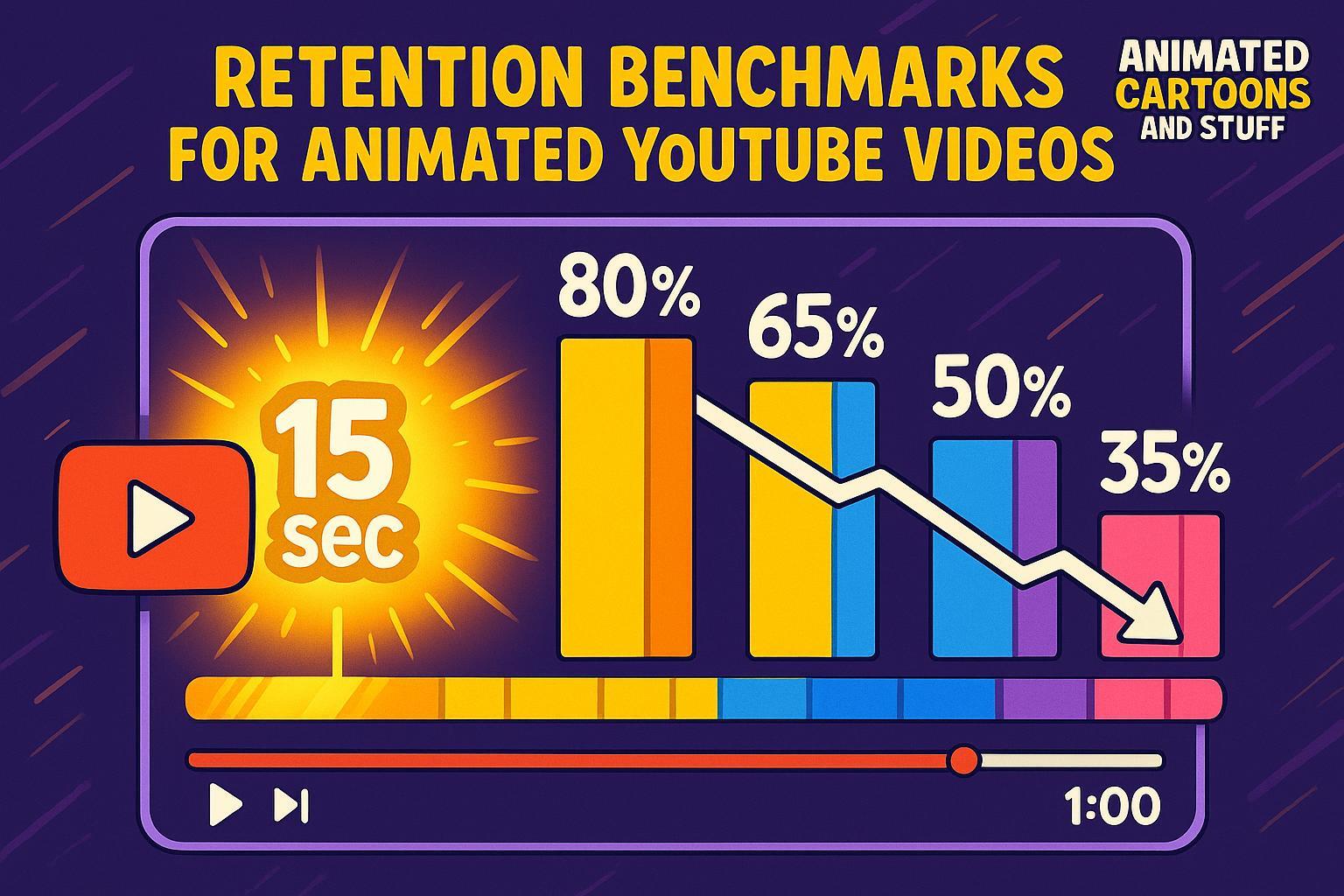
Want your animated videos to perform better on YouTube? Start by focusing on retention. Retention measures how long viewers stay engaged, and it’s a major factor in YouTube’s algorithm. Here’s what you need to know:
- Key Retention Goals: Short videos (<5 min) should aim for 60–70% retention, while longer videos (5–10 min) should target 40–50%.
- First 15 Seconds Matter: Hook your audience early; losing them here can hurt your overall watch time.
- Retention by Audience: Younger viewers prefer fast pacing and visual changes, while adults value meaningful content.
- Format Impact: Animation works well for simplifying ideas and storytelling but needs strong visuals and pacing to hold attention.
- Improvement Tips: Use clear hooks, trim unnecessary scenes, and analyze drop-off points in retention graphs.
Retention isn’t just about keeping viewers - it drives views, ad revenue, and channel growth. Even a 10% improvement can lead to 10x more views. Let’s dive into how to hit these benchmarks and keep your audience watching.
Retention Benchmarks for Animated YouTube Videos
Retention Rates by Video Length
The length of your video plays a huge role in how well viewers stay engaged. For short animated videos under 5 minutes, aim for an average view percentage of 60–70%. If your retention dips below 60%, it might be time to rethink your hook, pacing, or how you deliver the payoff.
When videos extend into the 5–10 minute range, retention typically drops. A good target here is a 40–50% average view percentage. If you notice viewers tuning out after 3–4 minutes, consider tightening your content into shorter 3–5 minute videos. This can help maximize completed views and improve your overall retention metrics.
On the other hand, if your retention curve holds steady beyond 5 minutes, it might be worth investing in longer videos (7–10 minutes). While you may see a slight decline in end-of-video completions, the increased watch time and mid-video engagement can make up for it. This is especially true for educational or story-driven content where viewers are looking for more depth.
If less than 30–35% of viewers stick around until the end, your video may not be hitting the mark. However, holding onto 40–50% or more of viewers is a solid sign of strong performance in most niches.
Retention Rates by Audience Demographics
Viewer engagement isn't just about video length - it also depends on who’s watching. Younger audiences, like children and teens, tend to respond better to quick pacing, constant visual changes, and straightforward storytelling. Keeping scenes short, transitions fast, and avoiding lengthy dialogue without visual action can help maintain their attention throughout the video.
For adult viewers, particularly those aged 25–44, retention is often tied to value. They’re more likely to stick with animated videos that offer clear educational insights, explainer-style content, or a compelling narrative. With this group, you can afford longer setups and more complex ideas, as long as you’re delivering meaningful content rather than dragging things out.
Devices also play a big role in retention. Mobile viewers, who make up a large portion of the audience, often have shorter attention spans. To keep them engaged, focus on crisp visuals that work well on small screens and make sure the first 15–30 seconds of your video grab attention. Text should be easy to read, and characters should be visually distinct.
Meanwhile, desktop and TV viewers tend to stick around for longer sessions. Videos with a slower, more deliberate pace or an episodic structure often perform better on these devices. If your analytics show a significant number of TV viewers, consider tweaking your content and thumbnails - for example, using more cinematic framing and fewer rapid cuts.
Geography also plays a part, though the effects are often subtle. For U.S.-based creators, it’s worth noting that animation styles, humor, and pacing preferences may vary by region. Still, the basics of good retention - strong hooks, clear content value, and consistent quality - apply no matter where your viewers are located.
Animated vs. Non-Animated Content
While audience demographics shape retention, the format of your content also has a big impact. Animation often shines when it opens with dynamic visuals to grab attention early. However, in some niches, live-action may perform better because it can feel more personal and relatable.
Top-performing animated explainer videos usually follow a clear problem–solution format, use clean visuals that complement the narration, and avoid long static scenes. These elements can help push retention rates into the 50–60% range for videos of medium length.
When deciding between animation and live-action, think about whether the visual style supports your message. Animation is great for simplifying complex ideas, building imaginative worlds, and maintaining consistent branding across multiple episodes. Live-action, on the other hand, excels at creating personal connections, showcasing real-world locations, and conveying subtle emotions. Neither format is inherently better - it all comes down to what your audience expects and what your content aims to deliver.
If you’re interested in experimenting with both formats, tools like LongStories.ai can simplify the process. This platform allows you to create and test long-form animated videos without the high costs of traditional animation, voiceovers, and editing. By reusing consistent character designs, styles, and voices, you can quickly test different runtimes, hooks, and story structures. Then, use YouTube Analytics to identify which combinations resonate best with your U.S.-based audience.
What Affects Retention in Animated Videos
Storytelling and Pacing
The first 5–15 seconds of an animated video are critical in deciding whether viewers stick around or leave. This brief opening should immediately showcase the main conflict, payoff, or transformation - no lengthy intros or slow logo reveals. A strong start can significantly boost total watch time, sometimes by as much as two-thirds.
To maintain interest, structure your script with a clear flow: setup, tension, and resolution. Include engaging moments every 20–40 seconds to keep the story moving and the audience engaged. Each scene should add value, either by advancing the plot or delivering fresh information. When viewers sense constant progress, they’re far less likely to click away.
For videos running 5–10 minutes, aim to create peaks of interest around the 25%, 50%, and 75% marks. These peaks could be cliffhangers, visually striking moments, or key insights that re-capture attention when focus might otherwise waver. Popular explainer and storytelling channels often use this rhythm to keep viewers hooked and prevent mid-video drop-offs.
Character development is another essential factor. Consistent, relatable characters with clear motivations help viewers connect emotionally, increasing the likelihood they’ll finish the video and return for more. Keep dialogue concise and natural - long-winded explanations or static scenes can make the story feel stalled, leading to retention dips.
When analyzing retention graphs, look for sharp drops at specific points. These dips often highlight pacing issues, missed jokes, or confusing visuals. Address these problem areas with tighter editing, clearer explanations, or reordering scenes to improve viewer engagement.
While storytelling holds the audience’s attention, the visual and audio quality of the animation plays a crucial supporting role.
Visual Style and Animation Quality
Clear, easy-to-follow visuals are key, especially on mobile devices where most YouTube viewing occurs. A limited, cohesive color palette and strong focal points help viewers process information quickly. Cluttered layouts or overly complex designs can overwhelm viewers, particularly on smaller screens.
Interestingly, animation quality doesn’t always need to be top-tier. For many U.S. audiences, strong storytelling and sound design matter more than ultra-smooth or high-budget animation. As long as the visuals are stable, legible, and stylistically consistent, retention can remain strong. Many successful channels use simpler animation styles but focus on tight scripts, consistent character designs, and clear emotional beats to keep viewers engaged.
Dynamic but controlled motion is another retention booster. Use camera movements, cuts, and character actions to guide the viewer’s eye without overwhelming them. Avoid static stretches where nothing changes for too long, but also steer clear of overly busy or effects-heavy scenes that can lead to visual fatigue.
Consistency across episodes is equally important. When viewers recognize the same characters, environments, and overall style in their recommendations, they’re more likely to click and binge multiple episodes. This familiarity reduces the effort required to reorient to the visual style, allowing viewers to focus on the story or information instead.
Don’t overlook audio quality - it’s a common reason for early exits. Even if the visuals are great, poor sound design or voiceovers can drive viewers away. Invest in clean voiceovers, balanced sound effects, and well-mixed music. Many creators find that simply fixing audio issues can eliminate unexplained early drop-offs. [1]
Platforms like LongStories.ai help creators maintain consistency by offering tools to define reusable "Universes" with consistent characters, voices, and visual styles. Their tiered animation options - No Animation, Fast Animation, and Pro Animation - let creators align production quality with their goals and budgets. By keeping characters and styles consistent across videos, creators can build trust and familiarity, encouraging longer watch times and repeat views.
Beyond storytelling and visuals, engaging viewers directly can further sustain their attention.
Call-to-Actions and Viewer Interaction
Strategic viewer interactions, like calls-to-action (CTAs), can strengthen audience loyalty. Prompts to "subscribe", "like", or "comment" can boost engagement, but their timing and delivery are crucial. Interrupting high-tension moments with a CTA can cause sharp drop-offs in retention. Instead, weave CTAs naturally into the narrative. For instance, a character could humorously mention subscribing right after a punchline or dramatic reveal, making the prompt feel seamless. [1]
Place short CTAs at natural transitions, such as after delivering a key tip, during a mid-episode climax, or in the final 10–15 seconds. At these points, viewers are less likely to feel the momentum has been broken. Keep these prompts brief so they don’t come across as interruptions.
Mid-video interaction prompts work well when tied to specific questions or choices. For example, asking viewers which character they support or what they think should happen next can re-engage attention during potential retention dips. Interactive videos with these elements have been shown to achieve retention rates up to 50% higher than similar videos without them.
End-of-video prompts are perfect for deeper engagement. Encourage viewers to suggest future topics or episodes, or direct them to watch another video in your series. This strategy can extend session watch time and encourage repeat viewing. One e-learning platform reported a 32% increase in course completion rates after adding interactive checkpoints to their videos, demonstrating the power of participation in keeping viewers engaged. [1]
Use retention analytics to fine-tune your CTAs. Experiment with different wording, timing, and visual styles, then compare how they affect retention. Over time, you’ll discover which approaches consistently keep your audience watching longer without feeling disrupted.
Can't Hit 57% YouTube Video Retention? TRY THIS
sbb-itb-94859ad
Using AI Tools to Improve Retention
AI platforms make it easier and faster for creators to test and refine their content, using real viewer data to optimize retention. Instead of guessing what works, creators can produce multiple episodes, analyze their performance, and adjust their approach - all in a matter of days. Tools like LongStories.ai are particularly helpful, streamlining processes like animated video production.
How LongStories.ai Supports Animated Video Production
Retention often suffers due to early drop-offs or inconsistent viewer engagement. LongStories.ai tackles these challenges by removing production bottlenecks. Its "Universes" feature allows creators to define characters, visual styles, and voice profiles once, then reuse them across multiple videos. This consistency helps reduce viewer confusion and mental effort, which can significantly lower early drop-off rates.
The platform also supports videos up to 10 minutes long, aligning perfectly with YouTube's monetization sweet spot and the typical 8–12 minute range where successful channels aim for 40–60% average view duration. By cutting out repetitive design tasks, creators can focus on perfecting hooks, pacing, and storytelling.
Three animation quality tiers give creators flexibility based on their retention goals:
- No Animation: Ideal for testing scripts and narrative flow before investing in visuals.
- Fast Animation: Suited for high-frequency channels that post multiple times a week, helping maintain a consistent schedule to build viewer loyalty.
- Pro Animation: Best for flagship episodes where a polished look is necessary to sustain retention during complex storytelling.
Additional features like bulk editing tools make it easier to refine multiple videos at once, especially when analyzing retention data across content. For creators managing large libraries, API access automates workflows and enables systematic A/B testing for elements like hooks, calls-to-action, or episode structures.
Subscription plans start at $9/month, with higher tiers offering more features and capacity. New users also receive 400 test credits, making frequent production and experimentation affordable - especially compared to traditional animation costs, which can run into hundreds or thousands of dollars per finished minute.
AI Platforms vs. Traditional Animation Methods
When it comes to optimizing retention, AI-powered platforms like LongStories.ai offer clear advantages over traditional animation workflows.
| Factor | AI Platforms (LongStories.ai) | Traditional Animation |
|---|---|---|
| Production Speed | Hours to days from script to published video, enabling quick adjustments based on retention data | Weeks per video due to separate storyboarding, design, animation, voiceover, and editing |
| Cost per 10-Minute Video | $9–$99/month subscription covers multiple videos, making it far more cost-effective for episodic content | Hundreds to thousands of dollars per video for U.S.-quality work |
| A/B Testing & Iteration | Quick and inexpensive to test variations and apply insights to new videos | Testing is slow and costly, requiring re-animating from scratch |
| Character & Style Consistency | Reusable Universes ensure consistent characters, voices, and styles across all episodes | Consistency depends on tight art direction and team coordination |
While traditional workflows excel at creating bespoke, cinematic projects, AI platforms are better suited for creators focused on retention. They allow for rapid testing, iterative improvements, and consistent publishing schedules - all of which are key to keeping viewers engaged. YouTube's algorithm rewards channels that hold viewer attention longer, making systematic retention improvements essential for success.
Creator Examples
Many creators are already seeing impressive results by leveraging AI-driven production methods.
Daily story channels are a great fit for these tools. Channels focused on animated commentary, storytelling, or news recaps can batch scripts and auto-generate episodes using consistent characters and settings. This approach prevents burnout and avoids schedule gaps, which can hurt subscriber loyalty. Additionally, consistent visuals encourage viewers to watch multiple episodes in one sitting, boosting session-level watch time - a metric YouTube heavily favors.
Educational creators are also making strides by turning dense topics into short, engaging animated episodes. For example, K–12 educators, language instructors, and coding tutors use retention data to pinpoint which formats work best. By incorporating reusable Universes, they can quickly mass-produce content that keeps students engaged. One case study even reported a 32% increase in course completion rates after adding interactive checkpoints every few minutes, showing how small structural changes can make a big difference.
Narrative creators producing episodic series benefit from predefining character arcs and settings. AI tools help them quickly generate new episodes that match the visual style of previous ones. This consistency reduces friction for viewers deciding whether to continue watching, encouraging binge-watching and increasing average view duration. For U.S. audiences, where mobile viewing dominates, maintaining clear and consistent character designs is especially important for retention on smaller screens.
Creators who treat AI platforms as tools for experimentation often see the greatest retention gains. They test multiple variations of the first 15–30 seconds - experimenting with different hooks, cold opens, or teaser scenes - and analyze audience retention graphs for each version. Over time, they refine winning patterns, such as faster pacing, earlier delivery of key points, or shorter exposition, and bake these strategies into their Universe presets. This way, every new video starts closer to a proven high-retention structure.
Conclusion and Key Takeaways
Summary of Retention Benchmarks
When evaluating your animated content, using benchmark percentages can help you set realistic goals and track your progress effectively. The benchmarks discussed earlier provide a helpful framework for analyzing your YouTube Analytics data.
For animated videos in the 5–10 minute range, aim for an average view duration of 40–50%. Videos that exceed this often benefit from engaging introductions and consistently interesting mid-sections. Shorter videos, under 3 minutes, tend to achieve higher retention percentages, while longer episodes over 10 minutes may see lower percentages but still deliver strong total watch time - a key factor for YouTube’s recommendation system.
To gauge your performance, consider these general tiers for a 6–8 minute animated video: retention above 50% is strong, 35–50% is average but has room for improvement, and below 30–35% signals the need to revisit your content’s hook, pacing, or audience targeting. Keep in mind that these categories are flexible, as audience behavior varies by niche.
Focus on three key metrics: average view duration, percentage viewed, and the audience retention graph. The retention graph is especially valuable for identifying where viewers drop off, allowing you to refine specific moments. Since even successful videos lose a portion of viewers before the end, aim for steady improvement rather than perfection.
Steps to Improve Retention
Boosting retention by even 5–10% can have a meaningful impact on watch time, recommendations, and revenue. Here’s a practical checklist to help you get started:
- Refine your opening seconds: Craft a compelling hook in the first 15–30 seconds to grab attention immediately. Use retention graphs to pinpoint where viewers leave and adjust your scripts, storyboards, or transitions accordingly.
- Trim unnecessary scenes: If a scene doesn’t move the story forward or add depth to characters, consider cutting or condensing it. Identify points where viewer interest wanes and make adjustments.
- Incorporate mini-arcs: Break your episodes into 30–60 second mini-arcs to maintain a sense of progression and keep viewers engaged, especially during dialogue-heavy or slower-paced sections.
- End with a strong bridge or cliffhanger: A well-thought-out ending that leads into the next video can encourage viewers to continue watching. YouTube values session time, so focus on how your video connects to others in your series or playlist.
- Experiment with small changes: Test one variable at a time - shorter intros, quicker cuts, or different episode lengths - and analyze retention curves, especially during the first 60–90 seconds and around the midpoint. Set measurable goals, like improving first-30-second retention by 5%, and review your top-performing episodes to identify what works.
- Leverage AI tools for efficiency: Platforms like LongStories.ai let creators produce multiple animated episodes quickly, enabling A/B testing for hooks, pacing, or endings without the time-intensive work of manual animation. This approach is particularly useful for smaller teams or solo creators aiming to refine their content while maintaining a consistent upload schedule.
Visual quality plays a critical role in retention. For creators with limited budgets, improvements like clearer character designs, easier-to-read text, stable framing, and consistent animation can help reduce viewer drop-offs. For those with higher budgets, smoother motion, expressive character animation, and subtle details during dialogue can make a big difference in holding audience interest.
Retention strategies are always evolving, and staying ahead of trends is key to maintaining and growing your audience.
Future Trends in Animated Content Retention
- Changing viewer habits: With shorter attention spans and a mobile-first audience, blending animation with gameplay, live-action, or overlays can help sustain engagement during longer videos.
- AI-driven production advancements: Tools for AI-assisted animation, voice synthesis, and asset reuse are cutting production times and costs, enabling creators to produce serialized content more efficiently and iterate quickly.
- Building narrative universes: Reusing characters and visual styles fosters deeper connections with viewers, encouraging loyalty and longer watch sessions. This strategy prioritizes sustained engagement over chasing one-off viral hits.
- Shifting retention benchmarks: As AI tools make animation more accessible, creators can maintain consistent output, build stronger viewer habits, and focus on session-level watch time. Producing videos up to 10 minutes long aligns well with YouTube’s preference for sustained engagement.
Improving retention is a gradual process, especially for animated content. Treat these benchmarks as flexible guidelines and focus on steady progress. Over time, these small improvements can lead to significant growth in reach, revenue, and audience loyalty.
FAQs
What can I do to improve the retention rate of my animated YouTube videos if they’re falling below the recommended benchmarks?
Keeping viewers engaged with your animated YouTube videos comes down to crafting compelling content and structuring it effectively. Start by diving into your YouTube Analytics and studying the audience retention graph. This tool can highlight where viewers tend to drop off, giving you clues about potential issues with pacing, storytelling, or relevance.
To keep your audience watching, grab their attention in the first 10-15 seconds. Whether it’s an intriguing question, a bold statement, or an eye-catching visual, make that opening count. From there, keep things concise and ensure the pacing aligns with what your audience enjoys. Don’t forget to include clear calls-to-action - like teasing a special reveal or bonus at the end - to encourage viewers to stick around.
For creators producing animated videos at scale, tools like LongStories.ai can be a game-changer. By using reusable characters and consistent styles, you can focus more on crafting great stories while keeping production efficient and high-quality. Posting frequently with this approach also helps strengthen your connection with your audience over time.
How can I keep viewers engaged throughout longer animated YouTube videos?
To keep viewers engaged in longer animated YouTube videos, focus on strong storytelling and smart pacing. Start with an attention-grabbing hook that pulls viewers in right away, and make sure your video flows smoothly with clear, engaging transitions to maintain their interest throughout.
Visual variety plays a huge role - use dynamic animations, appealing character designs, and a consistent style to keep things visually exciting. Always consider your audience by balancing entertainment with concise, meaningful content that resonates with them. If you're using tools like LongStories.ai, reusable characters and styles can make production more efficient while ensuring your visuals remain polished and consistent.
Don’t forget to dive into audience retention data to spot where viewers might be dropping off. Use those insights to fine-tune your content strategy and keep improving over time.
How do audience demographics and the devices they use affect retention rates for animated YouTube videos?
Retention rates for animated YouTube videos can vary widely depending on who’s watching and how they’re watching. Key factors like age, location, and interests play a big role in shaping engagement. For instance, younger viewers often gravitate toward fast-paced, dynamic animations, while older audiences might lean toward videos with richer storytelling and deeper narratives.
The type of device used to watch these videos also makes a difference. Mobile viewers are more prone to distractions, which can lead to shorter attention spans. On the other hand, desktop or TV viewers are more likely to stick around for longer videos, as these setups generally allow for more focused viewing. By understanding your audience’s habits and preferences, you can fine-tune your animation style and format to boost retention and keep viewers coming back for more.
Related posts
LongStories is constantly evolving as it finds its product-market fit. Features, pricing, and offerings are continuously being refined and updated. The information in this blog post reflects our understanding at the time of writing. Please always check LongStories.ai for the latest information about our products, features, and pricing, or contact us directly for the most current details.