
Text-to-Animation: How AI Transforms Workflows
AI-powered text-to-animation tools are simplifying animation production, making it faster, cheaper, and more accessible. Instead of relying on expensive equipment and time-intensive processes, creators can now turn written prompts like "a cat walking through a neon-lit city" into fully animated videos in hours, not weeks. These tools automate tasks like character rigging, lip-syncing, and motion capture, cutting production times by up to 80% and costs by 25%-30%.
Key highlights:
- What it does: Converts text prompts into animations using AI.
- Why it matters: Saves time and money while allowing creators to focus on storytelling.
- Who benefits: YouTubers, educators, small businesses, and anyone without access to traditional animation resources.
- How to start: Choose a platform like LongStories.ai, LTX Studio, or Domo AI, create reusable characters, script your project, and let the AI handle the heavy lifting.
AI tools are reshaping animation workflows, enabling creators to produce polished, 10-minute videos in under three hours for as little as $100-$200. Whether you're making marketing clips, training videos, or story-driven animations, these platforms are leveling the playing field.
Convert Text into 3D Animated AI Stories with Consistent Characters (AI Animation Tutorial)
How to Use AI for Text-to-Animation: Step-by-Step
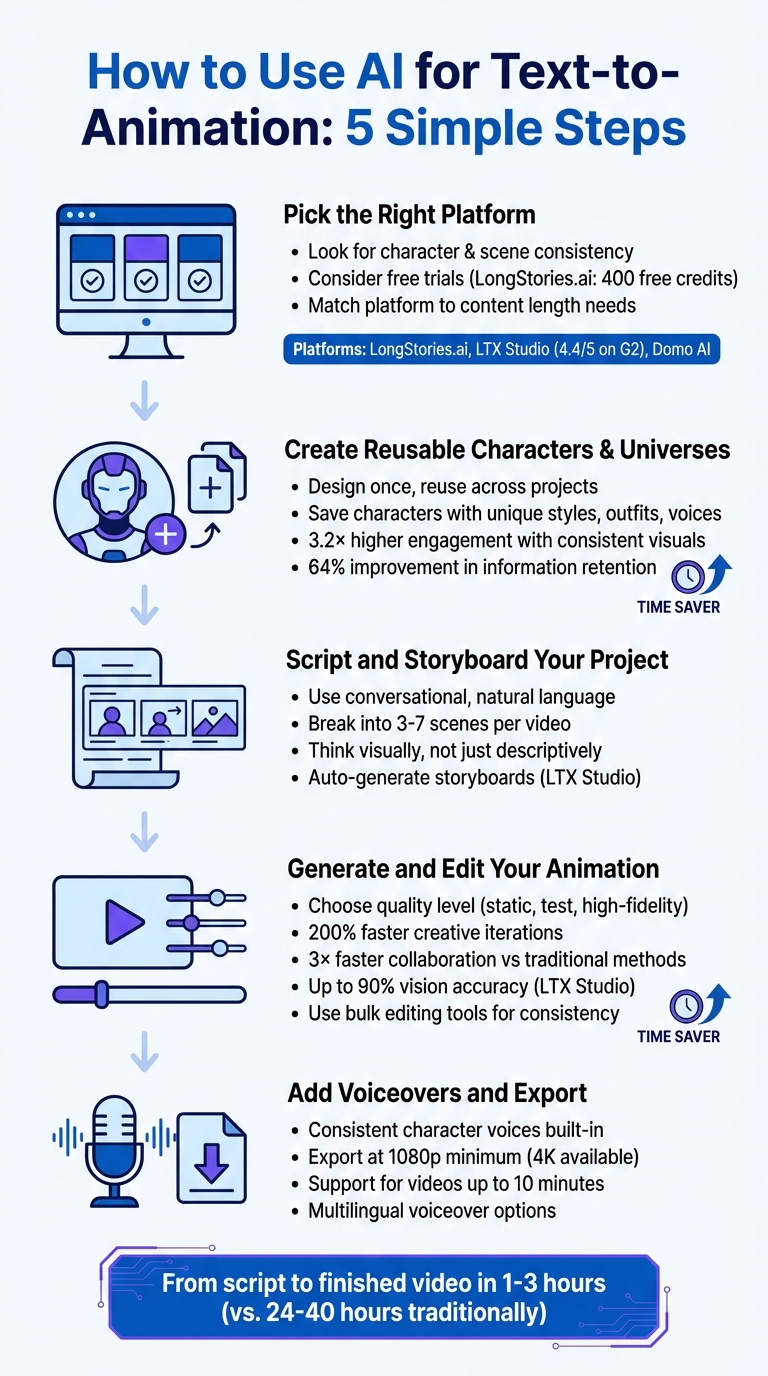
5-Step AI Text-to-Animation Workflow Guide
You don’t need a film degree or pricey gear to dive into AI animation. In fact, creating engaging animated content is easier than ever with the right tools. Whether you're a YouTube creator, educator, or small business owner, here’s a simple five-step process to get started.
Step 1: Pick the Right Text-to-Animation Platform
The first step is choosing a platform that fits your needs. A key factor here is character and scene consistency - this ensures your characters and environments look the same across all your videos, which helps build a cohesive brand. For example:
- LongStories.ai: Perfect for longer content (up to 10 minutes). Its "Universes" feature lets you define characters, styles, and voices once, then reuse them across multiple videos.
-
LTX Studio: Highly rated (4.4/5 on G2) and ideal for cinematic storytelling. It offers advanced tools like detailed camera controls and keyframe setups. As Taika Waititi, an Academy Award-winning filmmaker, said:
"It's amazing how fast it can generate ideas - it can accelerate the whole creative process."
- Domo AI: Great for beginners. It simplifies motion capture by letting you animate characters using real-life reference videos.
Look for platforms that are all-in-one or offer free trials - like LongStories.ai’s 400 free credits or Domo AI’s "Create for free" option - to test before committing.
Step 2: Create Reusable Characters and Universes
Once you’ve chosen a platform, focus on visual consistency. AI animation tools let you design characters and settings once and reuse them across different projects. For instance:
- LongStories.ai and AnimateAI: Allow you to save characters with unique styles, outfits, and voices for future use.
- LTX Studio: Features an "Elements" tool to lock in characters, objects, and locations for consistent storytelling.
You can upload reference images or use tools like Face Swap to ensure your characters’ facial details stay identical in every scene. If you’re working with a team, a shared asset library ensures everyone stays on the same page.
Consistency in style - whether it’s 3D animation, Japanese anime, or pixel art - also plays a big role. Studies show that creators see up to 3.2× higher engagement with consistent visuals, and educators report a 64% improvement in information retention when using visually consistent AI lessons. Tools like Krikey AI offer customizable templates for avatars and backgrounds, while AnimateAI provides starter packages for as little as $5.99.
Step 3: Script and Storyboard Your Project
Crafting a solid script is essential. Use conversational, natural language to make dialogue flow smoothly. Breaking your script into manageable scenes (3–7 per video) not only simplifies production but also keeps viewers engaged.
Platforms like LTX Studio allow you to upload scripts or concepts and instantly generate storyboards, speeding up the planning phase. Director Lane L. shared:
"I was drawn to LTX... because of its use of 'consistent characters,' but what I found really valuable... was the ability to quickly storyboard my videos."
When writing, think visually. Instead of describing emotions, paint a picture: "The hero sits alone on a park bench, shoulders slumped, staring at the ground." This approach helps the AI bring your story to life.
Step 4: Generate and Edit Your Animation
Now it’s time to bring your story to life. Start by generating your animation, choosing from various quality levels (e.g., static, test, or high-fidelity). AI tools can speed up creative iterations by up to 200% and enable collaboration that’s three times faster than traditional methods.
For example, LTX Studio boasts up to 90% vision accuracy, ensuring your animations align with your creative vision. Bulk editing tools let you tweak timing, emotions, and character movements across multiple scenes simultaneously, ensuring everything feels cohesive.
Once your animation looks polished, it’s time to add the finishing touch: voiceovers.
Step 5: Add Voiceovers and Export Your Video
The final step is integrating voiceovers and exporting your video. Platforms like LongStories.ai ensure your characters’ voices stay consistent, saving you the hassle of hiring voice actors or setting up recording sessions. For multilingual projects, tools like ElevenLabs can provide context-aware voiceovers.
Set your export resolution to at least 1080p for platforms like YouTube. Many tools, including LTX Studio and Domo AI, also support 4K outputs for higher-quality content. Keep an eye on video duration limits - LongStories.ai, for instance, supports videos up to 10 minutes, making it perfect for monetizable content.
As Veronica V., Team Leader at VW Trucks, put it:
"It's an AI-powered filmmaking tool that turns scene descriptions into fully realized movie sequences, and what really sets it apart is its ability to maintain consistency across scenes and characters."
Text-to-Animation Platform Comparison
When comparing top text-to-animation platforms, it’s clear each one has its own strengths and trade-offs. These differences often revolve around video length support, character consistency, and animation quality, making it essential to pick the right tool for your specific needs.
Platform Features and Capabilities
The most noticeable distinctions between platforms lie in video length, character consistency, and animation quality. Some platforms are tailored for quick, shareable clips, while others are designed for more elaborate, long-form storytelling.
| Platform | Primary Strength | Long-Form Support | Character Consistency | Max Resolution |
|---|---|---|---|---|
| LongStories.ai | YouTube-length videos with reusable Universes | Yes (up to 10 minutes) | Consistent characters | 1080p |
| LTX Studio | Full production suite (scripting to editing) | Yes (storyboard/timeline) | Consistent characters | 4K |
| Domo AI | Character rigging and style transfer | Optimized for short clips | High (motion capture) | 4K (upscaled) |
| Runway Gen-3 | High-fidelity motion and cinematic quality | Optimized for short clips (10 seconds) | Moderate (prompt-based) | High |
| Morphic | Quick generation and style variations | Optimized for short clips | Moderate | 1080p |
LTX Studio stands out with its robust tools, boasting over 135,000 users and 52 visual styles ranging from cinematic to anime. Its Shot Editor allows for precise control over camera angles and keyframes, offering a hands-on experience for creators. On the other hand, Domo AI has attracted a massive user base of 3 million, powering over 1 billion projects. Its beginner-friendly character animator uses real-life reference videos, making it particularly appealing for those new to animation.
For creators aiming to monetize their work on YouTube, platforms like LongStories.ai and LTX Studio are excellent choices. Both support longer video formats (7–10 minutes), which align with YouTube's monetization requirements, and ensure consistent characters across multiple projects.
Next, let’s dive into pricing and platform limitations to help narrow down your options.
Pricing and Platform Limitations
Pricing structures differ significantly across platforms, and understanding these differences can save you from paying for features you don’t need.
| Platform | Starting Price (USD/month) | Model Type | Key Limitations |
|---|---|---|---|
| LongStories.ai | $9 | Subscription (400 free credits to start) | Beta phase; three animation tiers |
| LTX Studio | Free / Paid | Computing time | Advanced features require paid tiers; desktop only |
| Domo AI | Free to start | Usage-based | Optimized for short clips; focuses on one character at a time |
| Runway Gen-3 | ~$12 | Credit-based | Credits expire quickly; steep learning curve |
| Morphic | Varies | Credit-based | Limited long-form capabilities |
LongStories.ai offers a straightforward entry point for YouTube creators, starting at $9/month with options for bulk editing and API access at higher tiers. LTX Studio provides a free tier, making it easy to test the platform, but premium tools and faster generation require a paid plan. Domo AI is ideal for those testing character animation, as its free plan allows users to experiment before upgrading.
One of the biggest challenges to watch for is video duration. Platforms like Runway Gen-3 and Morphic are better suited for short clips and may require multiple clips for longer content, which can disrupt visual consistency. Additionally, LTX Studio works exclusively on desktop browsers, limiting its usability on mobile devices. Meanwhile, Domo AI performs best when animating single-character scenes, making it less effective for complex multi-character projects.
Choosing the right platform not only simplifies your workflow but also ensures it aligns with your creative and monetization goals.
sbb-itb-94859ad
Benefits of AI-Driven Animation Workflows
AI tools are transforming animation production, offering more than just streamlined processes. They bring measurable advantages in saving time and money, scaling projects, and unleashing creative potential.
Time and Cost Savings
AI-driven animation tools can cut production time by up to 50%, and in some cases, as much as 80%, while reducing costs by 25%–30%. By automating labor-intensive tasks like keyframing, rigging, lip-syncing, and rotoscoping, these tools drastically reduce manual effort. For example, Adobe Sensei can shrink rendering times by up to 75%.
In 2025, Hatch Studios adopted SuperAGI's animation platform, achieving a 30% boost in production efficiency, a 25% cut in costs, and an 85% reduction in time spent on in-betweening and scene rendering. Even motion capture, once a costly and complex process, has become more accessible thanks to AI-powered solutions that work with standard webcams or smartphones, eliminating the need for expensive suits and studio setups.
The financial benefits go beyond large studios. Smaller teams and independent creators can now produce professional-quality animations without relying on big production houses or costly outsourcing. Today, 75% of animation studios use AI tools to streamline their workflows, and 85% of companies leveraging AI report significant time savings, with project timelines reduced by an average of 30%.
These productivity gains also ensure that as projects scale, creators can maintain consistency in their work.
Scalability and Brand Consistency
AI tools make it easier to create at scale while preserving a consistent visual and narrative identity. Platforms like LongStories.ai allow creators to build reusable universes with characters, styles, and voices that stay consistent across long-form content, even up to 10 minutes.
In 2025, Electrolux showcased the power of AI-generated content by using Synthesia's platform to cut post-onboarding training time for new employees by 60%, maintaining a unified instructional voice across its global offices. Similarly, Spirit Airlines reduced phone support inquiries by 76% by deploying AI-generated training materials, which enhanced both customer self-service and staff preparedness.
Modern AI models, using "transformers", ensure consistency in lighting, objects, and character appearances across frames, avoiding glitches or "popping" effects. This temporal consistency is crucial for creators producing frequent content while maintaining high quality. AI also enables rapid testing of multiple video versions, allowing creators to tailor content for diverse audiences and platforms without losing their brand identity.
With the technical challenges minimized, creators can focus their energy where it matters most - storytelling.
More Time for Storytelling
By automating repetitive tasks, AI shifts creators from technical operators to creative directors. Tools like Runway ML reduce manual editing by up to 90%, giving creators more time to refine tone, narrative flow, and emotional timing, rather than getting bogged down in frame-by-frame adjustments.
"AI is an incredible assistant, not a visionary. The soul of a story still comes from you, your voice, your experience, your curiosity." - Sabir Ahmed, Product, Marketing & Growth, Fliki
This shift isn’t just theoretical - it’s practical. Creators can now experiment with different narrative approaches or visual styles in minutes instead of weeks, enabling faster and more effective story development. The lowered barriers to entry - like reduced costs and the need for specialized equipment or years of training - mean that more storytellers can bring their visions to life. Among creatives using generative AI tools, 66% say it helps them produce better content.
The industry is moving toward hybrid workflows, where AI handles 50% of repetitive tasks, leaving humans to focus on the emotional depth and quality of the final product. Francis Daoust, CEO of Toon Boom, puts it best:
"AI is a tool that can help animators be more efficient and creative, but it's not a replacement for human talent and imagination".
With this balance, creators can dedicate their efforts to crafting stories that truly connect with audiences.
Conclusion
AI-powered text-to-animation tools are reshaping how content is created. What used to take 24–40 hours and cost between $1,800 and $3,000 for a five-minute video can now be done in just 1–3 hours for about $100–$200. This shift eliminates the need for traditional studios - complete with cameras, lighting, and editing experts - replacing them with a process as simple as drafting a document.
But it’s not just about saving time and money. These tools offer creators the ability to produce consistent, scalable brand visuals. Platforms now allow for the creation of reusable "universes" with characters, styles, and voices that remain consistent across projects. This removes the hassle of repetitive prompting and ensures every video maintains a polished, professional appearance. Here’s a quick breakdown of the benefits these tools bring:
Key Takeaways
- AI animation tools can slash production times by 85% to 95% and cut costs by 90% to 97%.
- AI-generated videos often see 40% to 60% higher engagement compared to traditional text-based content.
- Today’s platforms can create polished, 10-minute videos - complete with synchronized audio, consistent characters, and smooth animations - in under three hours.
- The secret to success lies in the script. Creators who dedicate 60% to 70% of their time to storytelling, while leaving tasks like keyframing, rigging, lip-syncing, and rendering to AI, achieve the best results.
(Data based on recent industry comparisons)
With these insights in mind, let’s explore how you can start integrating AI animation into your workflow.
Next Steps
Begin with a simple project to familiarize yourself with the process. Pick a platform that aligns with your goals, whether it’s for marketing clips, training videos, or long-form storytelling with recurring characters. For example, LongStories.ai offers 400 free credits for new users, making it easy to experiment before committing to a subscription. Most creators feel comfortable after producing 3 to 5 videos. Initial projects might take 4 to 7 hours, but as you gain experience, production time can drop to just 1 to 3 hours per video.
This streamlined approach not only simplifies animation workflows but also ensures you stay competitive in a fast-evolving landscape. Now’s the time to embrace AI animation and transform your creative process.
FAQs
How do AI text-to-animation tools keep characters consistent across videos?
AI text-to-animation tools make it easy to keep characters consistent by relying on reusable models or references. These can include base images, LoRA (Low-Rank Adaptation), or pre-defined "Universes." These references hold essential details like a character's visual style, voice, and key traits. When you create new poses, outfits, or scenes, the tool automatically integrates these elements, ensuring everything fits together seamlessly in your videos.
Platforms like LongStories.ai take this concept a step further. They let creators design customizable "Universes" where characters, styles, and voices remain consistent. This not only saves time but also helps creators maintain their brand identity with ease, allowing them to focus more on crafting engaging stories.
How does AI help save time and reduce costs in animation production?
AI-driven animation tools have transformed the production process, slashing timelines by an impressive 50–80% compared to older, more manual methods. They also bring down costs by 25–30%, making animation projects more affordable and within reach for a broader range of creators. By automating tedious tasks like character rigging, voiceovers, and scene rendering, these tools free up creators to concentrate on the heart of their work: storytelling. This shift not only streamlines workflows but also helps eliminate repetitive tasks and common production delays.
How can AI help creators produce animations without traditional resources?
AI-powered text-to-animation tools are changing the game for content creators, making it possible to turn written scripts into polished videos without needing a whole production team. These platforms take care of everything - visuals, voice-overs, and even background music - making animation accessible to anyone, no matter their skill level.
Take DomoAI, for instance. It can create lively character animations from just a simple description or even a photo. Then there’s LongStories.ai, which lets creators produce longer videos - up to 10 minutes - using reusable characters, styles, and voices. By automating the heavy lifting of animation and editing, these tools free up time and reduce costs, allowing creators to focus on what matters most: telling their story.
AI is reshaping animation by making it quicker, more affordable, and within reach for everyone. Whether you’re a solo creator or part of a small team, these tools empower you to produce high-quality, consistent content that strengthens your brand and engages your audience.
Related posts
LongStories is constantly evolving as it finds its product-market fit. Features, pricing, and offerings are continuously being refined and updated. The information in this blog post reflects our understanding at the time of writing. Please always check LongStories.ai for the latest information about our products, features, and pricing, or contact us directly for the most current details.