
Study: How Storytelling Styles Affect Audiences

Storytelling isn’t just about sharing tales - it’s a proven way to boost audience engagement and retention. Research shows that posts with storytelling elements drive 8x more interactions compared to standard content. Emotional connections, suspenseful narratives, and personal stories tend to perform best, while visual and interactive formats amplify impact.
Key findings include:
- Emotional storytelling builds deep connections and encourages sharing.
- Humor increases relatability and boosts virality.
- Suspense hooks audiences, keeping them engaged longer.
- Personal narratives foster trust and loyalty.
- Visual content is 40x more likely to be shared than plain text.
AI tools like LongStories.ai allow creators to test different storytelling styles quickly, helping them identify what resonates most with their audience. The takeaway? Tailor storytelling techniques to your audience’s preferences to maximize engagement and retention.
Main Storytelling Styles and Their Effects
Types of Storytelling Styles
Storytelling comes in many forms, each offering creators a unique way to connect with their audience.
Emotional storytelling dives into feelings like empathy, joy, and hope. By pulling at heartstrings, it creates a personal bond between the audience and the story, making them feel invested in both the narrative and its characters.
Entertaining storytelling leans on humor and playful narratives to keep people hooked. This style is a favorite among micro-influencers because it boosts engagement and keeps audiences coming back for more lighthearted, relatable content.
Personal narrative storytelling thrives on authenticity. By sharing real-life experiences and opening up, creators build trust and foster a sense of connection with their followers.
Sensory-rich storytelling paints vivid pictures with words, tapping into smells, tastes, and textures. It sparks the imagination, helping audiences feel like they’re right there in the moment with the characters.
Suspense-driven storytelling keeps viewers on the edge of their seats with cliffhangers and unresolved plotlines. This approach hooks audiences by making them eager to find out what happens next.
Data-driven storytelling takes a more factual route, weaving in statistics, research, and evidence. While it might not tug at the heartstrings as much, it appeals to analytical minds and builds credibility - perfect for professional audiences.
Let’s explore how these approaches shape audience reactions.
How Each Style Affects Audience Response
Each storytelling style has a unique way of engaging audiences, as research highlights.
Emotional storytelling creates lasting connections. By tapping into universal emotions, it encourages likes, shares, and comments. The deep emotional ties often lead to increased profile visits and stronger audience engagement overall.
Humor-based storytelling makes content feel approachable and fun. It’s highly shareable, often going viral as people pass along lighthearted, relatable posts to their networks.
Suspense-driven storytelling excels at holding attention. It keeps audiences curious and eager to stick around, as radio host Ira Glass explains:
"The whole shape of a story is that you are throwing out questions to keep people watching or listening and then answering them along the way".
Personal narratives build loyalty. Studies by Green and Brock (2000) and Escalas (2004) show that sharing personal experiences fosters emotional connections, leading to higher follower retention rates.
Interactive and visual formats encourage participation. Posts that end with a question see 92% more engagement than those that don’t, proving the value of inviting audiences to join the conversation.
The table below breaks down the effects of each storytelling style.
Storytelling Styles Comparison Chart
| Storytelling Style | Engagement Effects | Retention Outcomes | Best Audience Fit |
|---|---|---|---|
| Emotional | Encourages sharing, builds deep connections | Strong memory impact | All ages, especially millennials |
| Entertaining/Humor | Highly relatable, viral potential | Memorable and shareable | Younger audiences, social media users |
| Personal Narrative | Builds trust and loyalty | High follower retention | Broad appeal, especially Gen Z |
| Suspense-driven | Prolonged attention spans | Curiosity-driven repeat visits | All demographics, great for series content |
| Sensory-rich | Immersive and engaging | Sparks imaginative involvement | Creative audiences, visual learners |
| Data-driven | Boosts credibility, appeals to logic | Moderate retention | Professionals, B2B audiences |
| Interactive/Visual | Drives participation | Strong retention through engagement | Digital natives across platforms |
Brands that use structured storytelling approaches can see up to three times more engagement compared to those with unstructured content.
How Different Audiences Respond to Storytelling
Age and Background Differences
Audience reactions to storytelling aren’t just shaped by their age or cultural background - it’s also about how they prefer to learn and engage with content.
Age plays a big role in how stories are received. Children love visuals and interactive formats that spark their imagination. Think animated videos or gamified stories - these formats encourage participation and keep young minds entertained and engaged.
Teens, on the other hand, are all about fast-paced, serialized content that keeps them on the edge of their seats. Platforms like TikTok, with its short-form videos and interactive features like polls, are perfect for this group. They want content that feels immediate and gives them a chance to actively participate in the narrative.
Adults tend to connect most with stories that feel genuine and emotionally resonant. Personal narratives and behind-the-scenes content strike a chord because they offer authenticity and relatability.
Seniors lean toward spoken stories and reflective formats. They appreciate content that allows time for thought and ties into their own life experiences. Research shows that this group values depth and substance over speed, making them more likely to engage with thoughtful storytelling sessions.
Cultural background also plays a key role. People are naturally drawn to stories that reflect their own values, experiences, and worldviews. When creators incorporate culturally relevant symbols, language, or themes, the result is often a stronger emotional connection and higher levels of audience engagement.
But age and culture aren’t the only factors - how people prefer to learn also shapes what kind of storytelling resonates with them.
Learning Styles and Story Preferences
Different learning styles influence how audiences connect with storytelling elements.
Visual learners are captivated by strong imagery, infographics, and animations. These tools help them process information more effectively and keep them engaged. For visual learners, showing is always more impactful than telling.
Auditory learners thrive on spoken narratives, podcasts, and stories enhanced with sound effects or music. Clear voiceovers and well-designed audio elements create a richer experience for this group, who often enjoy consuming content while multitasking.
Kinesthetic learners need hands-on engagement to stay interested. Gamified experiences, interactive polls, and user-generated content work well for them because they prefer to actively participate rather than passively absorb information.
Matching Styles to Audience Groups
Understanding how different demographics and learning styles align with storytelling techniques helps creators make smarter decisions about their content. Here's a breakdown of how formats and styles match up with audience preferences:
| Audience Group | Preferred Format | Learning Style Match | Key Success Factors |
|---|---|---|---|
| Children (5-12) | Animated videos, games | Visual, kinesthetic | Bright colors, character interaction, simple plots |
| Teens (13-19) | Short videos, series content | Visual, interactive | Suspense, social elements, trending topics |
| Adults | Personal stories, behind-the-scenes | All styles | Authenticity, relatability, emotional depth |
| Seniors (55+) | Spoken stories, reflective content | Auditory, traditional | Life experience connections, slower pace |
Experts suggest structuring stories with clear narrative arcs, using emotional triggers like humor or inspiration, and tailoring content to align with audience values and interests. The most effective storytellers engage multiple senses, build suspense, and invite participation through interactive elements.
This all points to one clear takeaway: storytelling isn’t one-size-fits-all. When creators take the time to understand their audience’s age, cultural background, and learning preferences, they see much stronger engagement and retention across their content.
Using These Findings with AI Video Tools
How AI Tools Help Test Different Story Styles
AI video platforms are transforming the way creators experiment with storytelling by enabling them to test various narrative styles almost instantly. This bridges the gap between research insights and practical application for content creators.
Take LongStories.ai, for example. This platform allows users to input different prompts and generate fully animated, voiced stories in seconds. By doing so, creators can quickly test how audiences react to suspenseful plots, emotional arcs, or humorous twists - without the lengthy and costly process of traditional video production.
The platform’s chat-based interface makes it easy to tweak story elements like pacing, character development, and structure. Creators can then analyze audience engagement metrics to determine which style resonates most. Early adopters of LongStories.ai have reported higher interaction rates when using serialized stories or personal narratives that keep viewers curious for more.
Research backs up these findings. Storytelling content has been shown to generate nearly eight times more interactions (880 vs. 108). AI tools further enhance this by tracking metrics like watch time, drop-offs, and interaction rates, helping creators pinpoint techniques - such as starting mid-action or using emotional hooks - that improve retention.
The ability to test and refine in real-time is a game-changer. For example, creators can experiment with ending stories on engaging questions and immediately see how audiences respond. This feedback loop allows for continuous improvement, driven by actual audience behavior rather than assumptions.
How LongStories.ai Compares to Other Platforms
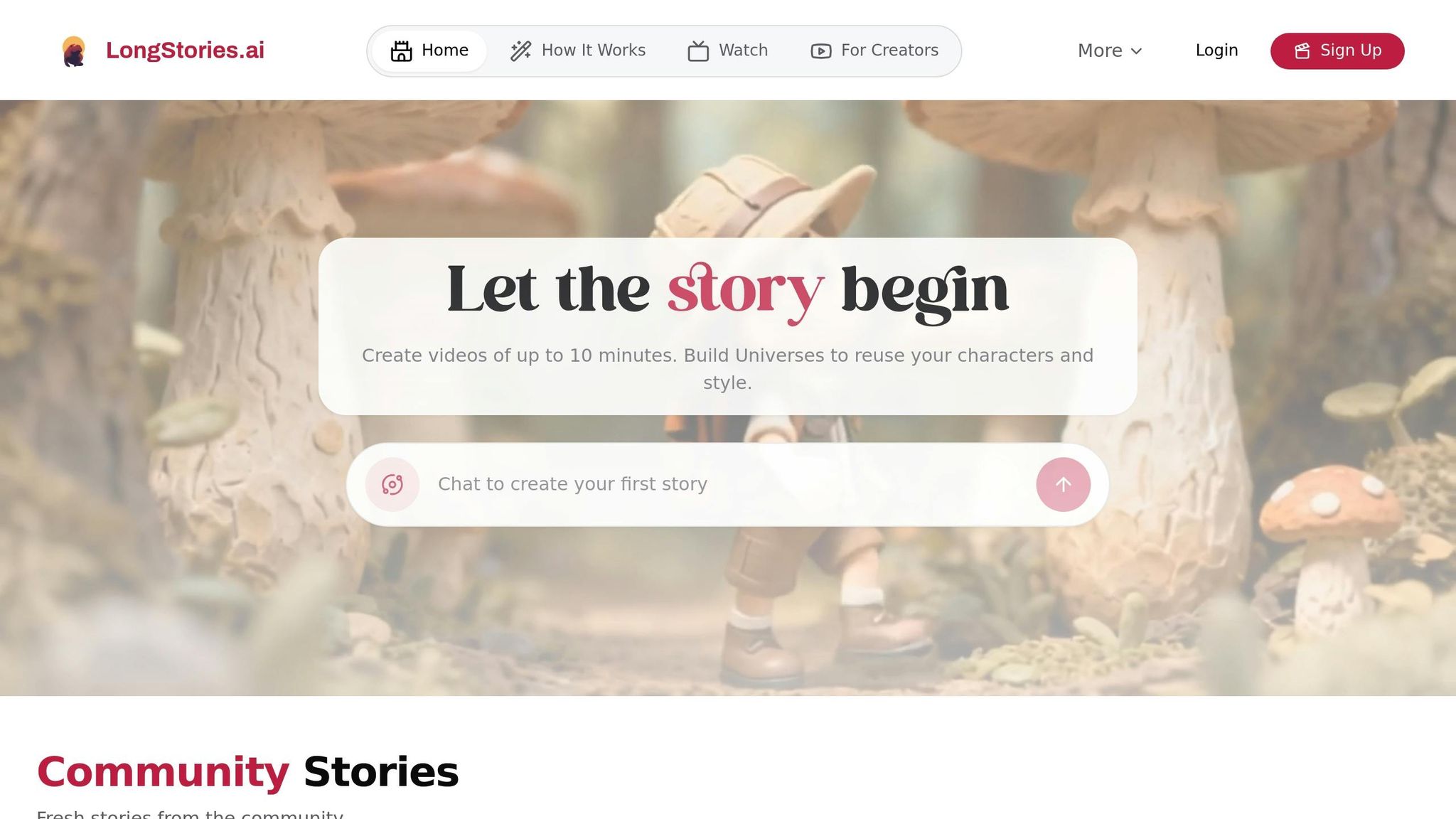
When it comes to applying storytelling research, not all AI video platforms are created equal. A closer look at the options reveals why LongStories.ai stands out.
One key advantage is its support for long-form content - up to 10 minutes. Research shows that spoken stories of this length tend to engage audiences more deeply than shorter formats. Many competing platforms, like Domo AI and LTX Studio, focus on short-form content, which can limit the depth of narrative development. For creators aiming to build a connection with their audience, this difference is critical.
Another standout feature is LongStories.ai’s "Universes" tool, which supports consistent world-building. This feature allows creators to test variations in storytelling techniques while keeping other elements - like visuals and audio - constant. This level of control makes it easier to identify which changes truly impact engagement.
While platforms like Domo AI and LTX Studio excel in automated video editing, they often rely on templates that restrict creative experimentation with story structure or character development. In contrast, LongStories.ai offers flexible animation modes, ranging from simple to professional-quality visuals. This flexibility is vital, as studies indicate that visual content is 40 times more likely to be shared than text-based content. Being able to adjust animation quality helps creators tailor their videos to audience preferences.
For those targeting specific demographics, LongStories.ai’s personalization features are invaluable. Creators can easily adapt language, themes, and visuals to suit different audience groups - a crucial capability given that factors like age and cultural background significantly influence storytelling preferences.
Additionally, the platform’s robust analytics tools support a data-driven approach to storytelling. Creators can track engagement trends across various audience segments and refine their content accordingly. This iterative process ensures that storytelling strategies are grounded in real audience feedback rather than generalized research findings.
With its blend of long-form content capabilities, creative flexibility, and advanced analytics, LongStories.ai provides creators with the tools they need to experiment effectively and apply storytelling research in a meaningful way. Unlike platforms that rely on static templates, it empowers creators to craft and refine narratives that truly connect with their audiences.
sbb-itb-94859ad
Research Methods and Limitations
How the Research Was Conducted
This study on storytelling styles and audience engagement took a multi-method approach, blending both quantitative and qualitative techniques. This combination allowed researchers to explore how different narrative styles resonate with various audiences.
One key method used was Q methodology, which helped capture subjective opinions by having participants sort statements about storytelling approaches. This process uncovered demographic trends and the reasons behind audience responses, going beyond simple preference data.
Social media analytics played a major role in tracking real-time engagement metrics like likes, shares, comments, and view durations across different storytelling formats. This provided concrete evidence of which narrative styles sparked the most interaction and held viewers' attention the longest. The data highlighted distinct audience reactions to storytelling elements such as character development, pacing, and emotional appeal.
The research also included surveys and focus groups to gather self-reported emotional responses and explore what made certain stories memorable. These methods offered a deeper understanding of audience motivations and the emotional impact of different storytelling techniques.
This mixed-methods approach was critical because each research tool revealed unique aspects of audience behavior. Analytics showed what people did, while surveys and focus groups explained why they acted that way. With the methods outlined, let’s now consider the study's limitations.
What the Research Does and Doesn't Tell Us
While the findings are insightful, several limitations should be kept in mind when applying them to broader contexts.
One key limitation is sampling bias. The study may have overrepresented younger, more digitally active audiences, potentially skewing results. This means the findings might not fully reflect the preferences of older or less tech-savvy demographics.
Another challenge was isolating the effects of storytelling from other factors. External variables like platform algorithms, audience familiarity with similar content, or even the time of day posts were published could have influenced engagement. As a result, it’s hard to pinpoint how much of the audience response was driven purely by storytelling style.
Self-reporting inaccuracies in surveys also present a concern. Participants may not recall their emotional responses accurately or might provide answers they think researchers want to hear. Focus groups face similar issues, as small sample sizes and group dynamics can limit how well the findings apply to larger populations.
Additionally, the methods varied in their ability to analyze demographic differences. While surveys and focus groups could segment responses by factors like age and background, social media analytics often lacked detailed user demographics unless platforms shared that data. This gap makes it harder to fully understand how storytelling preferences differ across audience segments.
Here’s a quick summary of the strengths and limitations of each method:
| Method | Strengths | Limitations |
|---|---|---|
| Q Methodology | Systematically captures subjective viewpoints | Results may not generalize to larger populations |
| Social Media Analytics | Provides real-time, quantitative engagement data | Lacks insight into deeper emotional or cognitive responses |
| Surveys | Offers direct feedback from participants | Prone to self-reporting bias and limited context |
| Focus Groups | Enables detailed exploration of perceptions | Small sample sizes and groupthink can skew results |
Despite these limitations, the research provides a strong foundation for understanding audience engagement. However, content creators should treat these findings as guidelines rather than definitive answers. To truly understand what works, it’s essential to test various storytelling styles with your own audience, track engagement metrics, and gather direct feedback.
Tools like LongStories.ai can help address some of these challenges by allowing creators to quickly prototype and test different storytelling approaches. By experimenting and refining based on real engagement data, content creators can tailor their strategies to suit diverse audience needs. These insights are a starting point, but ongoing experimentation is key to finding what resonates most.
How to Tell Powerful Stories That Connect With Your Audience
Key Takeaways
Our research highlights that using a variety of storytelling techniques leads to better audience engagement. Stories that tap into emotions, include personal experiences, and incorporate sensory details consistently perform better than straightforward, factual content. In fact, storytelling posts outshine non-storytelling ones across all engagement metrics.
Visual and interactive content also plays a big role in boosting engagement. Posts that include questions see an impressive 92% increase in engagement compared to those without, and visual content gets shared 40 times more often on social media. This underscores the importance of prioritizing multimedia storytelling over plain text-based content.
Building trust through authenticity is another key factor. Research shows that brands perceived as genuine and those using well-structured narratives experience greater audience loyalty and interaction. Creators who align their stories with their brand identity and audience values are more likely to see meaningful results.
AI tools are transforming how creators approach storytelling. Platforms like LongStories.ai make it easier to test and refine different narrative styles, experiment with character development, and identify what resonates most with audiences. With over 5,000 video adventures already created, this platform shows how AI can simplify sophisticated storytelling for creators without advanced video production skills.
To truly connect with diverse audiences, creators need to vary their storytelling techniques. Short-form videos resonate with younger audiences on social media, while serialized content helps build ongoing loyalty. Adding interactive elements like polls or user-generated content encourages community involvement and fosters deeper connections.
It's important to note that these findings serve as guidelines rather than hard-and-fast rules. Sampling bias toward younger, digitally active audiences means the results may not represent all demographics. Additionally, factors like platform algorithms and posting times can influence engagement beyond the storytelling style itself.
Ultimately, success comes from constant experimentation and refinement. By tracking metrics like interactions, retention, and audience growth, creators can use AI analytics or traditional methods to fine-tune their strategies. Whether through AI tools or more conventional approaches, those who experiment with different storytelling techniques and adapt based on audience feedback will cultivate stronger, more engaged communities around their content.
FAQs
How can AI tools like LongStories.ai enhance storytelling for content creators?
AI tools such as LongStories.ai make it easier than ever for creators to produce captivating, long-form video stories - no specialized video-editing skills required. With just a conversation, users can turn text prompts into fully animated, voiced cartoons that can run up to 10 minutes. The platform takes care of everything, from writing the script to animating the visuals, enabling users to create polished, customized content in just a few minutes.
This streamlined process not only cuts down on production time but also gives creators the freedom to explore different storytelling techniques, making it easier to engage with a variety of audiences.
How do emotional and data-driven storytelling styles impact audience engagement?
Emotional storytelling grabs attention by weaving relatable characters, vivid imagery, and engaging narratives into the mix. This style resonates deeply because it connects with the audience on a personal level, stirring emotions and making the message stick. It's no wonder this approach often leads to higher engagement and better recall.
On the other hand, data-driven storytelling appeals to those who prioritize logic and evidence. By leveraging statistics, charts, and factual insights, it builds trust and credibility. While it might not tug at the heartstrings, it's a powerful way to communicate complex ideas, particularly for analytical minds or professional settings.
Each approach has its own strengths, and the best choice depends on who you're speaking to and what you're trying to convey. In many cases, blending emotional elements with data-driven insights can strike the perfect balance, creating a story that's both persuasive and memorable.
How do age and cultural background shape audience responses to different storytelling styles?
Age and background have a huge impact on how people connect with and remember stories. For instance, younger audiences often lean toward fast-paced, visually rich storytelling, while older viewers might gravitate toward narratives that delve into emotions or follow more familiar, classic structures. Similarly, where someone comes from culturally influences their preferences for themes, pacing, and even humor - since storytelling often mirrors shared values and life experiences.
By understanding these nuances, creators can craft stories that truly resonate with different groups. Tools like LongStories.ai make this process simpler by allowing creators to test out various storytelling styles and fine-tune their content for specific audiences.
Related posts
LongStories is constantly evolving as it finds its product-market fit. Features, pricing, and offerings are continuously being refined and updated. The information in this blog post reflects our understanding at the time of writing. Please always check LongStories.ai for the latest information about our products, features, and pricing, or contact us directly for the most current details.