
Real-Time Script Editing: Benefits for Creators

Real-time script editing is changing how videos are made. Instead of tedious, manual edits, creators can now adjust scripts directly, and the visuals update automatically. This approach simplifies collaboration, reduces editing time by up to 50%, and avoids errors caused by outdated drafts or miscommunication.
Key Takeaways:
- Faster Production: Script-based editing slashes post-production time significantly.
- Improved Collaboration: Teams work on the same live document, eliminating version conflicts.
- Lower Costs: AI tools handle repetitive tasks, reducing labor hours and external resources.
For creators, marketers, and storytellers, these tools make video production smoother, more efficient, and accessible to non-editors. Platforms like LongStories.ai, Scripto, and InVideo lead the way by integrating AI and real-time updates into the workflow.
Common Scriptwriting Problems for Content Creators
Scriptwriting plays a crucial role in keeping production teams on the same page, especially when last-minute changes arise. Without proper tools or processes, teams can face miscommunication, version chaos, and frustrating delays.
Miscommunication and Collaboration Breakdowns
Rewrites often happen unexpectedly, and when they do, they can throw entire teams off track. These disruptions affect focus and productivity, especially when there's no clear creative hierarchy to resolve disagreements over storylines or character arcs.
Relying on outdated methods like email chains or static PDFs only worsens the problem. Experts describe this as a "flawed status quo". Scripto emphasizes the consequences:
One midnight rewrite. Five departments derailed
This illustrates how late-stage updates can ripple across departments, creating confusion and inefficiency. Real-time collaboration tools help avoid these issues by ensuring everyone works from the same, up-to-date script.
Version Control Conflicts
Keeping everyone on the same version of a script is another major hurdle. Version conflicts are common, with teams often using outdated drafts while others are editing or filming with newer versions. This mismatch leads to duplicated efforts and costly errors. As Scripto bluntly puts it:
If [scripts are] stuck in PDFs, your whole pipeline is guessing
Traditional file-saving methods add to the chaos. Corrupted or misplaced files can bring production to a standstill, while older tools that lock pages prevent multiple team members from working simultaneously. These bottlenecks can be avoided with cloud-based, real-time tools that centralize script access and updates.
Production Delays from Manual Revisions
Manual revisions are another time drain for production teams. What should be quick fixes often turn into hours-long tasks, as editors scramble to locate matching footage or adjust story arcs without a finalized script. Without a clear blueprint, post-production becomes a guessing game, doubling or even tripling editing time.
Kay Sesoko of Cutback Corporation sums it up well:
In 2025, skipping the script is skipping efficiency
Traditional methods like syncing footage "by eye" or "by ear" waste valuable time. Modern tools, on the other hand, streamline the process by automatically syncing script changes across the entire production pipeline, helping teams stay efficient and focused.
sbb-itb-94859ad
How Real-Time Script Editing Tools Solve These Problems
Real-time script editing tools tackle the headaches of outdated PDFs and endless email threads by centralizing updates. With these tools, everyone on the team can see changes as they happen. Christiane Jory from Scripto highlights this benefit:
Scripto was built with collaboration in mind. Like Google Docs, multiple people can open and edit a document at the same time.
Instant Updates and Collaborative Features
Modern platforms come loaded with features that make collaboration smoother and more efficient. For example, tools like presence indicators and color-coded avatars show exactly who is working on what. Clicking on an avatar automatically takes you to that person's section of the script. Scripto allows for simultaneous typing, while HeyGen uses a "Single Editor Mode" to avoid version conflicts. HeyGen explains:
Single Editor Mode makes it easy for members of Teams or Enterprise plans to make videos together... No switching tabs, no version confusion.
These platforms also simplify access control. A team member can request editing access with one click, and the current editor is smoothly transitioned to a viewer role without interrupting the process. This streamlined collaboration paves the way for even greater efficiencies through AI.
AI-Assisted Revisions for Faster Workflows
AI tools are changing how edits are made by replacing tedious, frame-by-frame adjustments with simple text commands. Instead of manually searching through footage to make changes, editors can update the script or type in specific modifications. Invideo highlights this advantage:
Invideo streamlines revisions through its 'fast and text-based' editing capabilities, allowing teams to quickly iterate on video content by applying changes directly via text commands.
Selective editing features, like LTX Studio's "Brush" tool, take precision a step further. With this tool, users can modify specific parts of an image or video without regenerating the entire asset. As LTX Studio explains:
Highlight an area, describe the change, and update only that section without regenerating the entire image.
This level of precision saves significant time, and AI steps in to handle repetitive tasks like animating text, sourcing b-roll footage, and syncing voiceovers automatically.
Feedback Integration
These tools also simplify the feedback process. Reviewers can add comments directly to the script in real time, and integrated tagging and navigation features make it easy to approve or refine edits on the spot. Scripto describes this functionality:
When anyone edits the script, every user will see their changes occur in real time on their own screen.
This real-time feedback loop allows teams to discuss and finalize changes during the editing session itself, cutting down on the delays that are common with traditional review processes.
Key Benefits of Real-Time Script Editing for Creators
Real-time script editing tools are changing the game for content creators by improving production speed, boosting team collaboration, and cutting costs. These tools are reshaping how creators approach their work, making the process faster, smoother, and more efficient.
Faster Script-to-Video Production
One of the standout perks of real-time script editing is how it slashes editing time - by as much as 50%. With these tools, you can paste your script into the platform, and it automatically generates a rough video cut by syncing the transcript with the text.
Take Invideo, for example. It allows creators to make text-based revisions that update videos instantly. As the company explains, the platform can "instantly turn your text inputs into publish-ready videos". For creators juggling multiple projects each week, this kind of efficiency can mean staying on top of deadlines without burning out. Plus, faster production times naturally lead to better teamwork and smoother workflows.
Better Team Collaboration
Gone are the days of version control headaches. Real-time tools ensure everyone works off the same, up-to-date document, eliminating confusion and miscommunication. For instance, production teams for major shows have used Scripto's real-time features to avoid delays caused by outdated versions. The platform acts as a "shared brain", keeping everyone on the same page.
Features like presence indicators let team members see who's online and what they're working on, while tools like HeyGen's "Request Access" function allow seamless task transfers. This means producers can watch writers edit live and jump in when needed. No more endless email chains or juggling multiple file versions - just a streamlined, collaborative process.
Lower Production Costs
Real-time editing doesn't just save time - it also saves money. By simplifying workflows, these tools reduce labor hours and cut down on the need for external resources. For example, instead of manually adjusting frames, creators can implement feedback through simple text edits, dramatically reducing revision time. Better version control also eliminates costly re-edits caused by outdated scripts.
AI-powered platforms take it a step further by generating scripts, voiceovers, and visuals in-house, reducing the need for stock footage or voice talent. Scripto even offers free access for small teams of up to three collaborators, making high-quality tools affordable for smaller operations. For larger teams, the cost savings multiply quickly. As Cutback.video puts it, "Skipping the script step isn't just inefficient anymore, it's costly". With up to 50% less time spent on post-production, teams can either double their output or slash their editing expenses in half.
Top Platforms for Real-Time Script Editing
Real-time script editing has reshaped how creators approach video production, offering tools that simplify workflows and enhance collaboration. Several platforms now cater to specific production needs, whether it's managing long-form content, fine-tuning pre-production processes, or syncing scripts with video footage. Here’s a closer look at some of the top platforms driving these advancements.
LongStories.ai: Scaling Long-Form Content Creation

LongStories.ai tackles a common challenge in video production: maintaining continuity across multiple episodes. Through its "Universe" system, creators can define characters, visual styles, and voices once, then generate unlimited videos based on these presets. This eliminates inconsistencies that often arise with traditional AI tools, where characters may vary from one video to the next.
The platform supports long-form videos of up to 15 minutes, helping creators maximize monetization opportunities. Subscription plans start at $25/month. Users can choose from three animation styles based on their needs: Just Storyboard for quick concept testing, Fast Animation for efficient production, and Pro Animation for polished results. Setup is quick - taking only 10–15 minutes - and future episodes can be generated with 30-second prompts.
One standout feature is its bulk editing capability, allowing creators to make sweeping changes - like updating a character’s outfit across an entire video - with a single command. The Pro and Creator plans, priced at $59/month and $99/month respectively, also enable users to download all clips, images, and audio files in a ZIP archive for easy access.
Revise AI: Streamlined Script Workflow Tools
Revise AI focuses on improving the pre-production phase of video creation. It offers AI-driven script breakdowns that make planning shoots more efficient, helping teams streamline tasks like scheduling and resource allocation. By integrating real-time script revisions with production planning tools, Revise AI facilitates better coordination among writers, directors, and production crews. Unlike platforms centered on video generation, Revise AI zeroes in on refining scripts and building production schedules.
Cutback Editor: Simplifying Script and Video Alignment

Cutback Editor solves the tricky problem of keeping scripts and video footage perfectly aligned during revisions. Its chat-based upload system and auto-alignment tools ensure that any script edits automatically adjust the corresponding video segments. This eliminates the need for manual adjustments, saving time and ensuring revisions remain consistent throughout the editing process.
Comparison of Real-Time Script Editing Platforms
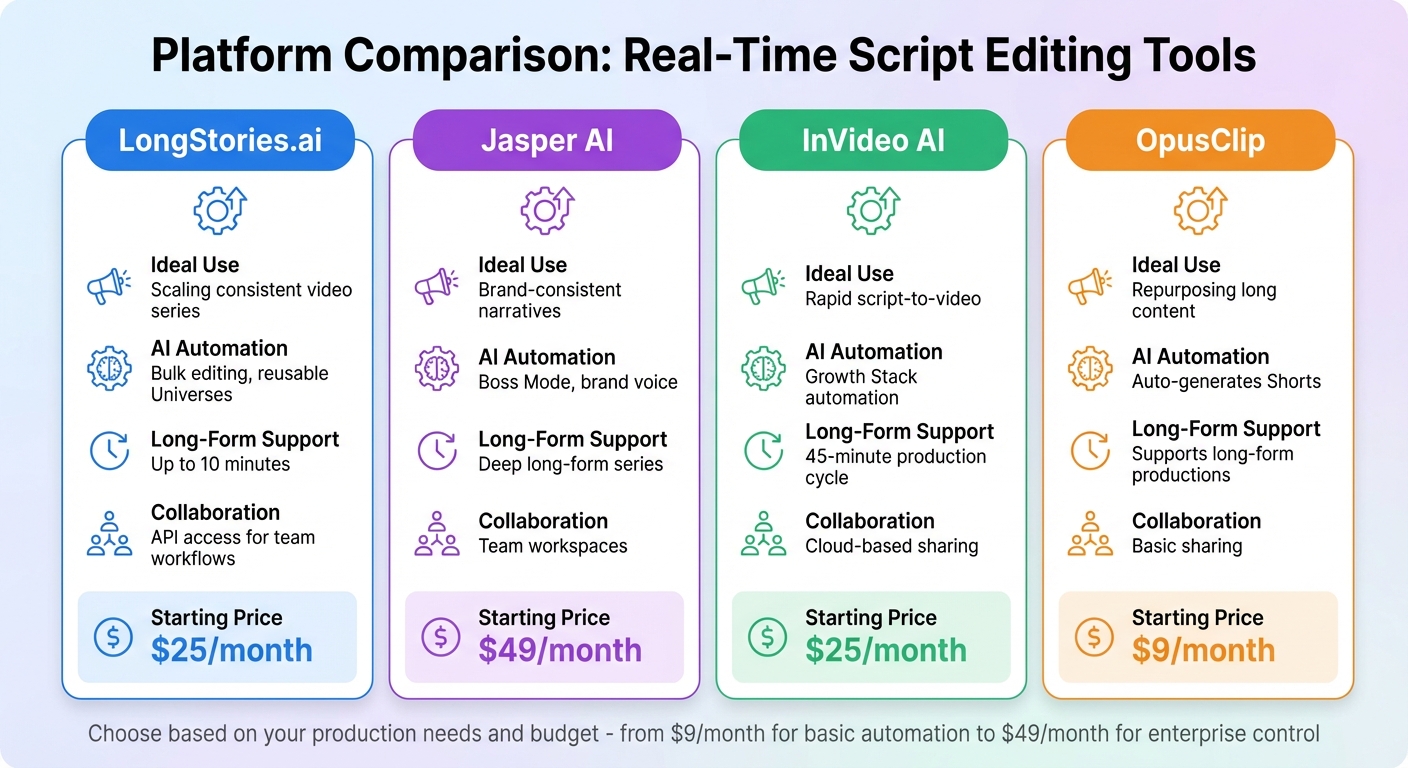
Real-Time Script Editing Platforms Comparison: Features and Pricing
Feature Comparison Table
Finding the right platform depends on your production goals and budget. For example, LongStories.ai stands out by offering bulk editing and reusable Universes, which is perfect for scaling long-form content. Below is a closer look at key platforms and their features to help you decide.
| Platform | Ideal Use | AI Automation | Long-Form Support | Collaboration | Starting Price |
|---|---|---|---|---|---|
| LongStories.ai | Scaling consistent video series | Bulk editing, reusable Universes | Up to 10 minutes | API access for team workflows | $25/month |
| Jasper AI | Brand-consistent narratives | Boss Mode, brand voice | Deep long-form series | Team workspaces | $49/month |
| InVideo AI | Rapid script-to-video | Growth Stack automation | 45-minute production cycle | Cloud-based sharing | $25/month |
| OpusClip | Repurposing long content | Auto-generates Shorts | Supports long-form productions | Basic sharing | $9/month |
For more advanced needs, platforms like Storyboarder AI and Runway offer features like live cursors and simultaneous annotations, making them great for collaborative workflows in 2026. Meanwhile, Descript is ideal for teams that rely on transcript-driven editing. Browser-based platforms also tend to enhance team accessibility compared to desktop-only tools, making collaboration smoother and more efficient.
If you're working with a tight budget, OpusClip is a solid starting point at just $9/month, offering basic automation. As your needs grow, you can transition to LongStories.ai for $25/month, which is tailored for character-driven series, or Jasper AI at $49/month for enterprise-level control over brand voice. Recent studies show that AI-powered growth stacks can increase viewer retention to 42%, compared to 28% with manual editing.
These comparisons underline how the right platform can streamline your production process, helping you achieve better results while saving time and effort.
Conclusion
Real-time script editing tools are changing the game for video production. By centralizing scripts on cloud-based platforms, they eliminate version control headaches and reduce miscommunication. Instead of relying on manual, frame-by-frame edits, these tools allow for text-based workflows, enabling instant revisions and cutting post-production time in half. As Scripto puts it:
A line change shouldn't set your production on fire.
The impact on productivity is hard to ignore. Without a finalized script, post-production time can triple. On the other hand, script-based editing offers a clear roadmap, or as Cutback describes it, "the script becomes your timeline". This keeps teams aligned and focused, saving time while ensuring the final product stays true to the intended message and brand identity.
For those looking to scale their production, platforms like LongStories.ai showcase how real-time editing can integrate into broader workflows. With features like reusable Universes and bulk editing tools, creators can maintain consistency across projects while producing videos of up to 10 minutes - all starting at just $25/month. This approach makes professional-quality video production accessible to marketers and developers, even without advanced editing skills.
Real-time script editing tools directly tackle the challenges of version conflicts, miscommunication, and production delays. With around 55% of viewers dropping off by the 60-second mark due to poor script structure, and platforms like YouTube rewarding consistent publishing schedules, these tools are essential for improving content quality and performance. The days of emailing PDFs and hoping everyone stays on the same page are over.
FAQs
Do I need editing skills to use real-time script editing?
You don’t need to be a professional editor to use real-time script editing tools. These platforms are built to make the process straightforward, even for beginners. For instance, AI-powered editors can automatically match your script to a rough cut, helping you create polished videos quickly and with minimal hassle.
How do teams avoid version conflicts with live scripts?
Teams tackle version conflicts by relying on real-time collaborative editing tools. These platforms sync updates almost instantly, so everyone is always working on the most up-to-date version. This approach cuts down on miscommunication and helps prevent mistakes from outdated edits.
What should I look for when choosing a script-to-video platform?
When choosing a script-to-video platform, it's important to weigh factors like video length capabilities, automation tools (such as AI-powered animation and voiceovers), and features tailored for serialized content, like maintaining character consistency and scene continuity. For instance, platforms like LongStories.ai provide scalable pricing options starting at $9/month, reusable "Universes" for consistent storytelling, and bulk editing tools to simplify production workflows. Additionally, ensure the platform is upfront about its features and limitations so you can make a well-informed choice.
Related posts
LongStories is constantly evolving as it finds its product-market fit. Features, pricing, and offerings are continuously being refined and updated. The information in this blog post reflects our understanding at the time of writing. Please always check LongStories.ai for the latest information about our products, features, and pricing, or contact us directly for the most current details.