
How Multilingual AI Voices Boost YouTube Growth
Want to grow your YouTube channel? Speak your viewers' language - literally. Multilingual AI voiceovers are helping creators break language barriers, leading to more views, longer watch times, and higher revenue.
Here’s what you need to know:
- 28x More Views: AI-dubbed videos outperform subtitles, with viewers staying 60% longer on average.
- Global Reach: Over 40% of watch time in YouTube's multi-language audio tests came from dubbed tracks.
- Cost Savings: AI dubbing is 70% cheaper and faster than traditional voiceovers, making it accessible for creators of all sizes.
Creators like MrBeast and Jamie Oliver are using multilingual audio to expand into global markets, tripling their viewership and boosting engagement. Whether you’re targeting Spanish, Hindi, or Portuguese-speaking audiences, AI solutions make it easier than ever to connect with millions worldwide.
Bottom Line: Adding multilingual audio tracks can transform your channel into a global powerhouse. Let’s dive into the data, tools, and strategies that make it happen.
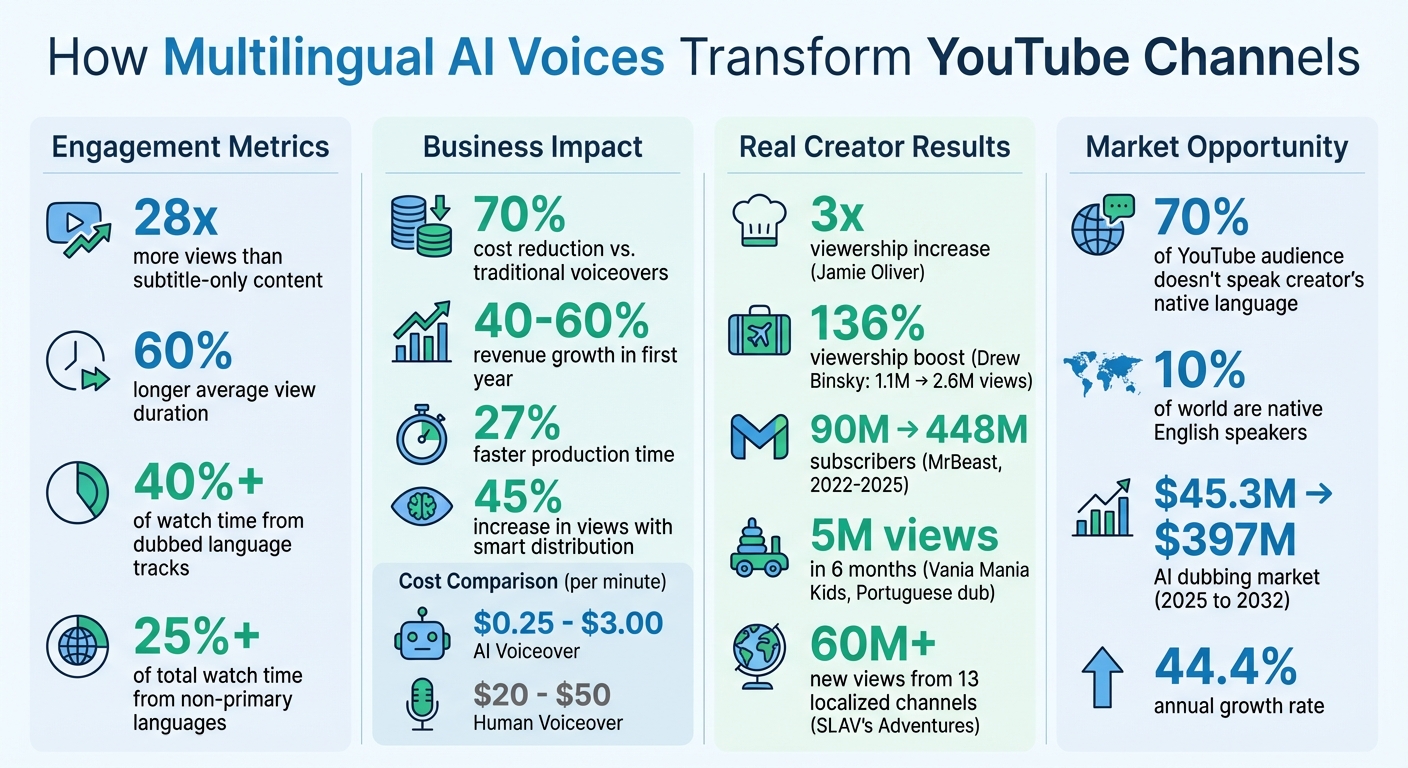
Multilingual AI Voiceovers Impact on YouTube Growth Statistics
You can Now Speak Any Language with AI | FREE
Research and Data on Multilingual AI Voiceovers
Expanding on the earlier discussion of cost and efficiency, research makes it clear: multilingual dubbing is a game-changer for audience engagement. Data from YouTube reveals that creators who added multilingual audio tracks experienced over 25% of their total watch time coming from viewers in non-primary languages. Even more striking, more than 40% of watch time on these videos came from viewers actively selecting dubbed language options. These numbers set the stage for exploring real-world examples that showcase the impact of this technology.
YouTube's Multilingual Audio Pilot Program Results
YouTube's two-year pilot program, officially rolled out to millions of creators in September 2025, delivered impressive results across various content genres. One standout example is Jamie Oliver's cooking channel, which experienced a threefold increase in viewership after incorporating multilingual audio tracks in Spanish, Portuguese, and Hindi.
"On average, creators uploading Multi-language Audio tracks to their videos saw over 25% of their watch time come from views in the video's non-primary language."
- Ritz Campbell, Product Manager, YouTube
Another noteworthy case involved creators using over 30 language dubs per video, successfully connecting with global audiences.
AIR Media-Tech Cross-Language Performance Data
Beyond YouTube, research from AIR Media-Tech highlights how multilingual dubbing resonates universally. Their findings revealed that combining multilingual dubbing with smart distribution strategies led to a 45% increase in views. One of their partners achieved 125 billion views through multi-audio dubbing strategies.
For example, the Vania Mania Kids channel added Portuguese dubs to its existing Spanish, German, and Polish content in July 2022. This move generated 5 million additional views within six months, engaging an audience that had previously shown no interest.
Similarly, Fremantle, leveraging AI-driven dubbing, witnessed extraordinary growth. Rob Cocker, their SVP of Digital and Social, reported "percentage increases in the 1000s" for views, watch time, and subscribers within just three months of automating content dubbing. Their multi-language audio tracks reached nearly 6 million plays during this period.
Creator Case Studies: Growth Through AI Dubbing
Jamie Oliver's 3x International Viewership Growth
Jamie Oliver's team leveraged AI-driven multi-language dubbing to expand into Spanish, Portuguese, and Hindi, leading to a threefold increase in viewership. Richard Herd, Head of Video at the Jamie Oliver Group, used channel analytics to pinpoint regions where international audiences were already engaging. Based on these insights, they chose AI tools capable of capturing Oliver's unique personality across different languages.
Scaling their content localization efforts proved to be a game-changer. By dubbing their existing recipe videos - starting with popular categories like pasta and vegetarian dishes - they provided YouTube's algorithm with ample content to recommend to new audiences. This strategic move not only boosted visibility but also created a feedback loop that kept viewers coming back for more.
Other creators have adopted similar approaches, achieving notable success across various niches.
Vania Mania Kids: 5 Million Views from Portuguese Dubbing
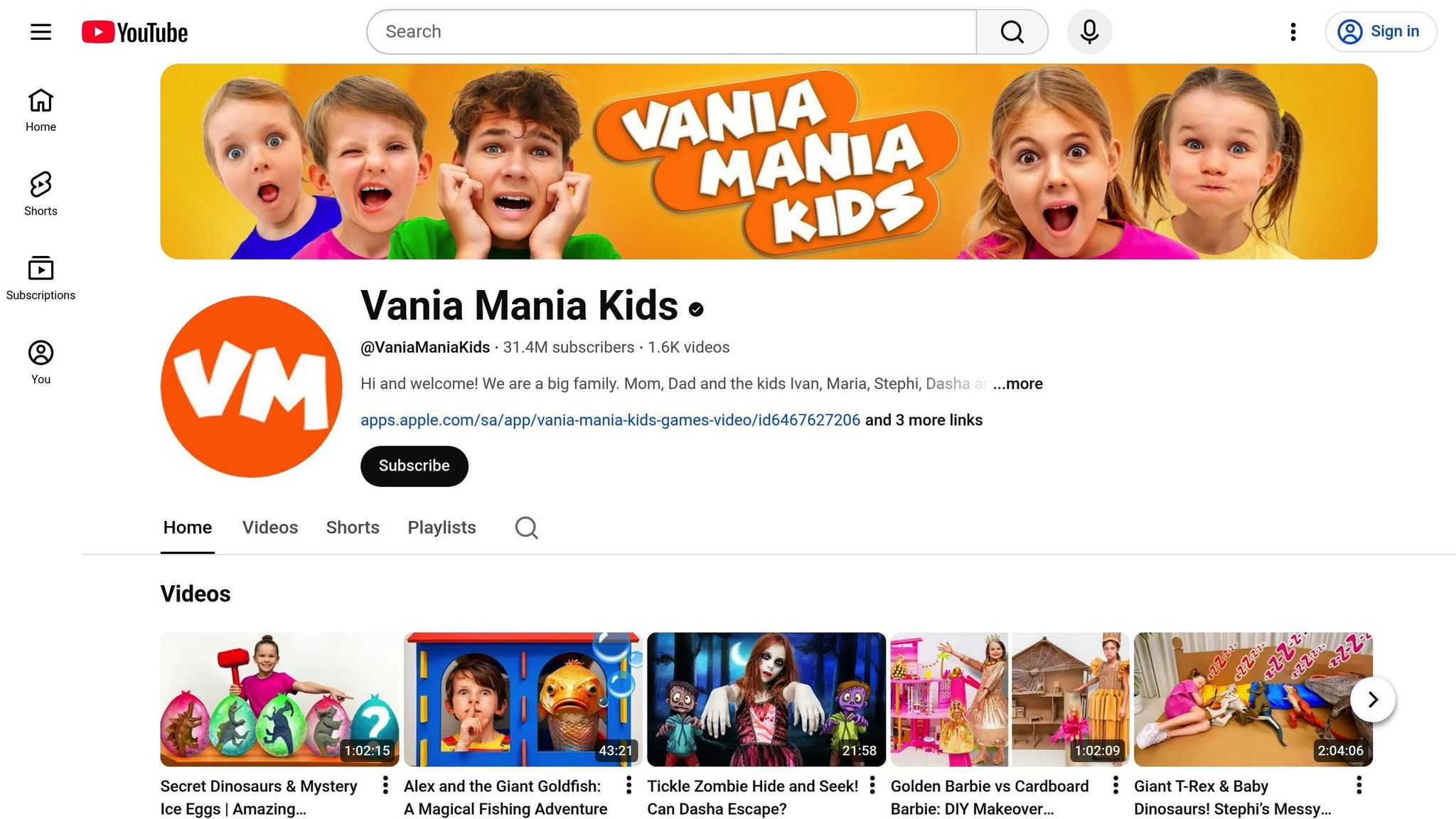
The Vania Mania Kids channel saw 5 million views in just six months by introducing Portuguese dubs to previously untapped audiences. In July 2022, they added Portuguese audio tracks to their high-performing Spanish, German, and Polish videos. This "test-and-scale" approach allowed them to gauge audience interest in new markets without committing to full-scale professional localization upfront.
This method exemplifies how AI dubbing can serve as a low-risk way to explore new regions. Other creators, like MrBeast, have taken this concept even further.
MrBeast's 30+ Language Expansion Strategy
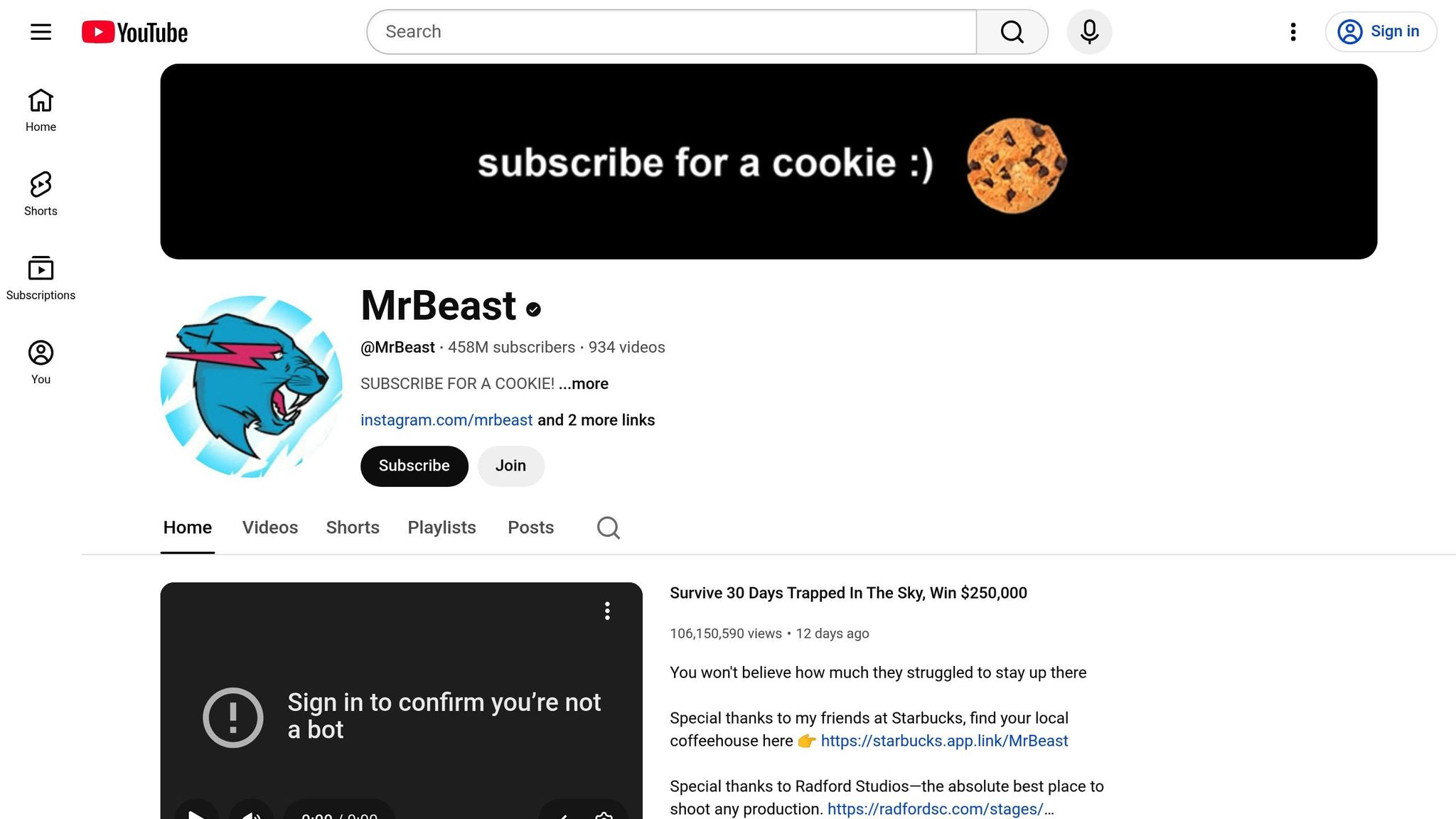
Between 2021 and 2025, MrBeast (Jimmy Donaldson) expanded his content into over 30 languages, fueling explosive growth. His main channel skyrocketed from 90 million subscribers in 2022 to an astonishing 448 million by October 2025. Key to this success was YouTube's Multi-Language Audio feature and an in-house dubbing team, Creator Global.
Evan DeFilippis, MrBeast's Vice President of Strategy, highlighted the data-driven nature of their approach:
"Jimmy refuses to make any kind of decision unless you can show him a bunch of data"
- Evan DeFilippis
Initially, they relied on professional human dubbing to preserve MrBeast's signature energy and enthusiasm. Later, they scaled up by utilizing YouTube's Gemini AI-powered dubbing pilot programs, enabling them to produce multi-language versions of videos more efficiently. MrBeast himself acknowledged the impact of multi-language audio on video performance.
This expansion opened doors to emerging markets like India and Mexico, where localized content not only attracted massive viewership but also commanded higher ad rates. DeFilippis underscored the global opportunity:
"There's only 10% of the world that is a native English speaker... creators who limit themselves to producing content solely in English miss out on 90% of potential viewers worldwide"
- Evan DeFilippis
AI vs. Human Voiceovers: Performance Comparison
Retention Rates and Revenue Metrics
AI dubbing has shown impressive results, increasing average view duration by 60% and generating 28 times more views than subtitle-only content. These numbers highlight how AI dubbing allows viewers to focus on the visuals instead of reading subtitles, creating a smoother viewing experience. For instance, travel vlogger Drew Binsky experienced a 136% increase in viewership for his AI-dubbed videos, which averaged 2.6 million views compared to 1.1 million for his English-only uploads.
That said, human voiceovers still have a unique edge in some areas. Studies indicate that human voices reduce cognitive load more effectively than AI, leading to higher purchase intentions and better conversion rates. The addition of subtitles to AI-dubbed content helps narrow this gap by improving comprehension, but emotional nuance remains a key advantage of human voiceovers. While AI dubbing offers a 27% faster production time, the emotional depth provided by human voices often translates to stronger audience engagement and higher conversions. These differences emphasize the importance of choosing the right voiceover strategy based on specific goals like retention or revenue.
Benefits and Limitations of Each Approach
| Feature | AI Voiceover | Human Voiceover |
|---|---|---|
| Production Speed | Quick turnaround - hours to days; ideal for fast trends | Slower - weeks; requires scheduling and recording sessions |
| Cost | $0.25–$3.00 per minute; up to 70% cheaper than studio recordings | $20–$50 per minute |
| Scalability | Extremely high; supports 100+ languages simultaneously | Limited by actor availability and budget |
| Emotional Range | Improving with voice cloning but can still sound monotone | Naturally rich; conveys humor, nuance, and complex emotions |
| Viewer Retention | Better than subtitles but still behind human voiceovers | Highest retention; reduces cognitive load and boosts engagement |
The table above highlights the strengths and trade-offs between AI and human voiceovers. While AI tools are evolving, especially with features like "emotional replication", they still fall short of the emotional authenticity that human voices bring. Jonny Steel, CMO at Linguana, sheds light on this advancement:
"When someone gets really excited in the original language, the cloned voice gets excited with them... it adds a lot of localization value" - Jonny Steel, CMO at Linguana
This progress underscores how AI is closing the gap between efficiency and emotional authenticity. However, for projects requiring deep emotional resonance, human voiceovers remain unmatched in delivering the nuanced performance that truly connects with audiences.
sbb-itb-94859ad
Platforms for Creating Multilingual AI Voiceovers
Platform Comparison: Features and Language Support
When it comes to multilingual AI voiceovers, YouTube creators have a variety of platforms to choose from, each catering to different needs and budgets. YouTube’s built-in Multi-Language Audio (MLA) tool, powered by Google’s Gemini AI, is a free option available directly in YouTube Studio. It mirrors the creator's tone, pacing, and emotions automatically. However, it can sound robotic at times and may struggle with videos featuring multiple speakers.
For creators seeking higher-quality results, ElevenLabs offers credit-based subscription plans starting at $5 per month. Their advanced voice cloning technology captures the original speaker's energy and tone. For even more polished results, their "Productions" service includes human-in-the-loop reviews, priced at about $22 per finished minute. If you’re working on longer videos or need batch dubbing, Rask AI might be your go-to. They offer monthly packages that cost between $1 and $3 per minute, making them ideal for creators who produce frequent content. Another option, AIR Media-Tech (AIR io), provides a self-service localization solution tailored for creators who want more control over their dubbing process.
For creators with established audiences, Linguana offers a unique revenue-share model with no upfront costs. This platform is particularly appealing for those with 1 million or more monthly views. Linguana handles the entire channel localization process, including audio, metadata, and thumbnails, to create language-specific channels. A great example is Slav's Adventures, a creator with 3.6 million subscribers. In December 2025, they partnered with Linguana to launch 13 fully localized channels in languages like Spanish, Portuguese, and French. This effort resulted in over 60 million views and a substantial boost in monthly revenue.
| Platform | Cost | Voice Quality | Best For |
|---|---|---|---|
| YouTube MLA | Free | Basic; may sound robotic | Testing demand in new markets |
| ElevenLabs | $5–$82.50/month; $22/min for Productions | High-quality AI with voice cloning | Mid-sized creators with a flexible budget |
| Rask AI | $1–$3 per minute | Effective batch dubbing for longer videos | Creators producing frequent content |
| Linguana | Revenue-share (no upfront cost) | AI-cloned with emotional replication | Established creators (1M+ monthly views) |
Some platforms go beyond just voiceovers, covering the entire production process.
LongStories.ai for Long-Form Multilingual Content
While most AI dubbing platforms focus solely on voiceovers, LongStories.ai (https://longstories.ai) tackles the broader challenge of producing long-form multilingual content. This platform allows creators to produce videos up to 10 minutes long, meeting YouTube’s monetization standards. It ensures consistency in characters, styles, and voices across multiple videos by using reusable "Universes." This feature is particularly helpful for scaling content into multiple languages, as creators can establish their brand identity once and apply it seamlessly across all localized versions.
LongStories.ai offers three animation quality tiers - No Animation, Fast Animation, and Pro Animation - along with bulk editing tools and API access for workflow automation. This makes it easier to maintain visual storytelling and character consistency across languages like Spanish, Portuguese, or German without having to rebuild assets from scratch. Pricing starts at $9 per month for the Starter Plan, and new users can take advantage of a 400-credit free trial to explore the platform's capabilities.
How to Implement Multilingual AI Voiceovers
Choosing Languages Based on Your Analytics
To successfully implement multilingual AI voiceovers, start by identifying where your content already performs well. Use YouTube Studio's Geography report to pinpoint countries driving substantial traffic. For example, if your channel gets 500,000 views from Brazil, where Portuguese is the dominant language, this audience could be a prime candidate for localized voiceovers.
Instead of spreading your efforts too thin, focus on 2–3 key languages that align with your audience demographics. Spanish and Portuguese often work well for creators targeting Latin America, while Hindi is a strong choice for South Asian viewers. If countries like Germany are generating traffic, German can be a smart pick since it’s a high-CPM market, potentially increasing your ad revenue. Keep in mind that around 70% of YouTube's global audience doesn’t speak the creator’s native language. Even small-scale localization can open doors to significant growth. A good rule of thumb: consider dubbing when international views make up at least 20% of your total traffic.
Once you've chosen your target languages, the next step is to test the waters with AI dubbing to gauge audience interest.
Testing with Automated AI Dubbing First
After narrowing down your language choices, start with automated tools to experiment with audience response. YouTube’s free auto-dubbing tool, powered by Google Gemini, is a great way to test the market. While the automated voices might sound robotic, they’re perfect for assessing engagement in new regions.
Upload a few of your best-performing videos with auto-dubbed tracks and track metrics like view duration and retention rates for each language. Many creators have reported a noticeable boost in engagement once they added non-primary language tracks.
If the demand looks promising, upgrade to premium tools like ElevenLabs or Rask AI for more natural voice cloning. For content that requires a polished touch - such as sponsor reads or emotional narratives - consider a human-in-the-loop workflow. This approach combines AI-generated dubs with fine-tuning by native speakers to refine tone and context. As Nicole Loney from RWS puts it:
"Viewers have a low tolerance for poorly translated or robotic-sounding audio. A bad dub can make your content seem unprofessional and will cause audiences to click away." - Nicole Loney, RWS
To maximize discoverability, pair your dubbed audio with translated titles and region-specific thumbnails. AI dubbing can cut production time by 70% to 90% compared to traditional studio methods, letting you test and adapt much faster.
What's Next for Multilingual AI Voice Technology
Expanding Language Options and Emotional Accuracy
The AI dubbing market is expected to skyrocket - from $45.3 million in 2025 to $397 million by 2032, growing at an annual rate of 44.4%. This growth will bring two major improvements: broader language support and more authentic emotional expression. While most AI tools currently focus on widely spoken languages like Spanish, Portuguese, and Hindi, the future will see support for less common languages and regional dialects. This means creators will be able to reach niche audiences in places like Vietnam, Indonesia, and parts of Eastern Europe - areas that have been overlooked due to limited data availability.
Another key development is natural voice replication. Right now, many auto-dubbed voices still sound mechanical. However, next-generation AI models are set to deliver more lifelike expressions, capturing excitement, tone, and other emotional nuances in real time. Current systems already preserve 90–95% of the original emotional tone and achieve over 95% accuracy in lip-sync alignment, marking a huge leap forward from the monotone, robotic voices of the past.
These upgrades won’t just improve audio quality - they’ll also make AI dubbing a seamless part of video production workflows.
Seamless Integration with Long-Form Video Production
As AI dubbing becomes more advanced, it’s transitioning from a standalone tool to an integral feature within video production platforms. A great example is YouTube, which has integrated auto-dubbing directly into its Studio platform using Google Gemini. This kind of integration is especially valuable for creators of long-form content, such as 10-minute videos designed to meet YouTube’s monetization requirements.
Platforms like LongStories.ai are pushing this evolution even further. By allowing creators to build reusable "Universes" with consistent characters, styles, and voices, LongStories.ai makes it easier to produce multilingual long-form videos at scale. Once you define your voice, AI can automatically generate multiple language tracks, letting you focus on storytelling while maintaining a consistent brand identity across languages.
The future is all about simplicity: one upload, many languages. Imagine a single video URL offering dozens of language tracks, consolidating views, comments, and watch history into one place. This not only streamlines user experience but also boosts recommendation signals. Early YouTube trials revealed that up to 25% of viewers chose a non-English dub when it was available, opening doors to a massive audience that was previously out of reach.
Conclusion
Multilingual AI voiceovers have become a game-changer for YouTube creators aiming to expand their reach beyond their native audience. As highlighted earlier, global viewers overwhelmingly prefer content in their own languages, and AI-powered dubbing has proven to deliver impressive results. Take Drew Binsky, for example - his average views skyrocketed from 1.1 million to 2.6 million per upload, a staggering 136% increase, simply by adding dubbed audio tracks. Clearly, there's a massive audience out there just waiting to connect with content in their preferred language.
The impact goes beyond just view counts. AI-dubbed content significantly boosts viewer engagement. On average, it increases view duration by 60% compared to subtitles. YouTube CEO Neal Mohan even shared that "For videos with dubbed audio, more than 40% of the total watch time comes from viewers choosing to listen in a dubbed language". This isn't just about reaching more people - it's about keeping them engaged. And when your audience sticks around longer, YouTube's algorithm takes note, promoting your content to even more viewers. This cycle of engagement naturally translates into higher revenue opportunities.
Speaking of revenue, the financial upside of multilingual strategies is undeniable. Creators who embrace multi-language approaches often see revenue growth between 40–60% within their first year. For instance, in December 2025, SLAV's ADVENTURES collaborated with Linguana to launch 13 localized channels in languages like Spanish, Portuguese, and French. The result? Over 60 million new views and a significant boost in monthly revenue. Similarly, Dr. Anton Alekseev expanded his Russian-language content into 10 additional languages, earning over 65 million new views in just one year.
What’s even better is that AI dubbing makes these achievements accessible, even for creators with smaller budgets. Platforms like LongStories.ai take this a step further, enabling creators to scale their efforts efficiently across both short-form and long-form content. These tools ensure consistency in characters, styles, and voices across multiple languages, all while streamlining production.
For creators looking to build a sustainable and profitable YouTube channel, multilingual AI voiceovers offer a practical way to break language barriers, connect with diverse audiences, and grow revenue - all without adding unnecessary complexity or cost. It's a smart strategy to establish a truly global presence and maximize your channel's potential.
FAQs
How do multilingual AI voiceovers save time and money compared to traditional dubbing?
Multilingual AI voiceovers offer a faster and more budget-friendly alternative to traditional dubbing. The conventional approach requires hiring voice actors, renting studio space, and managing translators and editors. These steps can quickly add up, costing hundreds of dollars per finished minute and taking weeks to complete.
AI-generated voiceovers, on the other hand, slash costs significantly - saving $50–$250 per minute - and cut production times from weeks to just days. By automating tasks like voice synthesis, lip-syncing, and file exports, AI eliminates the need for studio rentals and multiple revisions. This streamlined process makes AI voiceovers a practical and cost-efficient option for creating multilingual YouTube content at scale.
What challenges might creators face when using AI-generated voices on YouTube?
AI-generated voiceovers can make video production easier, but they’re not without their hurdles. For starters, YouTube’s monetization and authenticity policies often flag content with AI-only narration as repetitive or lacking originality. This can lead to demonetization or even reduced visibility on the platform. To stay on the safe side, creators also need to clearly disclose when synthetic audio is used - failing to do so could result in strikes or having the content removed altogether.
There’s also the issue of copyright and ethics. Using cloned voices or AI-generated models without proper permissions can cross legal boundaries, violating intellectual property laws and YouTube’s own guidelines. This could leave creators facing serious legal consequences.
Finally, quality and trust play a huge role. If the AI voice sounds too robotic or unnatural, viewers are less likely to stay engaged, which can hurt watch time and overall channel performance. Since YouTube values authentic, high-quality content, creators need to carefully balance cost savings with compliance and production standards to maintain long-term success.
What are the best platforms for creating multilingual AI voiceovers for YouTube?
For YouTube creators wanting to add multilingual AI voiceovers, Linguana, Rask AI, and PERSO.ai stand out as top choices. These platforms combine high-quality synthetic voices with user-friendly tools designed specifically for YouTube workflows.
- Linguana offers a full dubbing solution featuring emotionally nuanced AI voices, automated language channel creation, and minimal editing needs. It’s perfect for creators who want an efficient, hands-off experience.
- Rask AI works seamlessly with YouTube's Multi-Language Audio (MLA) tracks, making it easy to upload a single video and attach AI-generated audio tracks in multiple languages quickly.
- PERSO.ai prioritizes speed and affordability, providing simple voice cloning in over 30 languages. This is a great option for creators who need cost-effective solutions with fast turnaround times.
Other platforms, like ElevenLabs and HeyGen, deliver excellent voice quality but might require extra manual steps to manage YouTube channels. For creators working on long-form content, LongStories.ai can be a helpful addition, offering reusable character voices and consistent branding for multilingual projects.
Related posts
LongStories is constantly evolving as it finds its product-market fit. Features, pricing, and offerings are continuously being refined and updated. The information in this blog post reflects our understanding at the time of writing. Please always check LongStories.ai for the latest information about our products, features, and pricing, or contact us directly for the most current details.