
AI Voice Jobs: Threat or Opportunity?
AI voice technology is reshaping industries by automating tasks like audio production, customer service, and content creation. While it disrupts traditional roles, it also brings new opportunities in AI system management and training. Here's what you need to know:
- AI is replacing repetitive tasks in roles like voice acting, customer support, and narration, impacting jobs globally.
- Costs are dropping: OpenAI reduced API prices by up to 87.5%, making tools accessible to small businesses and freelancers.
- Job shifts: Over 30% of workers may see significant changes in their tasks, with women disproportionately affected.
- New roles emerging: Jobs like AI Trainers and Quality Controllers are growing, requiring workers to oversee and refine AI systems.
- AI tools assist professionals: Platforms like LongStories.ai and Speechify Studio help voice professionals streamline workflows and expand reach.
The future of work will depend on how individuals and industries adjust to these changes. Voice professionals can stay relevant by mastering AI tools, focusing on human skills like emotional delivery, and advocating for ethical use of their work.
Will AI Replace Voice Actors? The Truth No One’s Telling You
sbb-itb-94859ad
The Problem: How AI Voice Tools Displace Workers
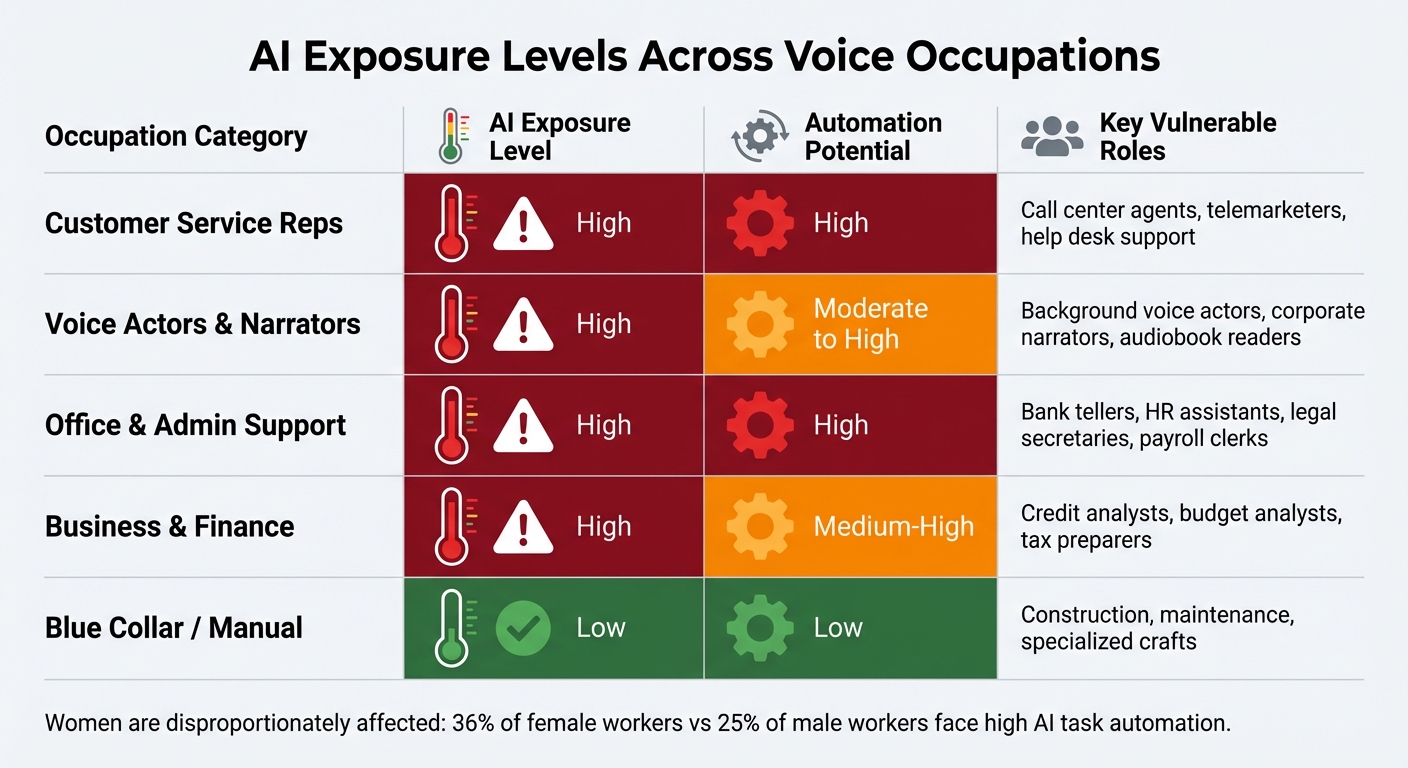
AI Exposure Levels Across Voice Occupations and Automation Risk
Voice Actors and Narrators Face Automation
Voice actors, particularly those in entry-level positions like background voices for animations, corporate training videos, or e-learning modules, are being edged out by synthetic voice technology. Companies often opt for AI-generated voices for tasks like HR videos, internal product demos, or low-budget ad drafts because it’s faster and more cost-effective than hiring human talent.
In audiobook production, text-to-speech technology is now widely used for creating multilingual content, reducing the demand for human narrators. Even podcast translation is shifting toward AI, with platforms like Spotify experimenting with features that translate voices into other languages. Dan Lenard from the World-Voices Organization warns that synthetic voices lack the emotional connection and engagement that human voices provide. This shift isn’t limited to creative fields - it reflects broader trends in automation across various industries.
AI Automation in Related Fields
The replacement of human workers with AI extends far beyond voice-related roles. For instance, in July 2023, Dukaan replaced 90% of its customer support team with an in-house chatbot, slashing costs by 85%. Similarly, Salesforce reduced its customer support workforce by 44%, dropping from 9,000 to 5,000 employees, as AI tools took over many responsibilities. Other companies like Ikea and Duolingo have also automated large portions of their customer service and translation operations. Across the U.S., AI contributed to around 55,000 job losses in 2025 alone. A study from MIT in November 2025 revealed that AI is capable of performing tasks in 11.7% of the U.S. labor market.
AI Exposure Levels Across Voice Occupations
The impact of AI-driven automation varies across different voice-related professions. Some roles are more susceptible to automation than others, as shown below:
| Occupation Category | AI Exposure Level | Automation Potential | Key Vulnerable Roles |
|---|---|---|---|
| Customer Service Reps | High | High | Call center agents, telemarketers, help desk support |
| Voice Actors & Narrators | High | Moderate to High | Background voice actors, corporate narrators, audiobook readers |
| Office & Admin Support | High | High | Bank tellers, HR assistants, legal secretaries, payroll clerks |
| Business & Finance | High | Medium-High | Credit analysts, budget analysts, tax preparers |
| Blue Collar / Manual | Low | Low | Construction, maintenance, specialized crafts |
Women are particularly affected by this shift. Approximately 36% of female workers are employed in roles where AI could take over half of the tasks, compared to 25% of male workers. This disparity is largely due to the higher concentration of women in administrative and white-collar jobs. The International Labour Organization highlights:
"growing abilities of GenAI models in such areas as voice, image and video generation have increased automation scores for a range of tasks in media- and web-related occupations".
These examples highlight the growing challenge industries face as AI continues to replace human workers in various fields.
The Solution: New Jobs Created by AI Voice Technology
New Jobs in AI Training and Management
AI voice tools may be shaking up traditional roles, but they're also paving the way for fresh opportunities in the workforce. New positions like Agent Product Managers, AI Evaluation Writers, and Human-in-the-loop Validators are emerging. These roles are all about designing, testing, and fine-tuning AI voice systems. Instead of doing tasks manually, professionals in these jobs focus on managing and improving AI systems, blending technical expertise with creative decision-making.
The need for AI fluency - the ability to effectively use and manage AI tools - has skyrocketed. In fact, it's grown sevenfold in just two years. Right now, around 8 million people in the U.S. are working in jobs that require at least one AI-related skill. A great example of this shift is the Mayo Clinic. Since 2016, they've deployed hundreds of AI models to assist with image analysis, but instead of downsizing, they've grown their radiology team by over 50%. This allows doctors to move away from routine tasks and focus on more complex decisions and patient care.
How AI Tools Enhance Existing Jobs
AI isn't just creating new jobs - it’s also supercharging existing ones. These tools are designed to work alongside professionals, boosting their productivity rather than replacing them. For instance, in February 2023, Endeavor (NYSE: EDR) made headlines by using an AI-generated voice from Speechify to deliver its entire annual earnings call. This breakthrough allowed executives to scale their communication efforts more efficiently.
AI voice tools are also helping professionals in creative fields. Voice actors and content creators can now use AI dubbing tools to translate their work into over 60 languages, reaching audiences worldwide without requiring native speakers. Meanwhile, sales teams use AI voice agents for training simulations, and recruiters rely on these tools to streamline early interview rounds so they can focus on deeper candidate evaluations. Looking ahead, generative AI is expected to boost U.S. labor productivity by 0.5 to 0.9 percentage points annually through 2030.
Platforms That Scale AI Voice Production
The rise of AI voice technology is supported by platforms that make content creation and production easier than ever. Take LongStories.ai, for example. This platform helps YouTube creators and digital storytellers produce high-quality, long-form videos - up to 10 minutes - by creating reusable "Universes" with consistent characters, styles, and voices. By removing production bottlenecks, LongStories.ai enables creators to post frequently, maintain their brand identity, and grow their audience while building sustainable income.
Other platforms are also stepping up. Speechify Studio offers unlimited voice cloning and exports with access to over 1,000 lifelike voices. Tools like Vapi and Bland provide robust voice agent infrastructure for businesses. These advancements are creating demand for roles like AI Trainers and Quality Controllers, who ensure emotional nuance and cultural accuracy in AI-generated content. These positions require a unique mix of technical skills and creative judgment.
How Voice Professionals Can Adapt
Learning to Work Alongside AI
Voice professionals are finding new ways to collaborate with AI, instead of competing against it. As technology evolves, roles like AI quality control specialists and creative directors are emerging. These positions require professionals to oversee AI-generated content, ensuring it aligns with emotional tone, cultural subtleties, and brand identity. Dan Lenard, President of the World-Voices Organization, highlights the irreplaceable uniqueness of human voices:
"Every voice is different, every accent is different, and I think that's one of the things AI cannot duplicate".
This opens doors for experts who can train AI models to sound more natural and authentic.
To stay competitive, voice actors should focus on skills that are beyond the reach of AI - like delivering emotional complexity, mastering unique dialects, and improvising in real-time. At the same time, they must carefully review contracts to ensure their work isn’t used to train synthetic voices without their consent. Jazz Mistri, a voice actor with the Voice Actors League of Kenya, underscores the importance of this proactive approach:
"We're in a great position to have a say, to determine how we interact with these AI platforms".
By becoming fluent in AI tools and platforms, voice professionals can streamline their workflows and maintain control over how their talent is utilized.
Using AI Platforms to Work Faster
AI platforms are transforming how voice professionals handle repetitive tasks, allowing them to focus on more creative and high-value projects. For instance, voice cloning technology can instantly update recordings, eliminating the need for costly studio sessions to tweak minor script changes.
Tools like LongStories.ai are game-changers for scaling output while maintaining consistency across projects. Similarly, Speechify Studio offers access to over 1,000 lifelike voices in 60+ languages, enhancing productivity for multilingual projects. Platforms such as Descript Overdub allow professionals to edit voiceovers simply by modifying the text script. This hybrid workflow - using AI for routine tasks like e-learning modules or straightforward informational videos - frees up human talent for projects requiring nuanced emotional delivery and intricate storytelling.
Comparing AI Voice Platforms
Selecting the right AI platform is crucial for voice professionals looking to stay ahead in a changing industry. Each platform caters to specific needs, so understanding your workflow and goals is key:
| Platform | Best For | Key Features | Pricing |
|---|---|---|---|
| LongStories.ai | Long-form video creators | Reusable Universes, up to 10-minute videos, bulk editing, API access | Starts at $9/month; 400 free credits |
| Domo AI | Short-form animation | Fast animation generation, style consistency | Varies by plan |
| Morphic | AI-powered search and content | Conversational search interface, content generation | Varies by plan |
| Speechify Studio | Voice cloning and narration | 1,000+ voices, 60+ languages, granular emotional controls | Free trial; premium plans available |
For creators focused on YouTube or digital storytelling, LongStories.ai ensures brand consistency without the need to re-prompt AI for every project. Meanwhile, Speechify Studio stands out for its robust customization options, especially for voice cloning and multilingual content. On the other hand, Domo AI and Morphic are ideal for professionals working on shorter, animation-heavy projects. Each platform offers unique strengths, so choosing the right tool can make all the difference in staying competitive.
Conclusion: Getting Ready for AI Voice Jobs
Weighing Job Loss Against New Opportunities
AI-powered voices are reshaping the job market, disrupting some roles while creating others. Over 30% of jobs are experiencing major task changes due to AI advancements. However, history shows us that new technologies tend to transform jobs rather than eliminate them entirely. When workers transition from performing tasks to overseeing them, AI can actually boost the need for human expertise.
The difference between thriving and struggling in this evolving landscape often comes down to how workers respond to change. As Molly Kinder, Xavier de Souza Briggs, Mark Muro, and Sifan Liu put it:
"Technology is not destiny, but inaction is".
Voice professionals who embrace AI as a tool - using it to handle repetitive tasks while focusing on areas like creativity and emotional depth - can enhance their productivity and value. On the other hand, resisting these changes could lead to falling behind, especially since around 85% of workers may see at least 10% of their tasks impacted by AI. Adapting to this transformation is no longer optional - it’s essential.
Next Steps for Voice Professionals
To navigate these changes effectively, voice professionals should prioritize three critical steps:
- Hone human-centric skills like emotional nuance, improvisation, and cultural insight. These abilities remain distinctly human and are becoming even more important as AI takes on routine tasks.
- Build AI fluency, a skill that’s seen a sevenfold increase in demand over just two years. Platforms like LongStories.ai can help professionals streamline routine work, freeing them to focus on more creative and high-value tasks.
- Collaborate and advocate through unions or professional organizations to establish ethical standards around consent, copyright, and fair compensation. The recent agreement between Hollywood writers and major studios serves as a powerful example of what collective action can achieve.
As the International Labour Organization highlights:
"most jobs will be transformed rather than made redundant".
FAQs
How can voice professionals adapt and thrive with AI voice technology?
Voice professionals have an opportunity to see AI not as a rival but as a powerful tool that complements their craft. While AI-generated voices can mimic tones and narrate text, they often fall short when it comes to emotional depth, cultural authenticity, and the subtle artistry that human voices bring to the table. By stepping into the role of the "human-in-the-loop", professionals can ensure that AI-generated content achieves the quality and nuance audiences expect.
To stay ahead in the industry, it's critical to embrace upskilling in AI technologies. Learning how to fine-tune and guide AI voice models can give you a significant edge. Focusing on specialized skills - like mastering unique accents, creating compelling character voices, or crafting intricate storytelling arcs - can set you apart in ways AI simply can't replicate. Additionally, offering services such as voice direction and quality assurance for AI-driven projects can unlock new revenue opportunities. Platforms like LongStories.ai are great examples of how creators can combine the efficiency of AI with the creativity of human expertise, enabling professionals to maintain their distinct value while boosting productivity.
By treating AI as a collaborative partner, voice actors can broaden their skill sets and secure their place in this fast-changing industry.
What kinds of new jobs are being created by AI voice technology?
AI voice technology is opening doors to a variety of new career paths. Jobs such as AI voice prompt engineers, synthetic voice data curators, voice UX designers, and AI integration specialists are becoming more prominent as businesses increasingly rely on these tools. These roles are all about crafting, fine-tuning, and managing AI-powered voice systems to enhance user interactions and ensure smooth system integration.
There’s also a growing demand in AI-driven content creation, where professionals can use advanced tools to streamline tasks like animation, voiceovers, and editing. These advancements are not just reshaping traditional workflows - they’re providing professionals with the tools to thrive in a fast-changing job market while playing a key role in shaping the future of digital communication.
How is AI affecting gender equality in the workplace?
AI is reshaping the job market, but it’s also shining a spotlight on existing gender inequalities. Women remain underrepresented in roles that leverage AI advancements - only 25.8% of women occupy these positions, compared to 31.6% of men as of January 2025. At the same time, women are disproportionately concentrated in jobs that are more vulnerable to automation. This imbalance is further compounded by longer unemployment periods for women after job disruptions and their lower likelihood of transitioning into AI-enhanced roles compared to men.
The disparity doesn’t stop there. Men are more likely to adopt generative AI tools, according to surveys, a trend that risks widening gaps in wages and career opportunities. Addressing these challenges requires targeted policies and skill-building initiatives to ensure women can adapt and succeed in this rapidly changing job market.
Related posts
LongStories is constantly evolving as it finds its product-market fit. Features, pricing, and offerings are continuously being refined and updated. The information in this blog post reflects our understanding at the time of writing. Please always check LongStories.ai for the latest information about our products, features, and pricing, or contact us directly for the most current details.