
AI Video Tools: Long-Form vs. Short-Form

AI video tools are transforming how creators produce content, with two main categories: long-form videos (10+ minutes) for platforms like YouTube, and short-form videos (5 seconds to 3 minutes) for TikTok and Instagram Reels. Here's the key difference: long-form videos focus on storytelling and audience retention, while short-form videos aim for quick engagement and viral potential.
Key Takeaways:
- Long-Form Tools: Best for YouTube, courses, or corporate content. Examples include LongStories.ai and LTX Studio, which help maintain consistent characters and narratives.
- Short-Form Tools: Ideal for social media and ads. Examples include Runway Gen-3 and OpenAI Sora, which create visually striking clips under 20 seconds.
- Monetization: Long-form videos earn higher ad rates ($5–$25 per 1,000 views) compared to short-form ($0.01–$0.30 per 1,000 views).
- Scalability: Long-form tools streamline extended projects, while short-form tools excel at producing high-volume, attention-grabbing clips.
Quick Comparison:
| Feature | Long-Form Tools | Short-Form Tools |
|---|---|---|
| Best Use | YouTube, storytelling | TikTok, Instagram Reels |
| Video Length | 10+ minutes | 5 seconds to 3 minutes |
| Examples | LongStories.ai, LTX Studio | Runway Gen-3, OpenAI Sora |
| Monetization | $5–$25/1,000 views | $0.01–$0.30/1,000 views |
| Focus | Narrative depth | Quick engagement |
Tip: A hybrid strategy works best - use short-form videos to attract viewers and funnel them to long-form content for better revenue and audience loyalty.
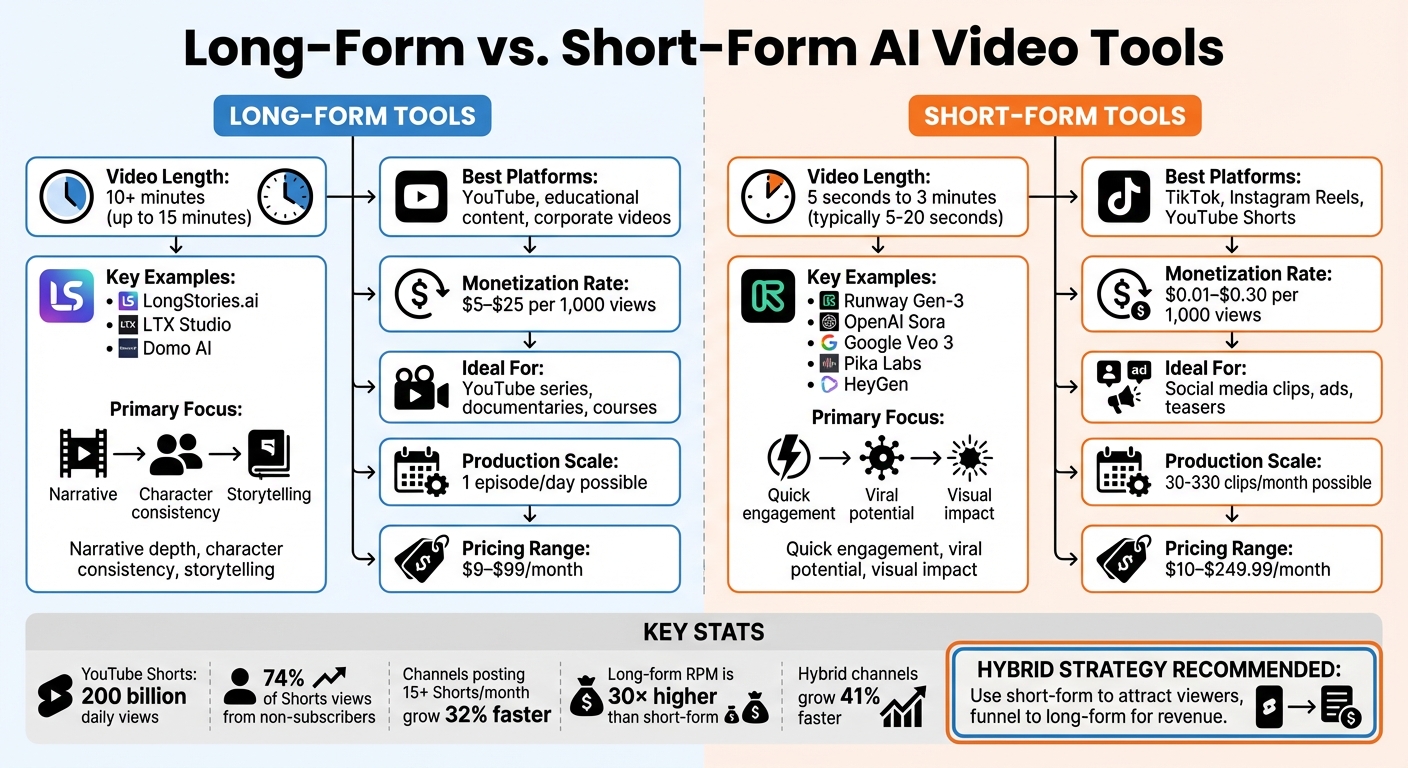
Long-Form vs Short-Form AI Video Tools Comparison Chart
I Tested Every AI Video Tool To Find Out The Best One
sbb-itb-94859ad
AI Tools for Long-Form Video Creation
Creating long-form videos - those lasting up to 15 minutes - comes with the challenge of maintaining a cohesive narrative and consistent visuals throughout. Platforms like LongStories.ai and LTX Studio tackle this challenge head-on, offering tools designed for seamless and efficient production.
LongStories.ai: Streamlining Long-Form Video Production
LongStories.ai simplifies the production of long-form videos with its "Universes" feature. These reusable templates let creators define characters, visual styles, and voices just once. After that, they can generate multiple episodes without needing to reconfigure settings. Setting up a Universe takes about 10–15 minutes, while generating new episodes can be done in as little as 30 seconds. This efficiency has allowed creators to scale their output significantly - one film studio increased its production from one episode per week to one per day.
The platform supports videos up to 15 minutes long and offers three animation quality options:
- Just Storyboard: Static scenes for quick script testing.
- Fast Animation: Balanced motion quality and cost efficiency.
- Pro Animation: High-end visuals paired with advanced sound design.
These options allow creators to tailor their projects to both their quality needs and budget. So far, over 2,500 creators have used the platform to produce more than 9,000 videos, collectively reaching 30 million subscribers.
LongStories.ai also includes bulk editing features, enabling users to make sweeping changes across entire projects. For example, a single adjustment can modify a character’s outfit or tweak a visual element in every scene. For those needing additional post-production flexibility, the Pro and Creator plans ($59 and $99 per month, respectively) include ZIP downloads of all scene assets, making it easy to refine content in tools like Premiere Pro or DaVinci Resolve. By focusing on consistent "Universes", LongStories.ai empowers creators to produce high-quality, scalable content.
LTX Studio: Precision for Professional Productions
While LongStories.ai emphasizes scalability, LTX Studio is designed for professionals who need fine-tuned control over every aspect of video production. It offers tools for scripting, storyboarding, timeline editing, and sound design - all in one platform. Trusted by over 135,000 creative professionals, including advertising agencies and filmmakers, LTX Studio provides advanced controls like camera movement, keyframes, and visual references.
Pierre-Jean Bernard, Head of Digital & AI at L'Oréal–McCann Paris, highlights the platform’s ability to maintain consistency:
"What we like about LTX is the consistency, so you can create your own universe".
The platform achieves this through its "Elements" feature, which ensures AI-generated characters, objects, and logos remain uniform across scenes. Academy Award–winning filmmaker Taika Waititi also praises its speed in generating ideas:
"It's amazing how fast it can generate ideas - it can speed up creative production".
With a 4.4/5 rating on G2, LTX Studio offers both free and paid plans. Premium tiers unlock faster generation speeds and advanced collaboration tools, making it ideal for creative teams. This level of precision and control makes LTX Studio a go-to option for agencies and filmmakers looking to produce polished, high-quality content efficiently.
AI Tools for Short-Form Video Creation
Short-form video tools are all about speed and grabbing attention. These platforms excel at creating 5–20 second clips, perfect for teasers and ads. However, their brevity comes with trade-offs, like limited storytelling depth and the need for manual assembly to create longer narratives.
Runway Gen-3: Precision and Visual Impact
Runway Gen-3 is a standout for creative control, thanks to its "Motion Brush" feature, which allows users to direct specific elements within a scene. It produces 5–10 second clips and supports upscaling to 4K resolution. In September 2024, Runway partnered with Lionsgate Studios to train a custom AI model on their extensive 20,000-title film library, including franchises like The Hunger Games and John Wick, enhancing pre-visualization and production processes [16, 17].
Runway's subscription plans range from $144 to $1,500 per year, depending on how much video content you need. With partnerships like Getty Images and Lionsgate, the platform ensures its training uses licensed content, reducing copyright concerns. This makes it a strong option for creating visually striking, rapid clips, though crafting longer, cohesive stories may require extra effort.
OpenAI Sora and Google Veo: Realism Meets Cinematic Quality
If realism and seamless audio-video synchronization are your priorities, these tools shine.
- OpenAI Sora focuses on photorealistic visuals and motion that respects physics. It can produce videos up to 20 seconds long at 1080p resolution (with the Pro tier). Its "Remixing" feature lets users tweak specific elements while maintaining continuity [21, 22]. Sora is included with ChatGPT Plus ($20/month) and Pro ($200/month) subscriptions, with Pro users enjoying higher resolution and more usage. During December 2024, OpenAI offered unlimited Sora access to ChatGPT Plus users to gather feedback on its social media potential.
- Google Veo 3 is all about cinematic polish and high-quality composition. It typically generates 8-second clips at 720p resolution and features automatic audio synchronization [17, 20]. In early 2025, creator Blaine Brown tested Veo with a prompt for "hands skillfully slicing a steak" and praised its ability to handle complex physics and detailed movements.
Both tools have their drawbacks. Sora, while realistic, can sometimes dip into the "uncanny valley" or struggle with basic physics, like characters walking backward. Veo, on the other hand, may fail to follow specific scripts or include unnecessary elements. Despite these limitations, they are excellent for creating short, realistic videos for social media or promotional use.
Pika Labs and HeyGen: Tailored for Specific Needs
For creators with niche requirements, Pika Labs and HeyGen offer specialized solutions:
- Pika Labs is a cost-effective choice for stylized social media loops and creative effects. With a free tier and paid plans starting at around $10/month, it’s designed for quick, visually engaging clips rather than detailed storytelling.
- HeyGen focuses on avatar-driven content and multilingual lip-syncing, making it ideal for talking head videos used in training or localized marketing. However, its emphasis on avatars may limit its application for animation-heavy or character-driven narratives.
Many creators now combine tools like Veo for dialogue creation with others for motion effects, highlighting the growing trend of using multiple platforms to achieve specific goals. These tools are particularly suited for short-form content where speed and precision matter most.
Long-Form vs. Short-Form AI Tools: Side-by-Side Comparison
Choosing between long-form and short-form AI tools boils down to your specific needs. Long-form tools, such as LongStories.ai and LTX Studio, are designed for maintaining character consistency and narrative flow over extended durations - think up to 15 minutes of cohesive storytelling. On the other hand, short-form tools like Runway Gen-3 and OpenAI Sora specialize in producing visually stunning clips lasting 5–20 seconds. These shorter outputs often require manual assembly for longer narratives. Essentially, long-form tools focus on depth and continuity, while short-form tools prioritize quick, impactful visuals.
From a technical standpoint, the two categories also differ significantly. Short-form tools emphasize high-resolution outputs, with features like 4K and HDR workflows. For instance, Luma Ray3 HDR supports 16-bit ACES EXR files, catering to professional post-production needs. Long-form platforms, however, focus more on timing, pacing, and cinematic storytelling to keep viewers engaged. A standout feature of long-form tools is their ability to maintain consistent characters throughout projects. For example, LongStories.ai has been used to create over 9,000 videos with consistent character dynamics. Short-form tools, like Sora's Storyboard mode, are still working to achieve similar levels of character consistency.
Scalability is another key difference. Long-form tools like LongStories.ai allow creators to scale production from one episode per week to one per day. Short-form tools, however, are optimized for high-volume outputs tailored for social media. For instance, Pika Labs offers cost-effective, stylized loops starting at $10/month, while premium short-form platforms such as Google Veo charge up to $249.99/month for enhanced cinematic features. Long-form platforms also provide advanced functionalities, like API access and bulk editing, which are less common in short-form tools.
Feature Comparison Table
Here's a closer look at how these tools compare:
| Tool | Category | Max Video Length | Key Strength | Monthly Price | Best For |
|---|---|---|---|---|---|
| LongStories.ai | Long-Form | 15 minutes | Consistent characters across clips | $9–$99 | YouTube series, music videos |
| LTX Studio | Long-Form | Multi-scene projects | Professional storyboarding & editing | Free–Paid tiers | Filmmaking, brand campaigns |
| Domo AI | Long-Form | Variable | Flexible content creation | Varies | Creative storytelling |
| Runway Gen-3 | Short-Form | 5–10 seconds | Motion Brush & 4K upscaling | $12–$125/month | VFX, cinematic b-roll |
| OpenAI Sora | Short-Form | 20 seconds | Physics-aware realism | $20–$200/month | Social clips, remixing |
| Google Veo 3 | Short-Form | 8 seconds | Cinematic composition & audio sync | $19.99–$249.99/month | Premium ads, promos |
| Pika Labs | Short-Form | Short clips | Cost-effective stylized loops | $10/month | Social media content |
| HeyGen | Short-Form | Varies | Avatar-driven multilingual videos | $29/month | Training, corporate communications |
The pricing differences highlight how these tools cater to distinct workflows. For example, Mootion can generate a 3-minute video in under 2 minutes - about 65% faster than the industry average. Meanwhile, short-form tools like Runway Gen-3 typically focus on delivering high-quality clips capped at around 10 seconds.
Which Format Should You Choose?
Matching Tools to Your Goals
When deciding on a video format, it’s all about aligning your tools with your objectives - whether that’s monetization or audience growth. If YouTube monetization is your focus, long-form content tools like LongStories.ai and LTX Studio often deliver better results. Take this example: in February 2025, Maldhound, the creator of Magic: The Gathering, reported earning $5.50 RPM from his 20–30 minute videos, compared to just $0.18 RPM from his Shorts. That’s a staggering 30× difference in earnings.
YouTube Shorts, however, have their own benefits. With 200 billion daily views, about 74% of which come from non-subscribers, Shorts are a powerhouse for discovery. Channels posting at least 15 Shorts per month grow 32% faster. Colin and Samir, for instance, found that while Shorts accounted for 86% of their total views and 61% of subscriber growth, they only contributed 2% of their overall income.
A hybrid approach often works best. By using short-form AI tools to create 3–5 Shorts daily, you can attract new viewers and funnel them toward long-form content, which generates higher revenue. Hybrid channels have been shown to grow up to 41% faster than those sticking to a single format. A great example is MrBeast’s Feastables brand, which made $215 million in 2024 by using a Shorts channel to drive awareness for its long-form videos. Of course, this strategy requires weighing the revenue potential against production costs, which we’ll explore next.
Calculating ROI: Cost vs. Output
AI tools range in price from $9 to $249.99 per month, but the real value lies in how they compare to traditional production costs. For example, LongStories.ai starts at just $9 per month and enabled Vilma, a movie studio, to scale from producing one episode per week to one per day. In contrast, hiring animators, voice actors, and editors can cost thousands per video.
Short-form tools like Virvid make content creation even quicker and more affordable. For $19 per month, Virvid can produce a complete Short in approximately 2 minutes, generating between 30 and 330 Shorts monthly. For creators in high-RPM niches like finance, legal, or tech, the earnings can be substantial. Long-form videos in these niches typically earn between $12 and $22 per thousand views. For instance, generating 100,000 views per month at a $4 RPM would bring in $400 in revenue - a solid return on a $59 monthly AI subscription.
Conclusion
Deciding between long-form and short-form AI video tools comes down to understanding the strengths of each format. Long-form tools - like LongStories.ai, Domo AI, and LTX Studio - are great for maintaining a cohesive story across multiple scenes, ensuring character consistency, and streamlining production workflows. These tools shine for creators focused on educational videos, documentaries, or monetized YouTube content. That said, they often require more time to master and come with higher subscription fees for top-tier exports.
On the other hand, short-form tools - such as Runway Gen-3, Google Veo 3, and OpenAI Sora - focus on delivering visually stunning clips with cinematic effects and realistic physics, typically lasting between 5 and 25 seconds. These are perfect for social media creators targeting platforms like TikTok, Instagram Reels, or YouTube Shorts. However, their outputs are often standalone clips, meaning additional editing might be needed to create a seamless longer narrative.
Many creators are now blending both approaches. Content strategy expert Louis Vick highlights this trend:
"The creators who succeed in 2025 aren't the ones who test Shorts or long-form in isolation. They are the ones who optimize across formats".
This makes sense when you consider the numbers: short-form content drives discovery - 74% of YouTube Shorts views come from non-subscribers - while long-form videos generate more reliable revenue, with RPMs often 15–30 times higher.
Your choice should ultimately depend on your goals. If you're aiming to build a strong, monetized presence with narrative-driven content, long-form tools provide the depth you need. If rapid audience growth and brand visibility are your main focus, short-form tools allow for quick, high-volume production at a lower cost. For most creators, a hybrid strategy works best - using frequent short-form posts to attract viewers and funnel them toward monetized long-form content.
As the landscape of AI video creation evolves, aligning your toolset with your goals is essential. Experiment with both formats, weigh costs against earnings, and refine your workflow based on results. This balanced approach not only maximizes ROI but also reflects the growing harmony between AI advancements and creative ambition.
FAQs
How do I choose between long-form and short-form AI video tools for my content strategy?
Choosing between long-form and short-form AI video tools depends on what you want to achieve and how you plan to connect with your audience. Long-form tools work well for in-depth storytelling, fostering strong viewer loyalty, and increasing revenue through options like multiple ad placements. Platforms like LongStories.ai simplify this by letting creators produce consistent, high-quality videos with reusable elements like characters and styles.
Meanwhile, short-form tools are great for capturing attention quickly, expanding your audience, and enhancing brand visibility. These tools focus on creating brief, engaging clips that are easy to share across platforms, though they often bring in less revenue per view compared to long-form content.
Many creators combine both approaches to maximize their reach and impact. By tailoring content to specific goals and using AI tools to streamline production, they can maintain quality while meeting diverse audience needs.
What are the key differences in monetization between long-form and short-form video content?
The key difference in monetization between long-form and short-form videos comes down to revenue potential and income strategies. Long-form videos, like those found on YouTube, tend to generate higher earnings per view. With RPMs ranging from $3 to $5 and the ability to include multiple ad placements, they offer better revenue opportunities. On top of that, features like channel memberships provide creators with additional ways to boost their income.
Short-form videos, such as YouTube Shorts, operate differently. Their RPMs are significantly lower, typically around $0.05 to $0.13 per view. However, they shine when it comes to audience discovery and growing a channel quickly. The sheer reach of short-form content can open doors to sponsorships, affiliate marketing, and other income streams, helping to make up for the lower ad revenue. While long-form videos are better for steady, per-view earnings, short-form content is a powerful tool for building visibility and scaling your audience fast.
What are the benefits of combining long-form and short-form videos in my content strategy?
Incorporating both long-form and short-form videos into your content strategy can help you connect with a broader audience while keeping them engaged. Each format serves a unique purpose and offers distinct advantages.
Long-form videos - those running over 10 minutes - are great for telling detailed stories, fostering deeper connections with viewers, and increasing overall watch time. These videos also open up more opportunities for monetization, such as placing multiple ads throughout the content.
On the flip side, short-form videos are perfect for grabbing attention quickly. They’re ideal for increasing visibility, sparking viral trends, and driving rapid discovery. These bite-sized clips are often the gateway to attracting new viewers.
By blending both formats, you can create a strategy that draws in fresh audiences with short, snappy videos while retaining their loyalty through longer, more immersive content. This mix not only helps grow your audience but also ensures a steady posting schedule and boosts your revenue potential.
Related posts
LongStories is constantly evolving as it finds its product-market fit. Features, pricing, and offerings are continuously being refined and updated. The information in this blog post reflects our understanding at the time of writing. Please always check LongStories.ai for the latest information about our products, features, and pricing, or contact us directly for the most current details.